Lessons · Lesson 2 of 3
Four options on one basis
Price buying, leasing, subcontracting and fixing the process against each other honestly, and see why payback, hurdle rates and the choice of comparator move the answer more than any figure in the machine.
Lesson 2 of 3 · 40 min
The proposal on Hung's desk
Not everything done to a garment happens in the factory that sews it. A wash, a print, a special finish: these are sent out to a specialist and come back. Every so often somebody asks whether it would be cheaper to do them at home. Answering that well depends less on the machinery than on the comparison itself. This lesson is about making a comparison that survives being checked.
Ban Mai's production manager wants a wash hall. The proposal is two pages, every figure in it is a real number, and it concludes that bringing washing in-house pays for itself in 2.74 years. Pham Quoc Hung's rule is that a machine must pay back inside four.
By the end of this lesson that proposal will still be honest and its answer will still be wrong, and the reason will have nothing to do with arithmetic.
The decision is not "should we buy a wash line". That is a question with two answers and it is the wrong question. There are four ways to get 410,000 trousers washed, and a decision that prices one of them against the way things are done today has already chosen its winner.
- Buy the line and run it.
- Lease the machines and run it.
- Subcontract, exactly as today.
- Fix the process and stay outside. Keep the wash house, and attack the three costs Ban Mai pays for using it that are not the wash house's price.
Course 20.4 costs the machine bought for a style that never repeated. This lesson is the step before that one, where the machine is not bought at all.
One basis, or the comparison means nothing
Options with different lives cannot be compared on their totals. The equipment has an eight-year policy life, the building conversion fifteen, the lease five, and the fourth option has no asset in it at all. So every option here is turned into an annual equivalent cost: the same yearly amount, year after year, that is worth exactly what the option's real cash flows are worth, at Ban Mai's 14%.
That is discounted cash flow — future money brought back to what it is worth today — expressed per year instead of as one lump. It uses the same two factors lesson 1 built.
14% over 8 years   capital recovery 0.215570   sinking fund 0.075570
14% over 15 years  capital recovery 0.162808
14% over 3 years capital recovery 0.430732Option 1: buy
Lesson 1 costed one washer-extractor. The project needs more than that.
| Amount, USD | |
|---|---|
| 110 kg washer-extractor | 46,000.00 |
| 120 kg gas tumble dryer | 21,500.00 |
| Automatic chemical dosing | 9,800.00 |
| Effluent pre-treatment: settling, pH correction, sampling point | 23,400.00 |
| Boiler capacity upgrade | 18,000.00 |
| Equipment quotations | 118,700.00 |
| Freight, duty and clearance on all of it | 8,940.00 |
| Foundations, drainage and plinths | 9,700.00 |
| Steam pipework, traps and condensate | 7,800.00 |
| Electrical supply and distribution | 4,200.00 |
| Gas supply to the dryer | 3,100.00 |
| Commissioning and training | 4,600.00 |
| Effluent connection and the consent application | 6,460.00 |
| Equipment and installation | 163,500.00 |
| Converting the 200 m² finished-goods store into a wash hall | 26,400.00 |
| Working capital: chemical stock and the spares kit | 11,200.00 |
| Capital required | 201,100.00 |
The quotations total USD 118,700 and the project needs USD 201,100, which is 1.69 times. That is lesson 1's finding at project scale, and it is the single commonest error in a machine proposal.
| Line | Amount, USD |
|---|---|
| Equipment and installation, 163,500.00 x 0.215570 less 16,350.00 x 0.075570 | 34,010.13 |
| Building conversion, 26,400.00 x 0.162808, 15 years, no residual | 4,298.13 |
| Interest on working capital, 11,200.00 x 0.14 | 1,568.00 |
| Effluent consent, monitoring and lab testing | 3,600.00 |
| Asset insurance, as invoiced | 1,180.00 |
| Maintenance, supplier schedules at Ban Mai's prices | 6,940.00 |
| Wash-hall supervisor, 1,875 hours at USD 2.90 | 5,437.50 |
| Fixed a year | 57,033.76 |
| Variable, 410,000 at USD 0.0913 | 37,433.00 |
| Annual equivalent cost | 94,466.76 |
The variable figure is built the same way lesson 1 built the machine rate. Every line is measured and none is assumed.
utilities   washer 0.9666667 h x USD 2.8844 = USD 2.7883 a load
            dryer  0.7 h       x USD 4.16   = USD 2.9120 a load
            5.7003 over 177 trousers                     = USD 0.0322
chemicals   enzyme, softener, acid, measured             = USD 0.0416
labour      0.66 min a trouser at USD 1.34 an hour       = USD 0.0147
rewash      0.9% of trousers at USD 0.31                 = USD 0.0028
                                                           USD 0.0913 a trouser
Option 3 before option 2: what the outside route really costs
Take the subcontract next, because options 2 and 4 both need it.
The wash house charges USD 0.1840 a trouser. That is the number in the contract and it is the number everybody quotes. It is about three quarters of what using the wash house actually costs Ban Mai.
| Line | As today, USD | With the process fixed, USD | How each was measured |
|---|---|---|---|
| Wash house piece rate | 0.1840 | 0.1840 | the contract |
| Transport | 0.0182 | 0.0149 | 129 round trips at USD 58, against 86 at USD 71 in a larger truck |
| Garments lost or returned unusable | 0.0111 | 0.0042 | 0.24% against 0.09%, at USD 4.62 each |
| Capital tied in garments outside the building | 0.0207 | 0.0103 | 8 days out against 4, at 14% |
| Ban Mai's own counting and paperwork | 0.0047 | 0.0063 | 0.21 minutes against 0.28, at USD 1.34 an hour |
| Total a trouser | 0.2387 | 0.2197 | |
| On 410,000 trousers | 97,867.00 | 90,077.00 |
The capital line is the one nobody puts in, so it is worth writing out.
daily output       410,000 / 250 days                 = 1,640 trousers a day
permanently out    1,640 x 8 days                     = 13,120 trousers
value out          13,120 x USD 4.62                  = USD 60,614.40
cost of that       60,614.40 x 0.14                   = USD 8,486.02 a year
                                                        USD 0.0207 a trouser
Thirteen thousand finished trousers are permanently outside Ban Mai's building. At USD 60,614.40 they are worth close to a third of the whole wash-hall project's capital. Nobody has ever seen them as capital, because they are not on an invoice.
Option 4: the one that was not in the proposal
Nothing in the middle column above needed a machine. Ban Mai's shipping clerk and the wash house's planner sat down for an afternoon and found three changes.
- Ship in full loads on a fixed day. The wash house's own vehicle takes 4,800 trousers at USD 71 a trip, instead of Ban Mai's 3,200 at USD 58. Round trips fall from 129 to 86.
- Cut the days outside from 8 to 4 by booking wash slots against the sewing plan, instead of sending goods when a trolley fills.
- Count out and count in under a numbered seal. Losses fall from 0.24% to 0.09%, at the cost of 0.07 more minutes a trouser of clerical work.
It needs USD 4,200 of trolleys, seals and a shared schedule board, and 0.35 of a shipping clerk: 656 hours a year at USD 2.90, or USD 1,902.40.
annualise the 4,200 over 3 years   4,200.00 x 0.430732  = USD 1,809.07
process cost outside, fixed        410,000 x 0.2197     = USD 90,077.00
coordination                                             = USD 1,902.40
annual equivalent cost                                   = USD 93,788.47
Option 2: lease
The lessor will take the washer, the dryer and the dosing system — USD 77,300 of equipment — on a five-year operating lease at USD 1,610 a month. An operating lease is a rental: the machines go back at the end. Scheduled maintenance on those three machines is included, worth USD 2,900 of the USD 6,940. Ban Mai still buys the effluent plant, the boiler upgrade and every dollar of the installation, because none of that leaves when the lease ends.
| Line | Amount, USD |
|---|---|
| Effluent plant, boiler upgrade and all installation, 86,200.00 x 0.215570 less 8,620.00 x 0.075570 | 17,930.72 |
| Building conversion | 4,298.13 |
| Interest on working capital | 1,568.00 |
| Lease payments, 12 at USD 1,610.00 | 19,320.00 |
| Effluent consent, monitoring and testing | 3,600.00 |
| Asset insurance | 1,180.00 |
| Maintenance not covered by the lease | 4,040.00 |
| Wash-hall supervisor | 5,437.50 |
| Fixed a year | 57,374.35 |
| Variable, 410,000 at USD 0.0913 | 37,433.00 |
| Annual equivalent cost | 94,807.35 |
| Capital still required | 124,000.00 |
The four, side by side
| Option | Annual equivalent cost, USD | Capital required, USD | Cost a trouser, USD |
|---|---|---|---|
| Fix the process and stay outside | 93,788.47 | 4,200.00 | 0.2288 |
| Buy the line | 94,466.76 | 201,100.00 | 0.2304 |
| Lease the machines | 94,807.35 | 124,000.00 | 0.2312 |
| Subcontract exactly as today | 97,867.00 | nil | 0.2387 |
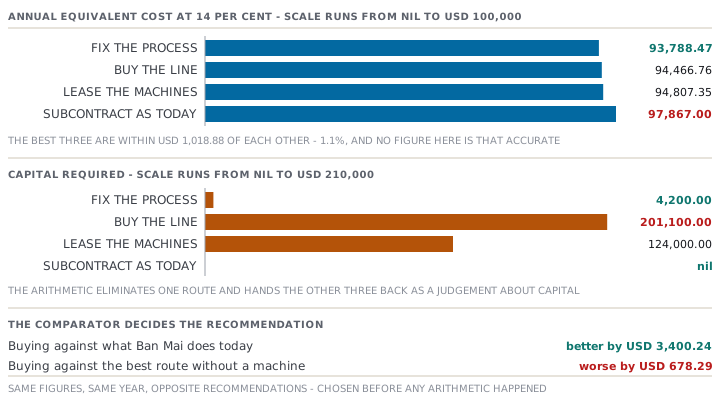
Three of the four are within USD 1,018.88 of each other, which is 1.1%. Not one figure on this page is accurate to 1.1%. The chemical rate is a measurement with a spread on it. The 0.9% rewash rate is one year's observation. The residual is an admitted unknown worth 2% of lesson 1's machine rate. And the maintenance figure is a supplier's schedule that lesson 3 shows to be a floor rather than an estimate.
So the arithmetic does not decide this. That is a finding rather than a failure. What the arithmetic did do is eliminate one option. Subcontracting unchanged is USD 4,078.53 a year worse than subcontracting well, for no capital and no risk. It then handed the remaining three back to a judgement about capital and risk that no spreadsheet was ever going to make.
Payback, and the three answers it gives
Hung's rule is four years. Here is the same project, in the same year, measured three ways.
| What is counted as capital, and against what | Capital, USD | Annual cash saving, USD | Payback |
|---|---|---|---|
| The equipment quotations, against the wash house as it is today | 118,700.00 | 43,276.50 | 2.74 years |
| The real capital, against the wash house as it is today | 201,100.00 | 43,276.50 | 4.65 years |
| The real capital net of the 4,200, against the wash house done properly | 196,900.00 | 37,388.90 | 5.27 years |
cash cost of washing in-house
  = 37,433.00 + 3,600.00 + 1,180.00 + 6,940.00 + 5,437.50   = USD 54,590.50
cash cost outside, as today                                  = USD 97,867.00
cash cost outside, done properly  90,077.00 + 1,902.40       = USD 91,979.40
The answer moved 2.53 years on nothing but two editorial choices, and the first row is the proposal on Hung's desk. Neither of its errors is a lie. It used the equipment quotations because that is what the quotations said, and it compared against today because today is what everybody can see.
Note also that a payback period is measured in cash, so it contains no charge for the cost of capital at all. That is not a flaw to be patched; it is what the measure is. Payback answers "when is my money back", and it is silent about every year after that. The tunnel-finisher case in course 20.3 is the sharpest version of this. There a crossover volume and a payback period pointed in opposite directions, and both were right, because they answer different questions about a machine that outlives the question.
The hurdle rate is a policy, and a payback rule is one in disguise
A hurdle rate is the return a project must clear before the board will approve it. Two hurdles are in play at Ban Mai and only one of them is written down.
The written one is 14%, the cost of capital set by the board, already charged in every annual equivalent cost above. The board also holds that a process the factory has never run carries risk the loan rate does not price, and adds 4 points for it. That gives a policy rate of 18% on this kind of project. Reprice the buy option's capital at 18% and its annual equivalent cost becomes USD 100,822.19, against the fix-the-process option's USD 93,788.47 at 14%. The gap is USD 7,033.72 a year. The premium applies to buying and leasing and not to the other two, because it is a premium for operating risk and only those two options take any on.
18% over 8 years   capital recovery 0.245244   sinking fund 0.065244
18% over 15 years  capital recovery 0.196403

equipment and installation  163,500.00 x 0.245244 - 16,350.00 x 0.065244 = 39,030.65
building conversion         26,400.00 x 0.196403                         =  5,185.04
working capital             11,200.00 x 0.18                             =  2,016.00
                                                                           46,231.69
The unwritten hurdle is the four-year payback rule, and it is much harsher than either.
a payback of exactly 4 years on an asset that lasts 8 years means
the annual saving is one quarter of the capital, so the 8-year
annuity factor must equal 4.0000

at 18% the 8-year annuity factor is  4.0776
at 19% it is                         3.9544

so the return the rule demands is about 18.6%
Hung's four-year rule is an 18.6% hurdle wearing a calendar's clothes, against a stated cost of capital of 14% and a stated policy rate of 18%. Nobody chose 18.6%. It fell out of a number that sounded prudent. That is not an argument against payback rules. A short payback is a real defence against being wrong about the future, which is what most factories are wrong about. But a rule whose implied return nobody has calculated is a policy nobody has actually set. Calculate what your payback rule demands, and then decide whether you meant it.
The thing with no number
One benefit of owning the wash has been left out of every column. It is left out because it cannot be priced from anything Ban Mai has measured.
Washing outside adds 8 working days to the cycle, or 4 if option 4 is done. Ban Mai turned down six short-cycle enquiries in 2027 on lead time alone. A typical one is 4,200 trousers at USD 0.42 of contribution — the money left after the direct costs of making them — so USD 1,764.
Rather than putting a value on it, put a break-even on it.
buying must close a gap of                          USD 7,033.72 a year
one short-cycle order is worth                      USD 1,764.00
orders a year needed                                4.0
Four of the six declined enquiries would have to have been won. Ban Mai does not know whether they would have been, because it never quoted them and has no idea whether it was competitive on price. That is unknown, and it is written as unknown. It is not zero, and it is not four. The action is not a machine. It is to quote the next six and record the outcome, which costs nothing and settles the question inside a year.
Check yourselfA supplier's finance arm offers you a machine on a lease at a monthly payment that works out cheaper per year than the depreciation you would charge if you bought it. Your production manager says leasing is therefore obviously cheaper. What is wrong with that, and how would you settle it?Show the answer
Depreciation is not the cost of buying. It is one part of it, and it is the part that leaves out the money. A purchase also ties up capital that has to earn the cost of capital. And it usually ties up installation, building work and working capital that a lease does not touch. Compare instead the annual equivalent cost of each whole route. For the purchase, that is a capital charge on the full installed cost at your own rate over the asset's life, plus everything you pay to run it. For the lease, it is the payments plus everything the lease does not cover. Then put the capital required beside each, because that is the real difference between them and it never appears in a per-year figure. At Ban Mai the lease came out USD 340.59 a year dearer than buying and needed USD 77,100 less capital. That is a legitimate reason to choose it, and it has nothing to do with which annual number is smaller. Also read what the lease covers: Ban Mai's included scheduled maintenance worth USD 2,900 a year, which has to come off the purchase route's maintenance line or the comparison is not on one basis.
Check yourselfYou have costed four options and the best three land within 1.5% of one another. A director asks you to sharpen the estimates until one of them clearly wins. What do you tell him, and what do you do instead?Show the answer
Tell him the estimates cannot be sharpened to 1.5%, because the inputs are not that good. Measured rates have spreads, and a one-year defect observation is one year. A residual value nobody has asked a dealer about is an assumption. And a maintenance figure taken from a service schedule has no breakdown term in it at all. Refining figures that are already inside their own error produces false precision and a decision that looks quantitative and is not. What to do instead is three things. Say plainly which options the arithmetic HAS eliminated, because that part is robust. At Ban Mai it eliminated subcontracting unchanged, which lost to subcontracting well by USD 4,078.53 for no capital. Then set the surviving options against the things that differ by more than the noise: the capital each needs, the risk each takes on, and how easily each can be undone. And then name the one unpriced benefit and give it a break-even instead of a value, so the judgement is made openly rather than smuggled into an estimate.
Prompt · Price buy, lease, subcontract and fix-the-process on one basis
Before any machine purchase is decided, and especially when the proposal compares the machine against what the factory does today.
Act as the person who refuses to let a machine proposal be compared against the status quo. I have a piece of work being done one way and somebody wants to buy a machine to do it another way.

First, before any figure, make me list FOUR options and refuse to proceed on fewer. Buy and run it. Lease it and run it. Subcontract it. And keep doing it the way I do now BUT fix the process - which means finding every cost I pay for the current route that is not the supplier's price, and asking what it would take to remove each one. Tell me plainly that the fourth option is the one that is almost never in a proposal and is frequently the winner, because nobody has ever costed it with the same care as the machine.

Then put all four on ONE basis. Because the options have different lives - a lease term, an equipment life, a building life, and an option with no asset at all - use annual equivalent cost rather than a net present value over some common horizon. For each option, charge every asset over ITS OWN life at my cost of capital using the capital recovery factor, less the sinking fund factor on any residual, and add interest on working capital. Show me the factors you use. Then add the cash operating costs, and then the variable cost times my real annual volume.

Make me cost the outside route properly, because this is where the hidden money is. The piece rate is not the cost. Also ask me for: transport, both directions, at trips a year times cost a trip; goods lost or returned unusable, as a measured percentage times the value of a unit AT THAT POINT in the process; the capital tied up in units that are permanently out of my building, being daily output times days out times unit value times my cost of capital; and my own counting, paperwork and chasing, in minutes times my clerical rate. Give me the total per unit and tell me what percentage of it the piece rate actually is.

Then give me a table with four rows and three columns: annual equivalent cost, capital required, and cost per unit. Rank them. Then tell me the SPREAD between the best and the worst, and the spread between the best three, as a percentage - and if the best options are inside the error of my own inputs, say so plainly and tell me the arithmetic has not decided this.

Then payback, and give it to me three times, not once: against the equipment price and the status quo; against the true capital and the status quo; and against the true capital and the BEST alternative. Show me how far the answer moves. Then tell me what annual return my payback rule actually demands, by finding the discount rate at which the annuity factor over the asset's life equals my payback cut-off - and ask me whether I meant to demand that.

Finally, make me name every benefit I cannot price. Do not let me put a number on any of them. For each, give me a BREAK-EVEN instead: how much would this have to be worth a year for the answer to change, expressed in units I can go and count. Then tell me the cheapest experiment that would settle it.
AI can make mistakes — check anything you act on.