Lessons · Lesson 2 of 6
- 01 · The garment is finished after it is sewn
- 02 · Specifying a measurement that does not exist yet
- 03 · Grading through a laundry, and the size set after wash
- 04 · Cloth or recipe: buying the same look twice
- 05 · The laundry's minimums, and the plan they rewrite
- 06 · Defects that are the product, and the ones that are not
Specifying a measurement that does not exist yet
Build a cut-to specification from a sewn-garment wash trial, and see why a fabric shrinkage test cannot size a jean.
Lesson 2 of 6 · 24 min
The situation
6 July, 11:20. Loads 1 to 18 of PO TW-7714 are washed, dried and hanging. Tarnwick's technologist has measured sixty pairs and sent two lines:
Waist runs large on every pair we measured. Thigh is tight. Please advise before the balance is washed.
Two complaints, pointing in opposite directions, on the same garment. That shape almost always means one cause. It does here.
What the pattern room actually did
In April, Ulvan did the right thing for a different question. Terkos sent a metre of the bulk quality, Sarband washed it to the approved recipe, and the mill's laboratory measured it:
| Direction | Shrinkage |
|---|---|
| Warp | 4.6 percent |
| Weft | 2.8 percent |
That test is right. It is the test course 2.4 tells you to demand, and it is exactly what you need in order to book cloth. The pattern room then used it to build the pattern. Every length measurement was cut long by 4.6 percent, every width measurement wide by 2.8 percent, and the arithmetic was checked.
Nobody made a mistake. The result was still wrong at two points out of six, in opposite directions.
A garment is not its fabric
A metre of denim in a machine is free to move in both directions. A jean is not. It is an assembly, and four things inside it refuse to shrink with the cloth around them.
- The sewing thread. Core-spun polyester thread — a polyester core wrapped in cotton — barely shrinks in a garment wash. So any measurement that is mostly stitched is held by a material that is not shrinking. It comes back shorter than the cloth wanted to be. Or rather, less short.
- Fused interlining. A jeans waistband is three or four plies of denim with a stiffening layer bonded across it and two rows of topstitching along it. Almost none of it is free cloth.
- Seams that pull. A leg is a tube. Its inseam and side seam contract lengthwise and drag the cloth between them inward. So a width measured across a tube can move more than the flat fabric did.
- Where the abrasion lands. The machine rubs hardest on whatever stands proud — hems, seams, waistband edges, pocket mouths. Those places lose surface. Surface loss is not shrinkage, but it lands on the same tape measure.
So a jean does not have a shrinkage. It has one per measurement point.
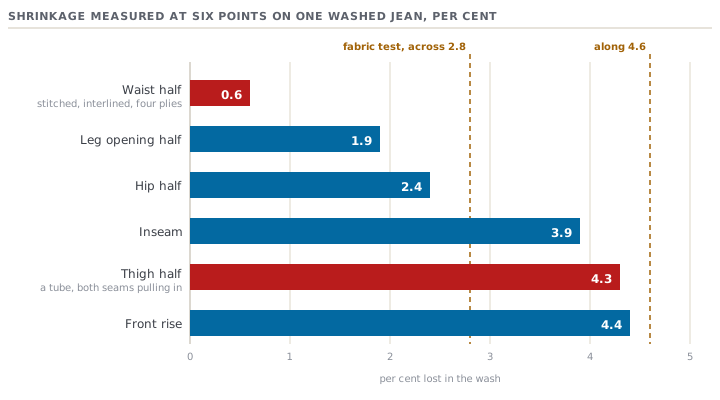
The six points, worked
Sarband washed twenty sewn pairs from the first load and measured them conditioned — four hours out of the dryer, in a room held at a steady temperature and humidity. Set that against what the pattern was cut to:
| Measurement | Spec after wash | Tolerance | Cut to | Shrank | Finished | Deviation |
|---|---|---|---|---|---|---|
| Waist half, relaxed | 37.0 | 0.8 | 38.07 | 0.6 percent | 37.84 | plus 0.84 |
| Hip half | 49.5 | 1.0 | 50.93 | 2.4 percent | 49.71 | plus 0.21 |
| Thigh half | 30.4 | 0.6 | 31.28 | 4.3 percent | 29.93 | minus 0.47 |
| Front rise | 29.0 | 0.6 | 30.40 | 4.4 percent | 29.06 | plus 0.06 |
| Inseam | 78.0 | 1.0 | 81.76 | 3.9 percent | 78.57 | plus 0.57 |
| Leg opening half | 17.6 | 0.4 | 18.11 | 1.9 percent | 17.77 | plus 0.17 |
The fabric test said the waistband would lose 2.8 percent. It lost 0.6 percent, because it is barely fabric. The thigh was told to lose the same 2.8 percent. It lost 4.3 percent, because it is a width across a tube whose two seams are pulling it in.
One point is over by 0.84 against a tolerance of 0.8. The other is under by 0.47 against a tolerance of 0.6. That one passes — and it has already spent 78 percent of the tolerance before any normal variation is added.
The lever that fixes one breaks the other
The instinct in the room on 6 July was to wash the batch again. Another thirty minutes hot does move the waist. Sarband ran twenty pairs and measured the second cycle at 1.2 percent off the waist and 1.1 percent off the thigh.
| Measurement | Before | After | Deviation after | Tolerance |
|---|---|---|---|---|
| Waist half | 37.84 | 37.39 | plus 0.39 | 0.8 |
| Thigh half | 29.93 | 29.60 | minus 0.80 | 0.6 |
The waist comes into tolerance and the thigh leaves it. That is not bad luck. Every recipe lever moves every measurement in the same direction. The two errors here point in opposite directions, so no recipe fixes both. The correction has to be made in the pattern or not at all — which is the whole argument for doing this before cutting rather than after.
The corrected specification
The fix is not a better single allowance. It is a different allowance at every point, taken from washed sewn garments:
| Measurement | Spec after wash | Measured garment shrinkage | Corrected cut-to | Change |
|---|---|---|---|---|
| Waist half | 37.0 | 0.6 percent | 37.22 | minus 0.85 |
| Hip half | 49.5 | 2.4 percent | 50.72 | minus 0.21 |
| Thigh half | 30.4 | 4.3 percent | 31.77 | plus 0.49 |
| Front rise | 29.0 | 4.4 percent | 30.33 | minus 0.07 |
| Inseam | 78.0 | 3.9 percent | 81.17 | minus 0.59 |
| Leg opening half | 17.6 | 1.9 percent | 17.94 | minus 0.17 |
Look at the last column. The pattern has to get smaller at the waist and bigger at the thigh. No single number, applied any way you like, can produce a change in two directions. That is the finding. It is why a jeans tech pack needs a shrinkage table with one figure per point, not a shrinkage line.
What a cut panel can and cannot absorb
On 6 July the order stood in three lays. A lay is one spread of cloth cut in one go. There were 4,320 pairs washed, 4,320 pairs cut and sewn but not yet washed, and 3,960 pairs not yet marked. What each lay can take is decided by one rule that only matters in this category:
Cloth can be removed from a cut panel. It can never be added.
- The waist correction is a reduction, and the waistband is a separate small piece. It can be recut and replaced on anything not yet washed.
- The thigh correction is an increase, and the thigh sits inside a leg panel that is already cut. No operation makes it bigger.
So the middle lay can take half the correction and the first lay can take none, because a repair on a washed jean is visible: the new band and its thread have not been through the laundry and read brighter than the garment they are sewn to.
| Lay | State | Action | Cost |
|---|---|---|---|
| 1, 4,320 pairs | Washed | Ship against a concession — a price discount the buyer agrees to for goods that are not quite to spec — at USD 1.20 a pair | 5,184.00 |
| 2, 4,320 pairs | Sewn, not washed | Unpick and replace the waistband, 259.2 m of cloth and 11.0 minutes a pair | 4,296.96 |
| 3, 3,960 pairs | Not marked | Cut to the corrected pattern; the re-marked lay used slightly less cloth | minus 96.23 |
| All | New pattern, marker and physical retest | 820.00 |
USD 10,204.73, plus 11 working days, plus a laundry booking that no longer fits. The alternative was a forty-pair sewn shrinkage lot, washed inside somebody else's production load in April: USD 362.00. That is 28 times cheaper.
And the order ships in two shapes. Lays 1 and 2 carry a thigh at minus 0.47. Lay 3 carries it at zero. Both are inside tolerance and both are legal, and the honest thing is to tell the buyer before they find it in a store.
Prompt · Turn a garment wash trial into a cut-to specification
When the buyer's measurements are post-wash, your pattern room has only a fabric shrinkage figure, and nothing has been cut yet.
Act as a senior pattern engineer on washed denim. I need a cut-to specification built from a garment wash trial, not from a fabric test. Style facts: buyer [BUYER], PO [NUMBER], style [STYLE], [QTY] pairs, base size [SIZE], fabric [WEIGHT] oz [CONSTRUCTION] with [PERCENT] elastane. The approved recipe is [PASTE THE STEPS]. My fabric wash trial gave [PERCENT] warp and [PERCENT] weft. The buyer's finished specification, all post-wash, is: [PASTE EVERY MEASUREMENT POINT WITH ITS VALUE, ITS TOLERANCE AND WHETHER IT IS A LENGTH OR A WIDTH]. My garment trial measured [PASTE THE MEASURED SHRINKAGE AT EACH POINT, OR SAY WHICH POINTS I HAVE NOT MEASURED]. Do the following. First, tell me which points I am missing and cannot responsibly infer, and say plainly that a fabric figure is not a substitute for them. Second, for every point I do have, give the cut-to dimension as spec divided by what survives the wash, and show the arithmetic on one line each. Third, flag every point where the garment shrinkage differs from the fabric figure by more than a quarter of the tolerance, and say why that point behaves differently — thread, interlining, a seamed tube, an abraded edge. Fourth, tell me for each point whether the correction makes the pattern bigger or smaller, and list separately any point that gets BIGGER, because a panel already cut cannot absorb that. Fifth, do the same for the graded steps: give me the cut step for each graded measurement and the accumulated error at the largest and smallest size if I cut the graded step instead. Sixth, write the measurement protocol line the tech pack needs — when after drying, in what state, in what atmosphere. Do not average my points into a single allowance under any circumstances, and name every assumption in a list at the end.
AI can make mistakes — check anything you act on.
Check yourselfA mill sends you a wash trial: 4.6 percent warp, 2.8 percent weft. Your pattern room asks whether they can start. What do you say?Show the answer
That they can start on the cloth booking and not on the pattern. A fabric trial is the right instrument for consumption, because the marker — the cutting plan that lays the pattern pieces on the cloth — is an area calculation on free cloth, and the mill's figures describe free cloth exactly. It is the wrong instrument for a size specification, because the garment is an assembly and four things in it do not shrink with the cloth: the thread, the fused waistband, the seams that pull a tube inward, and the abrasion that lands on the parts standing proud. Ask instead for a sewn lot, washed under bulk conditions, measured conditioned at every point on the specification, and let the pattern room build a cut-to figure per point. If nobody will pay for that lot, say what it costs and what the alternative cost on the last order.
Check yourselfYour washed bulk reads plus 0.84 on the waist and minus 0.47 on the thigh. The laundry offers a second hot cycle. Take it?Show the answer
No, and the reason is worth saying out loud because it generalises. A recipe lever moves every measurement the same way: harder wash, smaller garment. Your two errors point in opposite directions, so any cycle that brings the waist down takes the thigh further under. Measured here, the waist reaches plus 0.39 and the thigh drops to minus 0.80 against a tolerance of 0.6. You have traded a failing waist for a failing thigh and spent money doing it. When errors point the same way, a recipe change is a real option. When they point in opposite directions the only correction is in the pattern, and that means it is only available before cutting.