Lessons · Lesson 1 of 6
- 01 · The garment is finished after it is sewn
- 02 · Specifying a measurement that does not exist yet
- 03 · Grading through a laundry, and the size set after wash
- 04 · Cloth or recipe: buying the same look twice
- 05 · The laundry's minimums, and the plan they rewrite
- 06 · Defects that are the product, and the ones that are not
The garment is finished after it is sewn
Put the approvals on a jeans order in the order this category needs, and price the calendar when they run in the order a knitted top taught you.
Lesson 1 of 6 · 24 min
The situation
Almost every garment you buy is finished when it leaves the sewing line. A jean is not. It leaves the line stiff, dark and oversized, in a shade nobody ordered. It becomes the product afterwards — in a laundry, in a different building, owned by a different company.
That one fact reorders everything a merchandiser does.
12 March. Tarnwick, a British denim brand, confirms PO TW-7714 with Ulvan Konfeksiyon in Corlu: 12,600 pairs of style TK-905, a women's high-rise straight-leg jean in 11.5 oz comfort-stretch denim from Terkos Denim Mills. Denim weight is quoted in ounces per square yard, so 11.5 oz is a mid-heavy cloth. The price is FOB USD 17.40. FOB — free on board — is the price with the goods loaded at the port of shipment. Order value USD 219,240. First delivery 8 August, the balance 5 September. Ulvan sews. Sarband Laundry washes, nine kilometres away. Sarband is a separate company with its own order book.
What the laundry does to the cloth is course 3.6. What the cloth is before it gets there is course 2.4. This course is about everything else the arrangement breaks — starting with the order you do things in.
Why the sequence inverts
On a knitted top the sewing line makes the article. So the approvals run in the order the article is built: fabric, then fit, then a size set, then bulk. Each approval is a decision about an object that will not change again. Sign it and leave it alone.
On a jean, every one of those objects changes after you sign it. The wash moves the shade, the hand and the surface. It also moves the measurements, and that is the part that costs money. So an approval on a denim programme is never a decision about a garment. It is a decision about a garment plus the wash it was washed in. Without the second half it is worth nothing.
That gives this category one rule with no equivalent anywhere else in the track:
An approval on a washed garment carries its conditions with it. Change the recipe, the machine or the load, and the approval expires — and nobody withdraws it.
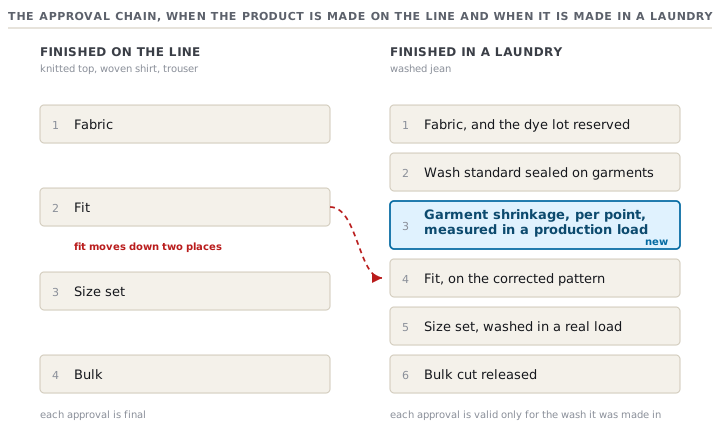
The sequence Ulvan ran, and the one the category needs
| Date | What was approved | What it was actually valid for |
|---|---|---|
| 27 March | Fabric quality, from a dry hanger | A dry hanger |
| 2 April | Fabric booked at Terkos, 19,200 m | The consumption of an unapproved pattern |
| 18 April | Fit, on a sample washed at Sarband | A garment washed in a 30 kg sample machine |
| 6 May | Wash standard sealed, three garments | The recipe, correctly, and only that |
| 21 May | Size set, six pairs, sample machine again | Six pairs washed in a 30 kg sample machine |
| 9 June | Bulk cutting released | Nothing that had been washed in a production load |
Read the last column and the failure is already there. Five approvals were given. Four of them were correct. And not one says anything about what a garment does in a 250 kg side-loader carrying 240 pairs — which is the only condition the 12,600 pairs will ever meet. A side-loader is the big front-to-back drum a laundry runs bulk in.
The sequence this category needs is not longer. It is the same steps, with one inserted and two moved:
- Confirm the fabric quality, and reserve the bulk lot. Shrinkage belongs to a dye lot, not to a quality.
- Seal the wash standard on garments — a light limit, a standard, a dark limit. Course 3.6 owns this step. It is the one Ulvan did in the right place.
- Measure garment shrinkage on sewn garments washed under bulk conditions, point by point. This step does not exist on a knitted top, and Ulvan never ran it.
- Approve fit on a garment washed to the sealed standard, cut from the corrected pattern. Fit comes after the wash here, because the wash decides the measurement that fit is a judgement about.
- Size set, washed under bulk conditions, measured conditioned — lesson 3.
- Release the bulk cut.
The one mistake a knitted-tops merchandiser makes
It is always the same one, and it is not carelessness. It is a habit that is correct everywhere else: approving fit before the wash is settled.
On a tee, fit is the expensive approval and finishing is a detail. So fit goes first and everything queues behind it. Move that habit onto a jean and you approve the shape of a garment before you know what the laundry will do to that shape. The fit sample then becomes evidence for a garment that will not be made, and the pattern room works forward from it in good faith for six weeks.
Two problems the arrangement creates that nobody owns
The laundry is a second factory with its own calendar. Ulvan's planner books Ulvan's lines. Sarband books Sarband's machines, and your order competes there with every other brand's denim in Corlu. A jeans TNA that shows "wash" as a two-day bar between sewing and packing has hidden the constraint that will really decide the ship date. A TNA — time and action calendar — is the dated plan of every step in an order. Lesson 5 opens that bar up and finds 15 days inside it.
Nothing can be repaired after the wash. This is the quiet one. On any other garment a fault found at final inspection can be unpicked and re-sewn, and nobody sees the repair. On a washed jean, the cloth and the thread of a repair have not been through the laundry. So a replaced waistband, a re-set pocket or a re-stitched seam reads brighter than everything around it. The window for correcting a jean closes when it enters the machine, not when it is inspected. That is why the approval sequence has to be right, and why this lesson comes before the other five.
The circularity, named honestly
Step 3 asks you to wash sewn garments under bulk conditions. Bulk conditions need a production-sized load. A production-sized load needs bulk fabric and a cut. And the cut is what step 3 is supposed to release.
That is a genuine circle. Pretending it is not is how the step gets skipped. You break it deliberately, and cheaply, and lesson 3 shows how: cut a small lot from the first roll, sew it, and put it inside somebody else's production load running the same recipe. Forty pairs of cloth and CMT cost USD 362.00. CMT — cut, make and trim — is what the factory charges to cut and sew. Skipping that lot cost USD 10,204.73 on this order, and 11 working days.
Check yourselfYour buyer signs off the fit sample on a jean in week 9 and asks you to seal the wash standard in week 12. What do you say?Show the answer
That the two are the wrong way round, and why, in one sentence: the wash sets the measurements, so a fit approved before the recipe is settled is an approval of a garment you cannot make. Then offer the practical version rather than the argument. Seal the wash standard first on three garments in the bulk quality. Run a small sewn lot through a production load to get the real shrinkage at each point. Correct the pattern. Submit fit on a garment made that way. It adds about ten days at the front of the calendar and it removes the recut at the back of it. If the buyer will not move the fit date, put in writing what the fit approval will then be valid for, so the second submission is expected rather than a surprise.
Check yourselfUlvan's TNA shows a two-day bar labelled wash between sewing and packing. What is missing?Show the answer
A machine and a date. A two-day bar is a duration, not a booking, and the laundry is a separate company whose calendar you do not control. The bar needs the name of the laundry, the number of loads the order is, which of the laundry's machines can run this recipe, and the days that block is reserved for. It also needs the dry processes costed in operator-hours rather than in days, because on most denim orders the wet side is not the constraint. On this order the wet side is a little over one day and the constraint is a single spray booth at 15 days. A TNA that cannot show that difference cannot be used to make a decision.