Lessons · Lesson 5 of 6
- 01 · The garment is finished after it is sewn
- 02 · Specifying a measurement that does not exist yet
- 03 · Grading through a laundry, and the size set after wash
- 04 · Cloth or recipe: buying the same look twice
- 05 · The laundry's minimums, and the plan they rewrite
- 06 · Defects that are the product, and the ones that are not
The laundry's minimums, and the plan they rewrite
Find the binding constraint inside a laundry booking, and plan an order around minimums a sewing factory does not have.
Lesson 5 of 6 · 22 min
The situation
8 July. Ulvan's planner has Sarband's confirmation in front of him: 10 to 26 July, thirteen working days, for the wash of PO TW-7714. On the TNA it is a bar labelled wash, drawn to fit the space between sewing and the first shipment.
Nobody has yet asked what is inside it.
A laundry is five capacities, not one
The wet side is what people picture when they think of a laundry, and on most denim orders it is not the constraint. Here are Sarband's resources, set against this order's 53 loads and 12,600 pairs:
| Resource | What there is | What this order needs | Days |
|---|---|---|---|
| Wet side | 4 of 6 washers plumbed for this recipe, two shifts | 53 loads at 90 minutes | 1.32 |
| Drying | 8 tumble dryers at 55 minutes, two passes, two shifts | 53 loads, twice | 0.81 |
| Dry-process floor | 22 operators, one shift of seven and a half hours | 4.2 minutes a pair | 5.35 |
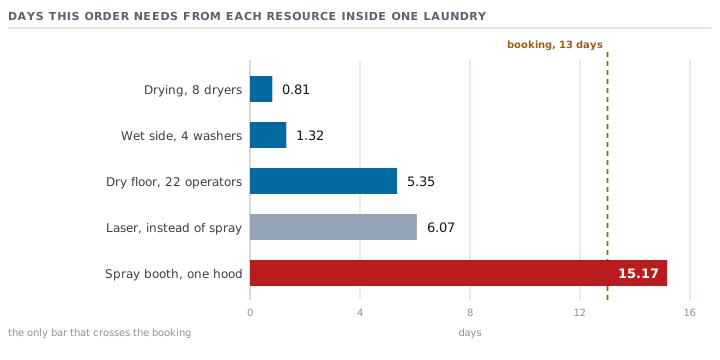
| Spray booth | One extraction hood, one station, two shifts | 65 seconds a pair | 15.17 |
| Laser, if used instead | One machine, two shifts | 26 seconds a pair | 6.07 |
The wet side is 90 minutes a load rather than the recipe's 55, because permanganate has to be neutralised in a second wet pass. So choosing the spray also buys the washers a second run at every load.
15.17 days, inside a thirteen-day booking, from a single extraction hood. It is 2.84 times the next constraint and eleven times the wet side, and it was never visible — because the thing everybody costs and audits is the washing machine.
The permanganate spray on TK-905 is what produces the pale cast on the front thigh. It takes forty seconds to apply and twenty-five to hang and transfer, at one station, because a second station needs a second hood.
Why you cannot buy your way out of it in July
A washing machine is a purchase. An extraction booth is not, or not only. The hood, the ducting and what comes out of the neutralisation bath all sit inside the site's environmental permit. Adding one is a variation to that permit, not an order to a supplier. Potassium permanganate is a strong oxidiser and a hazard to water, which is exactly why the booth is enclosed and extracted in the first place.
So on 8 July there are four options, and one of them is not real:
| Option | Time | Money | What it costs elsewhere |
|---|---|---|---|
| Keep the spray, extend the booking | Needs 15.17 days of booth time; Sarband has 13 | — | The first shipment moves |
| Drop the spray from the tech pack | Removes 15.17 days | Saves USD 0.31 a pair | A different garment; a new sealed standard, about two weeks |
| Move the effect to laser | 6.07 days | A file programme, USD 340.00, plus the running cost | A re-approval; the laser cannot make every effect |
| Split the order across two laundries | Fits | Two quotations | Two groups of shade in one order — refuse |
The fourth is the one that gets chosen under pressure, and it is the one to refuse. Lesson 3 showed a sealed shade band being spent by load weight alone. Two laundries are two sets of drums, two stone lots, two operators and two water supplies. What a laser can and cannot do, and what it costs to run, is course 3.6's second lesson. The number that belongs here is 6.07 days against 15.17.
Three minimums a sewing factory does not have
The load is the atom. A sewing line can make one more pair. A laundry cannot wash one more pair. It washes a load, and a load is a weight. At 240 pairs to a load, 12,600 pairs is 52.5 loads. So the last load is 120 pairs, about 90 kg in a drum set up for 180. It will tumble differently and come out differently, and it is 120 pairs of a shade nobody sealed.
There are two honest answers. Make it up to weight with ballast garments and write on the report that you did. Or cut a little over so the wash is a whole number of loads: 53 loads is 12,720 pairs, which is 120 pairs more than the order. At USD 14.87 that is USD 1,784.40 of garments, and most of them are not waste. They are the replacement pool every denim order needs anyway, because nothing can be repaired after the wash.
The shade batch is a run, not a quantity. Shade continuity holds across consecutive loads on the same drums, the same stone lot, the same drums of chemistry and the same operators. Wash 5,400 pairs in July and 7,200 in late August and you have two batches, not one order. The second needs its own comparison against the sealed standard before it ships.
The recipe block sets the queue. A machine coming off a bleach recipe has to be cleaned out before it can run a mid-blue rinse. So Sarband sequences its week by shade rather than by ship date, light to dark. TK-905's block runs Monday to Wednesday on the four machines that can take it. Four machines, three days, two shifts is 180 machine-hours a week, and this order's wet side needs 79.5. On this quantity the block is not binding, and it is worth saying so plainly. At roughly four times this quantity it would be the constraint, and a reader who assumes it binds here has planned around the wrong number.
The split, and the decision that solves two problems at once
Tarnwick wants 5,400 pairs on 8 August and 7,200 on 5 September. In loads: 22.5 and 30.0. The first shipment is half a load out, so one load has to be divided between two shipments three weeks apart — the same garments, one carton in August and one in September, from a wash that is a single batch by luck and two by paperwork.
Ask for the split in load multiples. And notice that the over-cut already on the table makes it possible. At 12,720 pairs the order is 53 whole loads, which divides as 5,280 and 7,440 — 22 loads and 31. One decision, taken at the cut plan, removes the part load, removes the split load, and pays for the replacement pool.
Prompt · Find the binding constraint inside a laundry booking
The day a laundry confirms a block of days for your order and the TNA shows it as one bar with no machine behind it.
Act as a denim laundry production planner who has no reason to flatter the site. I have been given a booking and I need to know whether my order fits inside it. Order facts: [QTY] pairs, style [STYLE], garment weight before wash [KG] a pair at the base size and [KG] at the largest. The recipe is [PASTE THE STEPS AND THE MINUTES]. The dry package is [LIST EVERY EFFECT WITH ITS HAND TIME IN MINUTES A PAIR, AND SAY WHICH ARE DONE IN A SPRAY BOOTH OR BY LASER]. The laundry has: [NUMBER] washers of [KG], of which [NUMBER] can run this recipe; [NUMBER] dryers at [MINUTES] a load; [NUMBER] dry-process operators; [NUMBER] spray booths with [NUMBER] stations each; [NUMBER] lasers at [SECONDS] a pair. Shifts per resource: [STATE THEM SEPARATELY, BECAUSE THEY DIFFER]. Booking offered: [DATES], which is [NUMBER] working days. Do the following. First, tell me how many loads my order is at the load WEIGHT the laundry actually runs, not at a pair count, and say what the last part load will be. Second, compute the days needed from each resource separately and put them in one table, largest last. Third, name the binding constraint explicitly and say how far ahead of the next one it is. Fourth, tell me which constraints can be relieved with money this month, which need a capital item, and which need a permit or a licence rather than a purchase — and be specific about why. Fifth, give me at least four priced options including the one I should refuse, and say which one you would refuse and why. Sixth, tell me what my delivery split should be so that every shipment is a whole number of loads, and what it costs to cut over to make that true. Do not give me a single capacity figure for the laundry; the whole point is that there is no such number.
AI can make mistakes — check anything you act on.
Check yourselfYour laundry confirms a thirteen-day booking. What do you need before you put it on the TNA?Show the answer
The five numbers behind it. How many loads the order is, and therefore how much washer time; the drying time and how many dryers can be given to it; the dry-process content in minutes a pair, divided by the operators actually assigned; the booth or laser time per pair, divided by stations, not machines; and the shifts each of those runs. Then take the largest and check it against the days you have been given. On this order four of the five came in under two days and the fifth came in at 15.17, from one extraction hood — which is invisible on a capacity statement that lists washing machines. A booking you cannot decompose is a date, not a plan.
Check yourselfYour buyer asks for a first shipment of 5,400 pairs. Your load is 240 pairs. What do you tell them?Show the answer
That 5,400 is 22.5 loads, so one load has to be split across two shipments weeks apart, and ask whether 5,280 or 5,520 would work instead. It sounds pedantic and it is not. A load is the smallest thing a laundry can produce consistently, so a half load is either washed with the first block and stored, or washed with the second block and shipped early. Either way, part of one shipment came out of a different batch from the rest of it. If the buyer needs exactly 5,400 for an allocation, wash the whole load with the first block, ship 5,400, and hold the balance as replacements rather than sending it in September against a different shade comparison.