Lessons · Lesson 5 of 6
- 01 · Gauge is the decision, and it prices the sweater and books the factory at the same time
- 02 · You are not buying fabric, you are buying yarn by the kilogram
- 03 · Fully fashioned, cut and sew, whole garment: three routes and the price that decides between them
- 04 · Linking is counted in loops, and it is where the bottleneck goes to hide
- 05 · Blocking sets the measurement, and the first wash takes it back
- 06 · A sample that fits is not proof: gauge drift, and two complaints with one cause
Blocking sets the measurement, and the first wash takes it back
Read a knitted garment's measurement as a state rather than a number, and see how a blocking board can hide a knitting error until the garment is in somebody's home.
Lesson 5 of 6 · 21 min
A panel has no dimension of its own
Cut a woven front panel from a marker and it is 53.0 cm across. Press it, hang it, put it in a carton: it is still 53.0 cm across. The dimension was decided by a pattern and a knife, and nothing after the cutting table can argue with it.
A knitted panel has no such number. It leaves the needles curled, tight and undersized, held in whatever shape the take-down tension was pulling it into. Over the next day it relaxes. Then it is scoured, softened, tumbled and blocked — pulled out over a shaped board and steamed — and it takes the dimension of the board. Wool will hold that dimension until it is washed.
So the question "how wide is this sweater" has several different true answers. A tech pack that gives a number without saying which one it means has not specified anything.
| State | Half chest |
|---|---|
| Off the machine, tension released | 49.6 cm |
| After 24 hours flat, dry relaxed | 51.4 cm |
| After finishing and steam blocking to the board | 53.0 cm |
| After 24 hours in the carton | 52.4 cm |
| After one home wash, dried flat | 51.9 cm |
| After five home washes | 51.1 cm |
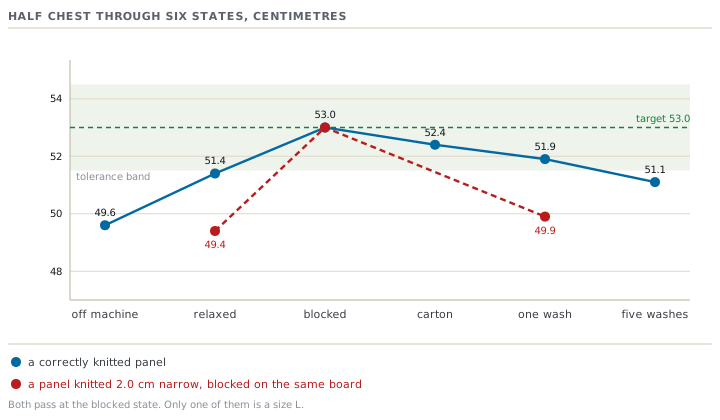
The tech pack says 53.0 cm, tolerance plus or minus 1.5 cm, and does not name a state. Follow it through the gates.
The factory measures at final inspection, after blocking: 53.0 cm. Exactly on target. Kilverstone's inward QC measures cartons that have sat for a day: 52.4 cm, comfortably inside. Kilverstone's laboratory tests to the care label and measures after one wash: 51.9 cm, which is 1.1 cm under target and still inside the tolerance. Every gate passes.
And the customer's sweater, after the fifth wash, measures 51.1 cm. That is 3.6% smaller than the garment they were sold. Nobody failed anything. The specification simply never said which of the six numbers it was.
Two mechanisms, one word
"Shrinkage" on a woven garment usually means one thing: the cloth's residual shrinkage, taken out at the mill or not, and measurable once. On a wool sweater the word covers two different physical events that behave in opposite ways. Treating them as one is how a factory gives the wrong answer to a complaint.
Relaxation is loops moving from a strained position to their unstrained one. It happens once, it is finished after a wash or two, and it is reversible: block the garment again and the dimension comes back. A garment that measures small because it was never properly relaxed before it was measured has a relaxation problem, and it can be corrected.
Felting is the wool fibre's scales ratcheting past one another under mechanical action in water, so the fibres lock together and the fabric becomes denser and smaller. It builds up — every wash adds a little — and it is not reversible. No amount of blocking brings a felted sweater back, because the yarn is no longer free to move.
The diagnosis is in the sequence, not in the size. A drop between blocking and the first wash that then stops is relaxation. A drop that keeps going wash after wash is felting, and that is a fibre and finish problem: the yarn, the wash recipe, the softener, and whether the wool was treated. Course 1.1 covers the treatment and the care label it obliges, and that is the page to argue from.
What blocking can hide
Now the part that matters most, because it is invisible until the garment is in a home.
A blocking board is a fixed shape. Wool on a steamed board goes where the board is, within roughly 5% either way. That is a very useful property and a dangerous one, because it means a wrongly knitted panel and a correctly knitted panel can leave the finishing room measuring exactly the same.
Take a panel knitted with too few stitches across, or with a loop that ran short. It is 2.0 cm narrow in the relaxed state, at 49.4 cm rather than 51.4.
| Correct panel | Under-knitted panel | |
|---|---|---|
| Relaxed, 24 hours | 51.4 cm | 49.4 cm |
| Blocked to the 53.0 cm board | 53.0 cm | 53.0 cm |
| After one home wash | 51.9 cm | 49.9 cm |
The under-knitted panel was stretched 7.3% to reach the board. It passed final inspection at exactly the target, and it comes back after one wash at 3.1 cm under, which is twice the tolerance. Pressing cannot add 2.0 cm to a woven chest. Blocking can, and it will, and it will hold long enough to ship.
What to put on the tech pack instead
Three lines turn a knitwear measurement from a number into a specification, and none of them is standard.
- The state. Which of the six numbers the measurement sheet means. "Measured after finishing, conditioned 24 hours flat" is a normal answer. So is "after one wash to the care label". Either is fine. Silence is not.
- A limit on size change after repeated washing, not just after one wash. A limit of 3.0% on length and width after five washes fails this garment at 3.6%, and it would have forced the question at the sample stage, where it is free.
- The relaxed panel dimension, agreed with the factory as an internal control, so that a knitting error is caught by the person who can still fix it.
And one physical thing to check on a factory visit: there is a blocking board per size, and somebody measures the boards. A board that has warped 0.5 cm makes every garment in that size 0.5 cm wrong, in one direction, on every machine, forever. No in-line check will ever find it, because the fault is downstream of everything anybody inspects.
Prompt · Diagnose a knitwear measurement complaint before you answer it
The morning a knitted bulk reads out of tolerance, or a yarn over-run appears, or a customer says the sweater shrank.
Act as a senior knitwear technologist. Something is wrong with a knitted bulk and I need a diagnosis before I answer the buyer. Facts: style [STYLE], gauge [GAUGE], yarn [SPEC], quantity [QTY], the measurement point with its target and tolerance [SPEC], and what the readings actually are [NUMBERS]. Yarn booked [KG] and yarn drawn so far [KG]. Number of knitting machines running the order [NUMBER]. The size set was knitted on [WHICH MACHINES] from [WHICH DYE LOT] and approved on [DATE]. Loop length recorded at set-up, if any [MM PER MACHINE]. Blocking board dimension [CM]. The state at which the factory measures [OFF MACHINE, RELAXED, BLOCKED, AFTER WASH]. Do the following. First, tell me at which state my measurements were taken, and what that state can and cannot prove. Second, put my two symptoms side by side: did the measurement move, did the weight move, and in what proportion. Give me the single cause that explains both, or say clearly that there are two causes. Use this key. Weight over with the measurement on spec points at the yarn count. Both over in the same proportion points at loop length. The measurement over with the weight on spec points at stretching rather than knitting. Both over with courses and wales per centimetre unchanged points at the program. Third, tell me what to measure next, in order, and how long each measurement takes. Fourth, work out whether the defect is spread through the lot or concentrated on particular machines, and say what that does to my inspection sampling. Fifth, price the options: concession, re-knit, re-block and re-label. Say which of them physically cannot work, and why. Sixth, write the control that would have caught it, as a one-page instruction for the knitting floor.
AI can make mistakes — check anything you act on.
Check yourselfA complaint arrives: sweaters returned by customers measure small. Your final inspection records show every carton was measured and passed. What are the first three things you look at, in order?Show the answer
First, which state your inspection measured in. Almost certainly blocked, in which case it proves nothing about the knitting. Second, the relaxed panel records for the machines that made the affected lots, if they exist. If they do not, that is the finding. Third, the wash sequence: get three garments washed once, three washed five times, and measure both sets. If the drop stops after the first wash it is relaxation, and the answer is upstream in the knitting or the blocking. If it keeps going, it is felting, and the answer is the yarn, the finishing recipe and the care label. Do not re-block the returned garments and measure those, which proves only that your board is the right size.