Lessons · Lesson 1 of 6
- 01 · Gauge is the decision, and it prices the sweater and books the factory at the same time
- 02 · You are not buying fabric, you are buying yarn by the kilogram
- 03 · Fully fashioned, cut and sew, whole garment: three routes and the price that decides between them
- 04 · Linking is counted in loops, and it is where the bottleneck goes to hide
- 05 · Blocking sets the measurement, and the first wash takes it back
- 06 · A sample that fits is not proof: gauge drift, and two complaints with one cause
Gauge is the decision, and it prices the sweater and books the factory at the same time
Cost one sweater at two gauges, and find the number that connects a cheaper cost sheet to a later ship date.
Lesson 1 of 6 · 24 min
The situation
4 February, 09:10, at Rangdhanu Sweaters in Kaliakair. Purchase order KIL-4417 has come in from Kilverstone, a British clothing chain: 18,000 men's crew-neck sweaters, style KV-2280, 100% lambswool, set-in sleeve, four colours, five sizes. The price is FOB USD 17.60. FOB means free on board: the price with the goods loaded on the ship. Order value USD 316,800. On board 22 May.
The fit sample was approved in January. One comment came with it:
The hand is coarse for the price point. Please offer the same style at a finer gauge.
The hand is how the cloth feels when you hold it. The request is reasonable and politely made, and it is the whole of this lesson. By the time it has been answered, the cost sheet will be USD 1.89 a garment cheaper and the ship date will be ten days later. Nobody involved will have made a mistake.
What gauge actually fixes
A flat V-bed knitting machine has two flat needle beds set in a V. Gauge is the number of needles in one inch of each bed. A low number means coarse needles and thick yarn. A high number means fine needles and thin yarn.
Course 2.2 does the loop arithmetic and the GSM arithmetic on a circular machine. GSM is grams per square metre, the weight of the cloth. That arithmetic does not change here. What changes is everything the gauge number decides outside the fabric.
Needle spacing allows only a narrow band of yarn thickness. Too coarse a yarn on a fine gauge breaks needles. Too fine a yarn on a coarse gauge makes a slack, holey cloth. The trade's working rule is short: the count arriving at the needle, in metric count, lands roughly on the gauge number itself. Metric count, written Nm, is the number of metres of yarn in one gram. The knitter reaches the count he wants by choosing a yarn and a number of ends, which is how many yarns are fed together into one needle. Course 1.1 already does this conversion for a sweater yarn, so it is not repeated here.
| Gauge | Yarn the machine takes | Ends | Machines on the floor | Typical finished weight, this style |
|---|---|---|---|---|
| 5 | Nm 2/14 lambswool | 2 | 12 | 0.712 kg |
| 7 | Nm 2/28 lambswool | 2 | 40 | 0.521 kg |
| 12 | Nm 2/48 lambswool | 2 | 36 | 0.341 kg |
| 14 | Nm 2/60 lambswool | 2 | 8 | 0.286 kg |
Read the fourth column before the second. A gauge is not a setting, it is a fleet. Nobody changes the gauge of a running machine, because the needle beds are cut for it. So choosing a gauge chooses which machines can knit the order, and there are only so many of each.
Two costs that move in opposite directions
KV-2280 was quoted at 7 gauge. The buyer wants 12 gauge. The finer sweater is lighter, so it eats less yarn. It also has far more stitches in it, so it holds the machine far longer.
Yarn is quoted on the cone, already dyed: Nm 2/28 lambswool at USD 18.50 a kilogram, Nm 2/48 at USD 21.20. The finer yarn costs more per kilogram, and the garment still gets cheaper. That is the first thing that surprises people.
Yarn issued per garment is the finished weight plus process waste. Rangdhanu's waste factor is 11%, built in the next lesson rather than borrowed. So the 7 gauge sweater issues 0.521 multiplied by 1.11, which is 0.5783 kg. The 12 gauge one issues 0.3785 kg.
Machine time is the panel set — front, back, two sleeves and the collar — from the first course to the last. A course is one row of loops right across the fabric. The knitting manager's own timings are 34 minutes at 7 gauge and 58 minutes at 12 gauge. A machine-hour on the flat floor costs USD 1.65. That rate is built from four things: depreciation on a USD 38,000 machine over eight years, power, one operator to six machines, and the floor space around them.
| 7 gauge | 12 gauge | |
|---|---|---|
| Finished weight | 0.521 kg | 0.341 kg |
| Yarn issued | 0.5783 kg | 0.3785 kg |
| Yarn | USD 10.70 | USD 8.02 |
| Knitting | USD 0.94 | USD 1.60 |
| Linking and making up | USD 0.48 | USD 0.61 |
| Total | USD 12.12 | USD 10.23 |
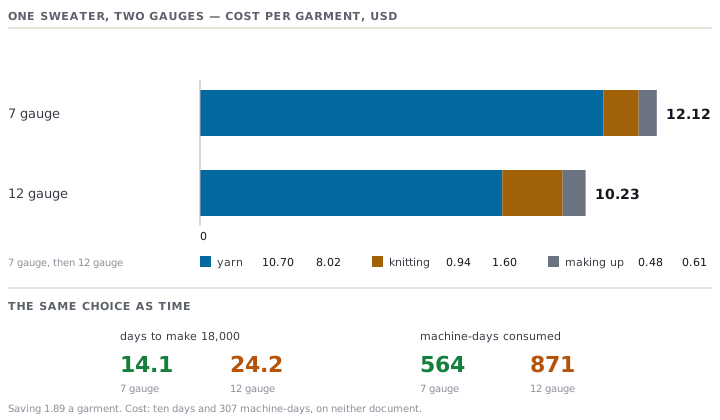
The buyer's comment saves USD 1.89 a garment, which is USD 34,020 on the order. That is a real saving and it should be taken. The making-up line comes from lesson 4. It moves the same way as the machine time, for a reason worth knowing before you meet it.
The number on neither document
Now take the same choice as a calendar.
Rangdhanu has 40 machines at 7 gauge and 36 at 12 gauge. Each one gives about 1,200 productive minutes a day after change-overs and stoppages.
- 7 gauge: 40 machines, 34 minutes a set, so 1,412 sweaters a day off the knitting floor.
- 12 gauge: 36 machines, 58 minutes a set, so 745 a day.
Knitting is not the only floor. At 7 gauge it is not even the floor that limits the order: the linkers cap it at 1,278 a day, which lesson 4 works out. Take the two floors together.
| 7 gauge | 12 gauge | |
|---|---|---|
| Knitting can produce, a day | 1,412 | 745 |
| Linking can produce, a day | 1,278 | 887 |
| The order therefore runs at | 1,278 a day | 745 a day |
| Days to knit and link 18,000 | 14.1 | 24.2 |
| Machine-days consumed | 564 | 871 |
The gauge change adds ten days to the order and 307 machine-days to the factory. A machine-day is one machine working for one day. Neither number appears on a cost sheet or on a tech pack. The cost sheet has a column for money per garment. The critical path has a column for days. Machine-days is the quantity that turns one into the other, and no standard document carries it.
The mistake nobody made
Rebuild the chain and look for the error.
- The buyer's technologist writes that the hand is coarse for the price point. Correct. It is, and January is exactly when to say so.
- The merchandiser offers 12 gauge. Correct. It is the right answer to that comment.
- The costing clerk rebuilds the sheet and reports a saving of USD 1.89 a garment. Correct, and anyone can check it.
- The knitting manager is asked for a knitting plan at 12 gauge and returns 24.2 days. Correct. He was asked for a plan, not for an opinion about the ship date.
- Nobody moves the ex-factory date, because the change made the garment cheaper, and a cheaper garment does not feel like a problem with a calendar in it.
Five correct actions. The order is now ten days late against a 22 May vessel, and the recovery is bought at the airport.
The whole order by air costs USD 66,240 against USD 4,800 by sea. That is USD 61,440 spent to rescue a USD 34,020 saving. Sending only the 6,000 pieces the launch needs by air, and the rest by sea, costs USD 20,480 more than the sea freight it replaces. That is the sane option, and it still spends three fifths of the saving. Which is why this arithmetic belongs in step 2 and not in May.
Prompt · Price a gauge change in money and in machine-days
The moment a buyer asks for a finer or coarser hand on a sweater, and before you answer with a price.
Act as a sweater factory's planning manager. A buyer has asked me to change the gauge on a knitted style. I need the full consequence, not just a price. Order facts: buyer [BUYER], PO [NUMBER], style [STYLE], quantity [QTY] pieces, FOB [PRICE], ship date [DATE], size ratio [RATIO]. Current gauge [GAUGE] and proposed gauge [GAUGE]. For each gauge give me: the yarn count and the number of ends the machine takes, the finished garment weight in the size ratio, the yarn price per kilogram, my knitting minutes for the full panel set, my machine-hour rate, my linker minutes a garment, my linking rate, and how many machines I own at that gauge. If I have not given you one of those, ask for it rather than assuming a number. Then do the following. First, build the per-garment cost at both gauges as three lines: yarn, knitting, and making up. Give me the difference per garment and on the order. Second, build the capacity at both gauges as two separate floors, knitting and linking, in pieces a day, and tell me which floor is the binding one at each gauge. Third, convert that into days to complete the order and into machine-days used, and say plainly how many days the change adds or removes. Fourth, tell me whether the ship date still holds. If it does not, price the recovery: full air, part air for the launch quantity only, and a split shipment, each against the sea freight it replaces. Fifth, state the net of the saving and the recovery in one sentence a merchandiser can put in an email. Sixth, list what would make this answer wrong.
AI can make mistakes — check anything you act on.
Check yourselfThe buyer asks whether the 12 gauge version could be delivered in the original fourteen days if the factory simply runs it on the 5 and 14 gauge machines as well. What do you answer?Show the answer
That those machines cannot knit this garment. A 5 gauge bed will not hold the Nm 2/48 yarn in a stable loop, and a 14 gauge bed will break needles on it. So the fleet available to a 12 gauge sweater is 36 machines, and no amount of scheduling makes it 56. The honest answers are a later date, a split shipment, a subcontracted knitter at the same gauge using the same yarn lot, or the 7 gauge hand at the original date. Knitting capacity is not one pool. It is a set of pools that do not drain into one another.