Lessons · Lesson 3 of 6
- 01 · Gauge is the decision, and it prices the sweater and books the factory at the same time
- 02 · You are not buying fabric, you are buying yarn by the kilogram
- 03 · Fully fashioned, cut and sew, whole garment: three routes and the price that decides between them
- 04 · Linking is counted in loops, and it is where the bottleneck goes to hide
- 05 · Blocking sets the measurement, and the first wash takes it back
- 06 · A sample that fits is not proof: gauge drift, and two complaints with one cause
Fully fashioned, cut and sew, whole garment: three routes and the price that decides between them
Cost one sweater three ways, find the yarn price at which the cheap route stops being cheap, and see why the newest machine is a capacity decision rather than a cost one.
Lesson 3 of 6 · 22 min
Three ways to make the same sweater
A sweater panel can reach its shape by three completely different routes. A merchandiser who has only ever bought cut-and-sew jersey will assume the first is a luxury and the second is normal. On a wool sweater it is the other way round, and the reason is arithmetic rather than taste.
Fully fashioned. The machine shapes the panel as it knits. It moves loops inward or outward at the edges, so the number of needles in work changes. Every edge is a selvedge, which is a finished edge made by the machine itself. Nothing is cut. The panels are joined loop by loop on a linking machine. Moving the loops leaves small marks a few stitches in from the edge, called fashioning marks. On a woven garment, a visible disturbance beside a seam would be a defect. Here the buyer's tech pack asks for the marks to be placed where they can be seen. They are the only evidence, from across a shop, that the garment was knitted to shape rather than cut out of a blanket.
Cut and sew. The machine knits a plain rectangular blank, sometimes with a rib welt across it. A welt is the ribbed border at the bottom of a panel. A cutting room lays the blanks, cuts them to a pattern, and overlocks the pieces together. Overlocking is the stitch that sews a seam and covers its raw edge at the same time. This route is the fastest on the list to knit and needs no shaping program, and it wastes cloth in exactly the way lesson 2 said knitwear does not have to.
Whole garment. The machine knits the entire sweater in one piece, body and sleeves together, with no panels and no seams at all. There is essentially nothing to link.
The three, costed
Everything below is KV-2280 at 12 gauge, per garment, on the rates built in the first two lessons.
Cut and sew loses yarn at the cutting table. Rangdhanu gets 84% of a knitted blank into garment pieces on this shape, so the finished 0.341 kg has to be cut out of 0.406 kg of knitted cloth. After the same 11% process waste, the route issues 0.4506 kg against fully fashioning's 0.3785 kg.
It gains that back on time. A blank has no shaping and the carriage runs the full width on every course, so the set knits in 41 minutes against 58. And the making up is an overlock operation at a general labour rate, not a linking operation at a skilled one: 17.5 minutes against the linked route's 26.
| Fully fashioned | Cut and sew | Whole garment | |
|---|---|---|---|
| Yarn issued | 0.3785 kg | 0.4506 kg | 0.3683 kg |
| Yarn | USD 8.02 | USD 9.55 | USD 7.81 |
| Knitting | USD 1.60 | USD 1.13 | USD 4.91 |
| Cutting | — | USD 0.06 | — |
| Making up | USD 0.61 | USD 0.33 | USD 0.11 |
| Total | USD 10.23 | USD 11.07 | USD 12.83 |
The cheap route is the dearest. Cut and sew costs USD 0.84 more a garment here, which is USD 15,120 on the order, and it also looks cheaper. That result offends everybody's intuition once, and then it becomes obvious. Yarn is 55% of this garment, so a route that spends nineteen per cent more material to save USD 0.69 of machine and labour time is trading the big number for the small one.
The price at which the answer flips
Write the two routes as lines rather than as totals, and the argument stops being a matter of opinion. Let p be the yarn price per kilogram:
- Fully fashioned:
0.3785 p + 2.21 - Cut and sew:
0.4506 p + 1.52
Cut and sew starts USD 0.69 lower on the fixed side, and climbs USD 0.0721 faster for every dollar the yarn costs. Set them equal, and the two lines cross at USD 9.57 a kilogram.
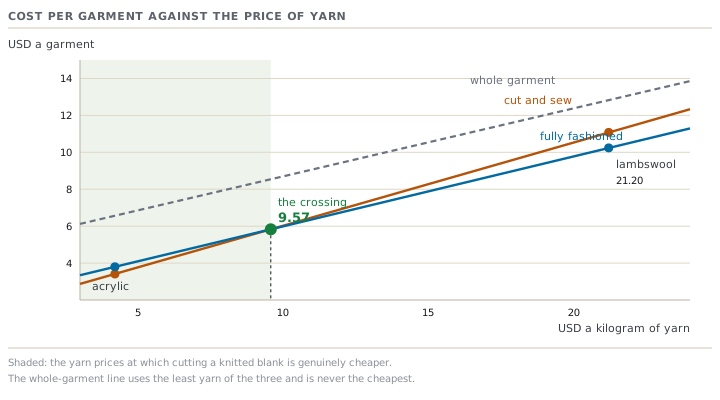
That number does most of the work in this trade without anyone writing it down. At USD 21.20 lambswool, fully fashioning wins by USD 0.84. At USD 4.20 acrylic, cut and sew wins by USD 0.39. That is why the acrylic sweater in a supermarket is cut out of a blanket, and the lambswool one in a department store is knitted to shape. It is also why a factory that is good at one is usually bad at the other.
Two cautions before you use the crossing price as a rule.
It is this factory's price, because the fixed side is this factory's labour rates, machine rate and cutting yield. Rebuild it with your own four numbers and you will get a different price. The shape of the answer does not change, but the number does.
And the yarn price is not the only thing that moves. If the cutting yield falls from 84% to 78% — a longer sleeve, a shaped armhole, a smaller marker — the cut-and-sew line gets steeper and the crossing price drops. Yield is a design outcome, so a style change can move the crossing without anybody touching a price.
Whole garment is not on this axis at all
The third line barely moves with yarn price, and it never comes down to meet the other two. It saves the most material of the three and pays for that in machine time: 82 minutes a garment, on a machine that costs USD 118,000 rather than USD 38,000. That makes a machine-hour USD 3.59 rather than USD 1.65.
The number that settles it is not on the cost sheet.
Rangdhanu has four whole-garment machines. Four machines at 1,200 productive minutes each, at 82 minutes a sweater, is 58 sweaters a day. PO KIL-4417 is 18,000 pieces. 310 days.
So the route is not rejected on USD 12.83 against USD 10.23. It is rejected because the order would ship in the following spring. Whole garment earns its place where linking labour is expensive enough to dominate — Japan, Italy, a European sampling unit — or where the run is small, the garment is dear, and the seamless hand is the product itself. On an 18,000-piece lambswool crew neck at USD 17.60, it is the right technology in the wrong factory for the wrong order.
Two things that are defects everywhere else
Mending is a department, not a failure. A dropped stitch or a broken end leaves a hole. A mender closes it by hand with the same yarn, and a well-mended sweater is a first-quality sweater in every knitwear buyer's manual. On a woven line a repaired garment is downgraded. Budget the labour here — it is inside the USD 0.21 mending and inspection line — and inspect the mend rather than pretending it is not there.
Fashioning marks are asked for. They are placed, counted and specified. A garment with the marks in the wrong place is a defect for the opposite reason to the one a woven inspector would give.
The opposite case is the one that catches people. A cut edge in a weft-knitted fabric can be unravelled one course at a time, because the whole course is one continuous yarn. So an overlocked edge in cut-and-sew knitwear is not a finish. It is the only thing stopping the garment from coming apart, and a skipped stitch there is a structural defect rather than a cosmetic one. Course 6.2 sets the sampling plan. What changes here is the classification, and a knitwear inspection manual copied from a woven one will have this backwards in both directions.
Prompt · Build the sweater cost from the yarn up, then choose the construction
Before you quote a knitted garment, and any time a cost sheet for one arrives with a fabric consumption on the first line.
Act as a knitwear costing manager. I need a sweater cost sheet built the way knitwear is actually made, and then a construction decision that falls out of it. Facts: buyer [BUYER], style [STYLE], quantity [QTY], FOB [PRICE], gauge [GAUGE], fibre and yarn count [SPEC], yarn price per kilogram [PRICE], size ratio [RATIO], colour split [COLOURS AND QUANTITIES]. My dyer's minimum and maximum lot sizes are [KG] and [KG]. My rates: machine-hour [AMOUNT], linking [AMOUNT] an hour, general making up [AMOUNT] an hour. Knitting minutes a panel set [NUMBER]. Linked edge length [CM]. Cutting utilisation if I knit blanks [PERCENT]. Do the following. First, take the finished garment weight ACROSS THE SIZE RATIO rather than from the sample size. Show me both numbers and the difference in dollars on the order. Second, build a waste factor from named sources: set-up and trial panels, panels rejected at the machine, mending and garment rejects, and cone tails. Give me the yarn issued per garment and for the order. Third, work out how many dye lots each colour becomes, flag any colour whose quantity is below the dyer's minimum, and price the dead yarn per garment for that colour. Fourth, build the full cost sheet to a total, a margin per garment and a margin percentage, and tell me what share of the cost is yarn. Fifth, cost the same garment as fully fashioned, as cut and sew, and as whole garment, and give me the yarn price per kilogram at which fully fashioned and cut and sew cross. Sixth, say which route my yarn price implies, and what would change the answer. Never put a fabric consumption in metres anywhere in this sheet.
AI can make mistakes — check anything you act on.
Check yourselfA buyer wants the fully-fashioned look at the cut-and-sew price, and suggests mock fashioning marks embroidered onto a cut-and-sew sweater. Is that a cost saving?Show the answer
Not at this yarn price, and it makes the garment worse. Cut and sew is already USD 0.84 dearer here before you add an embroidery operation, so the request spends money to imitate the cheaper route it is already losing to. It is a real option in acrylic, where cut and sew genuinely wins by USD 0.39 and the marks would be the only thing missing. The general rule is the one the crossing price gives you: decide the construction from the yarn price first, and only then ask what the garment has to look like.