Lessons · Lesson 4 of 7
- 01 · The machine is the size: needles, cylinders and a bank you cannot borrow from
- 02 · The dozen pair, and the five denominators on one cost sheet
- 03 · The toe: one seam, three ways to close it, and the money between them
- 04 · Boarding: the operation that makes the measurement
- 05 · A size that is a range
- 06 · Recovery: the number that is not on the measurement sheet
- 07 · Pairing, packing and the multiplier
Boarding: the operation that makes the measurement
Why a sock's size is set by a metal form and not by a pattern, and what a measurement change actually costs.
Lesson 4 of 7 · 17 min
The sock is not the size it was knitted
A sock comes off the machine as a limp, slightly oversized, shapeless tube with a heel in it. It becomes a size two operations later, in boarding.
Boarding means pulling the sock onto a flat metal form shaped like a foot and a leg, and passing it through steam and heat. The form is the size. The sock takes the form's outline, the yarns set to it, and the measurement on the buyer's point-of-measure sheet is the measurement of the boarded sock.
Course 4.4 taught how to win a measurement argument before bulk: a size set, a graded specification, tolerances, a measured sample against a pattern. All of that assumes the measurement comes from a pattern, and that changing it is a drawing job. Here it comes from a tool.
What a measurement change costs at Tanyeri
On 26 May, after the fit session, Quillan's technologist asks for the 43-46 foot length to come down by 8 mm. It is a small, reasonable, well-evidenced request.
Tanyeri runs two rotary boarders on this order, and each carries 24 forms. A size needs 48 forms. Aluminium boarding forms cost about USD 34 each from the form maker in Bursa. So the change is USD 1,632 and three weeks.
Three weeks is the number that matters. Knitting starts on 2 June.
So the mill has three levers, and only one of them is free:
- New forms. USD 1,632 and three weeks. It is the only lever that changes the length without changing anything else. It arrives after knitting has started.
- Fewer courses in the foot. A machine program change: free, and immediate. It shortens the foot by shortening the knitting. That also takes about 3 g a pair out of the sock and changes the ratio of leg to foot. It is the right lever if the sock is genuinely too long. It is the wrong one if the sock is the right length and merely relaxes.
- More setting. Board hotter and longer, so more of the boarded shape survives the first wash. This does not shorten the sock. It stops the sock from getting shorter later, and as the next section shows, that is what was actually wrong.
The measurement that means something different here
Quillan's specification says the finished sock must not move more than 3.0% in length after washing. That sentence was copied from their jersey tops specification, and that is where the trouble starts.
The first bulk delivery is tested and the foot length has moved 6.5%. It has not shrunk the way a knitted tee shrinks. It has relaxed off the board. Boarding stretched it, washing let it go, and it went back toward the shape the knitting gave it.
In the other direction the number has the wrong sign altogether. The leg circumference, measured relaxed and flat, is 3.1% wider after washing than before. On a woven, both directions shrink, and a specification saying "not more than 3.0% either way" makes sense. On a boarded sock, length comes back down and girth comes back out, because those are the two directions the form pulled it in.
| Measured | Off the board | After five domestic washes | Change |
|---|---|---|---|
| Foot length | 262 mm | 245 mm | 6.5% shorter |
| Leg circumference, relaxed flat | 97 mm | 100 mm | 3.1% wider |
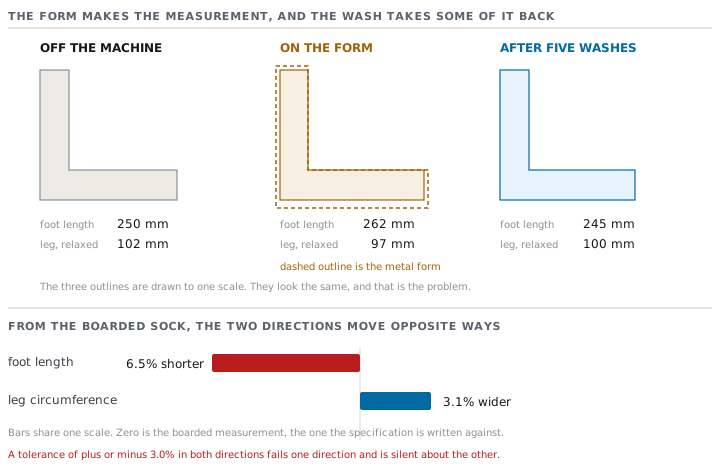
Two working rules come out of that table, and neither is in a general measurement course.
A hosiery point of measure must say whether it is taken on the board, or flat and relaxed off it. A specification that does not say is unusable, because the two readings differ by more than any tolerance you would set. Most disputes described as a measurement disagreement are two people measuring different objects correctly.
A hosiery dimensional-change specification needs a direction and a sign, not a band. For HS-244 the sensible wording is a maximum length loss and a maximum girth gain, with different numbers, because they are different failures. A sock that loses too much length pulls off the heel. A sock that gains too much girth falls down.
What the mill did, and why it was right
The form order goes in on 26 May and will not arrive in time. The foot cannot be shortened by knitting, because the fit session found the length correct before washing. The sock is the right size, and it does not stay that way.
So on 19 June the boarding is changed. Steam goes from 118 to 132 degrees Celsius, and dwell time from 9 to 22 seconds. After-wash length loss drops from 6.5% to 2.8%, inside Quillan's tolerance. The technologist is satisfied. It cost nothing, it took one shift to set up, and it is exactly what an experienced finisher would have done.
Lesson 6 is the bill for it.
Check yourselfA mill offers to hit your length specification by boarding hotter, at no cost and with no lead time. What do you ask for before you say yes?Show the answer
Ask what else the boarding change touches, and have it tested rather than argued. Boarding is a heat treatment applied to every fibre in the sock at once. So a change to it lands on the elastane's recovery, on any optical brightener in an undyed or pale shade, and on the hand of the cotton. None of those appear on a measurement sheet, and none of them will show in a shipment inspection. Be specific. Ask for a welt recovery test and a shade check on the pale colours, from the first batch boarded at the new setting. And ask that the boarding settings be written on the batch card, so a later problem can be traced back to a date.
Prompt · Audit a heat-process change before it becomes two complaints
The day a mill fixes a measurement problem by boarding hotter, drying longer or setting harder, and everyone is relieved.
Act as a senior hosiery quality manager who has seen a boarding change come back as a customer complaint. A measurement problem on my order has been solved by changing a heat process, and I want the consequences found now rather than in September. Order facts: buyer [BUYER], PO [NUMBER], style [STYLE], fibre composition [LIST WITH PERCENTAGES], colours [LIST, AND SAY WHICH ARE UNDYED, PALE OR OPTICALLY BRIGHTENED], quantity [QTY], deliveries and their dates [LIST]. The problem that was fixed: [WHAT FAILED, THE MEASURED FIGURE, THE TOLERANCE]. The change made: [PROCESS, OLD SETTING, NEW SETTING, DATE IT WAS MADE, WHICH BATCHES ARE BEFORE AND AFTER]. The buyer's specification for anything other than measurement: [RECOVERY OR GROWTH LIMIT, SHADE TOLERANCE, HAND, FASTNESS]. Do the following. First, list every fibre and every component in the article that this heat treatment also touched, and say what the change plausibly does to each one, in the direction it does it. Second, tell me which of those consequences the buyer's measurement sheet CANNOT see, and why, being specific about relaxed measurements against properties under extension. Third, give me the tests that would separate a batch made before the change from one made after, with the cost and turnaround of each, and tell me the minimum number of samples that would be convincing. Fourth, tell me how long the feedback loop is for each consequence in the field, in washes or in wears, and therefore how much production would be made before a complaint could physically arrive. Fifth, put a number on the exposure: how much of the order was made after the change, what a discount claim on it would be at [PERCENT], and what that is against the order's margin. Sixth, tell me what should have been recorded on the batch card so that a complaint could be traced to a date, and write the change-control note I should have written. Do not tell me to add material to fix a property that a process destroyed until you have ruled out reversing the process.
AI can make mistakes — check anything you act on.