Lessons · Lesson 1 of 7
- 01 · The machine is the size: needles, cylinders and a bank you cannot borrow from
- 02 · The dozen pair, and the five denominators on one cost sheet
- 03 · The toe: one seam, three ways to close it, and the money between them
- 04 · Boarding: the operation that makes the measurement
- 05 · A size that is a range
- 06 · Recovery: the number that is not on the measurement sheet
- 07 · Pairing, packing and the multiplier
The machine is the size: needles, cylinders and a bank you cannot borrow from
Why a sock size is a machine and not a pattern, and how to schedule an order whose sizes cannot share capacity.
Lesson 1 of 7 · 18 min
The situation
14 April, a hosiery mill in Kirklareli, in Turkish Thrace. Hosiery means socks, tights and stockings: garments knitted to shape instead of being cut out and sewn.
Tanyeri Hosiery Mills has confirmed purchase order QLW-2214 for Quillan Legwear, a British sock brand. It is for 7,200 dozen pairs of style HS-244, a men's cushioned-sole crew sock, 75% combed cotton with polyamide and elastane, in four colours and four size ranges. The price is USD 11.40 a dozen pairs, delivered to Quillan's warehouse in Northampton. Order value USD 82,080.
That is 86,400 pairs, 172,800 socks and 17,280 five-packs. Four units for one order, and this course uses all four. A sock is the only garment in this track where the unit you knit, the unit you sell, the unit you inspect and the unit you price are four different things.
The planner looked at the order and wrote 5.04 days of knitting on the schedule. The floor will take 6.48 days. Overtime will not change that. The difference is not effort. It is which machines exist.
What you already know, and where it stops
Course 2.2 taught the loop, the course and the wale. A course is one row of loops across the fabric. A wale is one column of loops up it. That lesson also taught that a circular machine's needle count fixes the number of wales for the life of the cylinder. Course 20.5 taught that the machine's diameter and gauge decide what cloth can exist, before anyone writes a specification. Both lessons are about fabric by the metre: a knitted tube, slit open, dyed, and sent to a cutting room.
A sock never becomes fabric. It leaves the machine as a garment: welt, leg, heel, foot and toe in one piece, with only the toe left open. The welt is the ribbed cuff at the top that grips the leg. There is no marker (course 4.5), no cutting loss, no grade rule in the sense course 4.3 teaches, and no pattern. The shape comes from the machine changing what it does, course by course.
So here is the sentence that governs this whole course:
The three numbers on a hosiery machine
A small-diameter circular hosiery machine is described by two things: the cylinder diameter in inches, and the needle count. Not needles per inch. The needles sit in grooves around the cylinder. So the needle count fixes how many wales go round the sock, and the cylinder diameter fixes how much room each needle has.
Together they set a circumference band: the range of sock widths that machine can make. Inside that band the knitter has one lever to pull, stitch length. A longer stitch makes a slightly bigger, lighter, looser sock. A shorter one makes it smaller and denser. That lever is worth about one size range either way. Past that the fabric stops being acceptable: slack and holey at one end, board-hard and heavy at the other.
Outside the band there is nothing to adjust. You change the cylinder, and that means changing the machine.
| Bank | Machines | Cylinder | Needles | Size ranges it can hold | Cycle, minutes a sock |
|---|---|---|---|---|---|
| A | 10 | 3.75 inch | 144 | 35-38 | 2.20 |
| B | 54 | 4 inch | 168 | 39-42 and 43-46 | 2.75 and 3.00 |
| C | 6 | 4.5 inch | 200 | 47-50 | 3.30 |
Read the cycle column. A bigger sock is not only more needles round. It is also more courses up, because the leg and the foot are longer. On bank B the same machine that turns out a 39-42 in 2.75 minutes needs 3.00 minutes for a 43-46. The 200-needle machines in bank C need 3.30.
Tanyeri runs three shifts and gets 1,320 running minutes out of each machine-day. The rest of the day goes to doffing (taking the finished socks off the machine), yarn changes and needle replacement. So:
- Bank A: 1,320 divided by 2.20 is 600 socks, which is 300 pairs a machine-day
- Bank B on a 39-42: 240 pairs. On a 43-46: 220 pairs
- Bank C: 200 pairs a machine-day
The order, laid against the machines
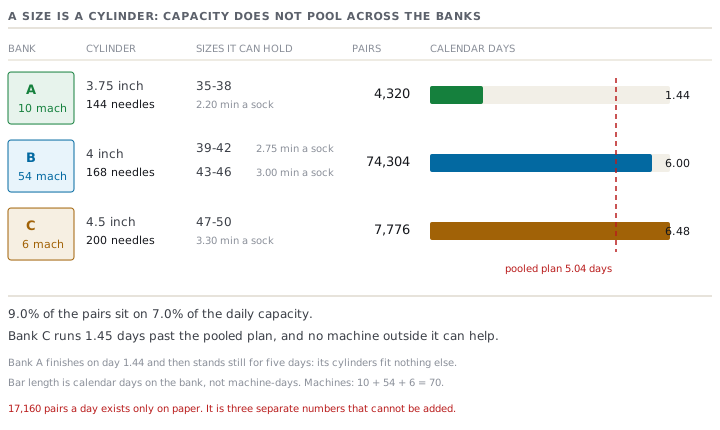
Quillan's size curve was agreed at the range meeting in February. Nobody has questioned it since, because nothing about it looks wrong.
| Size range | Share | Pairs | Bank | Pairs a machine-day | Machine-days | Machines | Calendar days |
|---|---|---|---|---|---|---|---|
| 35-38 | 5% | 4,320 | A | 300 | 14.40 | 10 | 1.44 |
| 39-42 | 42% | 36,288 | B | 240 | 151.20 | — | — |
| 43-46 | 44% | 38,016 | B | 220 | 172.80 | — | — |
| Bank B total | 86% | 74,304 | B | — | 324.00 | 54 | 6.00 |
| 47-50 | 9% | 7,776 | C | 200 | 38.88 | 6 | 6.48 |
The order is finished when the last bank is finished, and that is bank C at 6.48 days.
Now take the planner's number. Add up what the banks make: 10 machines at 300 pairs, 54 at 240, and 6 at 200. The hall makes 17,160 pairs a day. Divide 86,400 by that and you get 5.04 days. Every figure in that sum is real. The sum is still wrong, because it pools capacity that cannot be pooled. Not one of the 54 machines in bank B can knit a 47-50, and the six that can are already running.
The slip is 1.45 days, and it belongs entirely to one size range: 9.0% of the pairs sitting on 7.0% of the daily capacity. Nobody made a mistake. The range meeting added a large size because customers asked for one, which was right. The costing blended it into one price, which is normal. The planner divided quantity by capacity, which is what a planner does. The size chart said nothing about cylinders, because size charts never do.
What the 1.45 days actually costs
Kirklareli to Northampton is a road movement, not a sailing. One 13.6 metre trailer costs USD 4,200 for the whole order, which is USD 0.58 a dozen pairs. The trailer is booked for a Thursday.
The 47-50 misses it. There are two ways out:
- Hold the finished 6,552 dozen for four days and send everything on the next trailer. But Quillan's shops are already promoting the sock.
- Send the trailer, and put the 648 dozen of 47-50 on a groupage part-load at USD 1,450. Groupage means sharing a trailer with other shippers' freight.
Option 2 is what happens. The part-load is USD 2.24 a dozen pairs against USD 0.58, so the extra is USD 1.65 a dozen on 648 dozen: USD 1,072. The order's whole quoted margin is USD 8,562, and you will build it line by line in the next lesson. So one size range, added for good reasons and scheduled by a division that looked correct, has taken 12.5% of the margin before anybody has discussed price.
The other half: the size that does not exist
In May, Quillan's buyer asks whether HS-244 can be offered in a children's 31-34. The commercial answer is yes. The physical answer is no. Bank A's 144-needle cylinders are the smallest in the house, and a 31-34 needs fewer needles on a smaller cylinder. The mill would have to buy machines.
That is not a refusal a merchandiser can negotiate around. It is worth learning the shape of it early, because it comes back. A hosiery range's size span is a capital decision taken years before the range meeting. The size chart comes after the machine list, and the machine list comes after what the mill decided to buy in 2019.
Check yourselfA second mill quotes the same order and its schedule says 5.1 days. What is the one question that tells you whether the number is real?Show the answer
Ask for the machine count and the cycle time for the 47-50 alone, and do the division yourself. A mill with twenty 4.5 inch machines really does finish the big size faster than Tanyeri, and 5.1 days may be honest. A mill with four is quoting a pooled average, and it will discover the problem in week two. The question is not whether they can make a 47-50, because everybody can. The question is how many machines can make it at once. In hosiery, capacity is not a number. It is a list.
Prompt · Schedule a sock order by cylinder, not by total
Before you accept a delivery date on a hosiery order, or the first time a mill answers a capacity question with one number.
Act as a hosiery production planner in a sock mill. I need a knitting schedule built per machine bank rather than as one pooled figure, because a sock size cannot move to a machine that was not built for it. Order facts: buyer [BUYER], PO [NUMBER], style [STYLE], total [QTY] dozen pairs, price [AMOUNT] a dozen pairs, terms [TERMS], required at [DESTINATION] on [DATE]. Size ranges and their share of the order: [LIST EACH SIZE RANGE AND ITS PERCENTAGE]. The mill's machine list: [FOR EACH BANK, GIVE CYLINDER DIAMETER, NEEDLE COUNT, NUMBER OF MACHINES, WHICH SIZE RANGES IT CAN HOLD, AND THE CYCLE TIME IN MINUTES A SOCK FOR EACH OF THOSE SIZES]. Running minutes a machine-day: [NUMBER]. Do the following. First, convert every size range into pairs and then into machine-days on the bank that can actually knit it, and show the arithmetic. Second, give me calendar days PER BANK and tell me which bank finishes last, because that is the order's knitting date. Third, calculate the pooled figure a planner would get by dividing total pairs by total daily capacity, and state the gap between the two in days. Fourth, name any size range that is over-represented relative to the capacity that can make it, expressed as its share of the order against its share of the daily capacity. Fifth, tell me what the late bank does to the shipment: whether it misses the booked transport, what a part-load or a split delivery would cost, and what that is as a share of the order's margin if I give you the margin. Sixth, list the size ranges the mill cannot make at all with this machine list, and say what equipment would be needed. Do not give me a single number for the order, and do not average cycle times across banks. If a cycle time is missing, ask for it rather than assuming one.
AI can make mistakes — check anything you act on.