Lessons · Lesson 7 of 7
- 01 · The machine is the size: needles, cylinders and a bank you cannot borrow from
- 02 · The dozen pair, and the five denominators on one cost sheet
- 03 · The toe: one seam, three ways to close it, and the money between them
- 04 · Boarding: the operation that makes the measurement
- 05 · A size that is a range
- 06 · Recovery: the number that is not on the measurement sheet
- 07 · Pairing, packing and the multiplier
Pairing, packing and the multiplier
Why a small sock defect rate becomes a large pack defect rate, and which unit the inspection is drawn on.
Lesson 7 of 7 · 16 min
The product is assembled at the very last operation
Everything before this point made socks. Nothing before this point made a pair, and Quillan does not buy socks. It buys 17,280 five-packs.
Pairing is a person at a table with two tubs of finished socks. They put two socks together, check them, and drop the pair into a pack. It is the cheapest operation in the whole route, at USD 0.21 a dozen pairs of labour, from lesson 2. And it is where three things happen that happen nowhere else.
It is the last 100% inspection in the factory. It is the operation that creates the one defect class that cannot exist on a single sock. And it is the point where a small number turns into a large one.
The defect that only exists in pairs
Two socks come from two different machines, knitted from two different cones, dyed in the same bath. Each one is inside the shade band against the sealed standard. Neither is a defect. Put them together and they do not match each other.
The same logic governs the mechanical properties. A pair of socks with slightly different welt recovery does not feel like a good sock and a bad sock. It feels like a sock that slips down on one leg, and the customer returns the pair.
Here are the practical rules, and all of them are about production rather than inspection. Pair within one dye lot. Keep the machine group on the trolley card, so a pairing table never mixes machines it should not. And pair from the same trolley rather than from a bulk bin, which costs nothing and removes most of the problem.
The multiplier
Tanyeri's sock-level defect rate at pairing is 0.90%. That is the rate at which one individual sock has something wrong with it. It sounds like a good factory, and it is.
Now push it through the units.
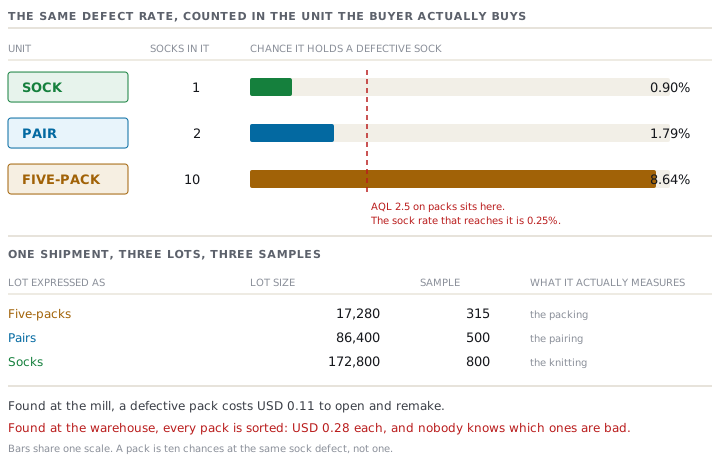
| Unit | Socks in it | Chance it contains at least one defective sock |
|---|---|---|
| Sock | 1 | 0.90% |
| Pair | 2 | 1.79% |
| Five-pack | 10 | 8.64% |
A 0.90% sock defect rate is an 8.64% pack defect rate. That is 9.6 times the number the factory quotes about itself, and neither figure is wrong. They are the same fact, counted in two units.
Now turn it round, because that is the useful direction. Say Quillan inspects packs at an AQL of 2.5. AQL means acceptable quality limit: the defect rate a buyer will still accept, checked by sampling. For that, the pack defect rate has to sit well under 2.5%. And to get a pack rate of 2.5% you need a sock rate of 0.25%. The factory's target is not the buyer's number. It is the buyer's number divided by roughly ten.
This is what pairing is really for. If the pairing operator catches 92% of sock defects, the escape rate is 0.07% and the pack rate falls to 0.72%, comfortably inside. So the whole quality position of a sock order rests on one manual operation that costs twenty-one cents a dozen pairs. And that is normally the first place a factory takes people out of when it is behind.
Which unit is the inspection drawn on?
Course 6.2 owns AQL: the sampling tables, the code letters, the accept and reject numbers, and the switching rules. It is not repeated here. What belongs to this category is the question that comes before the table, and most sock contracts answer it wrongly:
What is the item?
The same physical goods can be presented as three lots.
| Lot expressed as | Lot size | Sample size |
|---|---|---|
| Five-packs | 17,280 | 315 |
| Pairs | 86,400 | 500 |
| Socks | 172,800 | 800 |
Three sample sizes, three accept numbers, one shipment. And they do not only differ in size. They measure different things. A sample of 800 socks measures the knitting. A sample of 315 packs measures the packing, and a pack is defective if any one of its ten socks is. That is the multiplier again.
What a defect costs, depending on where it is found
A pack found defective at final inspection in Kirklareli is opened, the bad pair is replaced from stock, and the pack is made up again. That is about USD 0.11 in labour, plus a new header card and a new bag. Re-packing every pack expected to contain a defect, which is 8.64% of 17,280, comes to USD 164.
The same problem found at Quillan's warehouse means the delivery is sorted there. A third-party sorting house charges about USD 0.28 a pack to open, check and re-pack all of them, because nobody knows which ones are bad. That is USD 4,838.
Twenty-nine and a half times the cost, for the same defects, on the same goods, four days later. That ratio is not special to socks. It is the ordinary shape of the cost of quality. But the multiplier makes it bite much earlier here than in a cut-and-sew order, because the pack failure rate reaches an alarming-looking number while the sock failure rate still looks excellent.
Check yourselfYour mill reports a 1.2% sock defect rate and your buyer's AQL is 2.5 on packs of three pairs. Are you in trouble?Show the answer
Work it in the buyer's unit before you answer. A three-pack is six socks, so the pack rate is one minus 0.988 to the sixth, which is about 7.0%. That is nearly three times the AQL, so yes. But the answer is not to argue about the AQL. It is to find out what the pairing table catches, because the 1.2% is the rate BEFORE the last inspection, and the pack rate depends on what escapes it. Ask for the pairing reject tally, not the final inspection report. If the table is pulling out 90% of them, the escape is 0.12% and the pack rate is 0.7%, and the order is fine. If the table is a conveyor with nobody looking, then the 1.2% is the escape rate, and you have a serious problem that no amount of final inspection can sample its way out of.
Prompt · Cost a sock per dozen pairs, with every denominator named
When a sock cost sheet has one column of money and you cannot tell which lines are per sock, per pair, per dozen or per pack.
Act as a hosiery costing manager. Build me a cost sheet for one sock style per DOZEN PAIRS, and name the denominator underneath every line, because the lines in a sock cost sheet are counted in at least five different units and that is where the errors live. Style facts: [STYLE], [QTY] dozen pairs, price [AMOUNT] a dozen pairs, terms [TERMS], pack format [HOW MANY PAIRS TO A PACK]. Size ranges, their share of the order, and the finished weight in grams a pair for EACH size: [LIST THEM]. Yarns bought, with grams a dozen pairs and price a kilogramme: [LIST EACH, AND SAY WHICH ONE IS THE COVERED ELASTANE AND WHAT ITS CORE AND COVERING ARE]. Over-issue above the in-sock weight: [PERCENT]. Dyeing: [PRICE A KILOGRAMME], machine load [KG], and the split between chemistry that scales with weight and machine cost that does not, if known. Knitting: cycle minutes a sock and the machine-minute rate. Toe closing: the route and its rate. Boarding, pairing, packing and packaging: rates and the unit each is quoted in. Seconds rate and the salvage value of a second. Freight and overhead. Do the following. First, build the cost per dozen pairs line by line with the denominator written beside each line, and flag any line I have given you in the wrong unit. Second, reconcile the yarn bill against the label composition, showing how much of the covered elastane yarn is core and how much is covering, and what percentage of the finished sock each declared fibre is. Third, recalculate the yarn and dyeing lines at the ORDER'S BLENDED WEIGHT rather than at the middle size, and tell me in money what the size mix costs against the size the quote was built on. Fourth, express seconds as a cost per SHIPPABLE dozen pairs, net of salvage, not as a percentage. Fifth, carry it to a margin a dozen pairs and a margin on the order. Sixth, tell me what a defective sock costs at each unit: opened and remade at the mill, and sorted at the customer's warehouse. Name every assumption in a list at the end, and do not give me a range where a number is possible.
AI can make mistakes — check anything you act on.