Lessons · Lesson 1 of 6
- 01 · Down is bought by weight and specified by volume
- 02 · Filling the garment: the dose, the drift and the tolerance
- 03 · The baffle is a cost decision before it is a warmth decision
- 04 · Seam sealing is a machine, not a step
- 05 · The labour multiplier, and the calendar it breaks
- 06 · Inspecting what you cannot see
Down is bought by weight and specified by volume
Cost one parka's fill four ways at the same warmth, and see why the cheapest certificate is not the cheapest down.
Lesson 1 of 6 · 20 min
The order
3 February. Corrievreckan Outdoor, Glasgow, confirms PO CV-5290 with Bo Ha Outerwear in Hai Duong, Vietnam: 7,400 men's hooded technical down parkas, style KV-3620. The price is FOB USD 84.50 — free on board, the price with the goods loaded at the port of shipment. Order value USD 625,300. Ex-factory 21 August, on board 28 August.
The parka has a laminated 20-denier shell, taped seams, box-wall baffles and a hood. A baffle is the wall that holds the down in one place; lesson 3 is about it. The specification says one line about the fill that everything else in this course hangs from:
Fill: 90/10 grey goose down, minimum 800 fill power, 210 g in size M, graded by size.
Here is the FOB it was costed against.
| Line | Per parka, USD |
|---|---|
| Shell, laminated 20-denier nylon | 11.40 |
| Lining | 5.06 |
| Baffle mesh | 1.11 |
| Down fill | 31.08 |
| Seam tape | 2.13 |
| Zips, cords, elastics, labels | 6.40 |
| Sewing labour | 7.82 |
| Factory overhead | 9.10 |
| Wastage and rejects | 2.60 |
| Factory margin | 7.80 |
| FOB | 84.50 |
Read the fourth row against the first three. The down costs more than the shell, the lining and the baffle mesh put together — USD 31.08 against USD 17.57. It is 36.8% of the FOB. Across the order it is USD 229,992 of a USD 625,300 contract. Nothing else in a down parka behaves like that. That is why this category is costed differently from every other garment you will buy.
Course 8.1 owns the cost sheet and course 8.2 owns fabric buying. What is yours here is the row they cannot help you with: a material sold by the kilogram whose price is set by a volume measurement.
What fill power actually measures
Fill power is a volume per unit of weight. A sample of down is conditioned — held at a set temperature and humidity until its moisture settles — then dropped into a cylinder. A light disc is laid on top, and you read off the volume the down occupies. The figure is reported in cubic inches per ounce. So 800 fill power means one ounce of that down settles to 800 cubic inches.
Two things follow at once, and they are the whole lesson.
First: fill power is not warmth. It is warmth per gram. A jacket keeps you warm by trapping still air, and what matters is the total volume the down fills. That is fill power multiplied by weight. Fill power on its own tells you nothing about a garment. A 900 fill-power gilet with 40 g in it is a cold garment with an impressive number on the hangtag.
Second: at a fixed warmth, fill power sets the weight and the price, and nothing else. Hold the total loft volume constant and the arithmetic is forced.
The ladder, at equal loft
KV-3620 carries 210 g of 800 fill-power down. Free to expand, it occupies 5,926 cubic inches. Take that as the design target. Then ask what it costs to reach the same target four different ways. The down prices below are Gao Ping's quotation to Bo Ha for delivery in April. They are prices in one invented market on one date, not a rate you can look up.
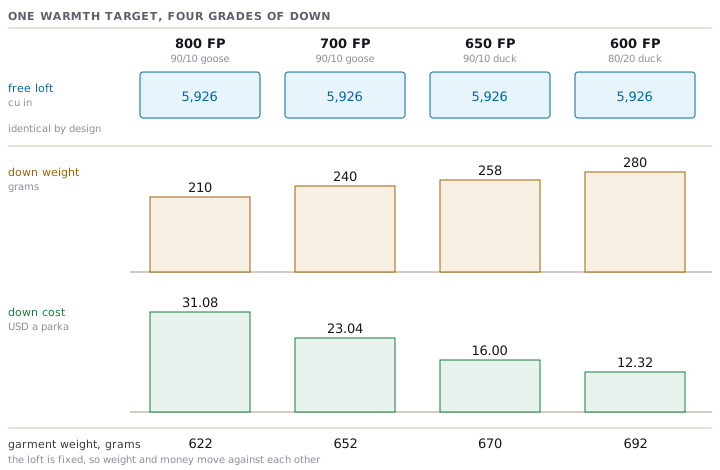
| 800 fill power | 700 fill power | 650 fill power | 600 fill power | |
|---|---|---|---|---|
| Composition | 90/10 grey goose | 90/10 grey goose | 90/10 grey duck | 80/20 white duck |
| Weight to reach the target | 210 g | 240 g | 258 g | 280 g |
| Price per kilogram, USD | 148.00 | 96.00 | 62.00 | 44.00 |
| Down cost per parka, USD | 31.08 | 23.04 | 16.00 | 12.32 |
| Finished garment weight | 622 g | 652 g | 670 g | 692 g |
Weights are rounded to the nearest gram. Everything else follows from the two lines above them.
Now read the last two rows together. The decision sits in the gap between them. Moving from 800 to 600 fill power saves USD 18.76 a parka — USD 138,824 on this order, 22.2% of the contract value. What you get back is a garment 70 g heavier. It is not a colder garment: the loft is the same on the day it is made. It is a heavier one, a bulkier one in the stuff sack, and one whose loft recovers a little less well each time it is compressed, because the clusters are smaller.
That is a product decision, not a sourcing one, and Corrievreckan had already made it. Their 800 fill-power line retails at GBP 320. Their 700 fill-power line retails at GBP 260. Dropping a grade saves 9.5% of the FOB and gives away 19% of the retail price. The saving is real. It is just smaller than the thing it costs.
What 90/10 means, and why it is a price
"90/10" is a composition declaration. By mass: 90% down cluster, and 10% everything else the sorting allows — small feather, fibre, residue. It matters commercially because you pay for the whole kilogram and only part of it lofts. Feather has a fraction of the fill power of down cluster. So a bag declared 80/20 is already a blend, and its stated fill power is the blend's figure, not the cluster's.
That is why the 600 fill-power column above is 80/20 white duck and the 800 column is 90/10 grey goose. They are not the same material at two prices. They are different materials, and one of them holds more of the thing you are buying.
The mistake nobody made
On 14 April, Bo Ha's purchasing found a second supplier. Same 90/10 grey goose down, at USD 121.00 a kilogram, with a mill certificate reading 800 fill power. That is USD 27.00 a kilogram under Gao Ping. Purchasing did exactly what purchasing is for: same declared composition, same declared fill power, better price. The supplier's certificate was genuine. Nobody lied to anyone.
Corrievreckan's technologist, Morven Aitchison, asked for a re-test. At the buyer's nominated laboratory, by the method the specification names. The same lot came back at 742.
Both numbers are real. Fill power is measured by more than one published method. The cylinder and the way the sample is conditioned differ between them. So the same down gives two different figures under two methods. A number without its method beside it is not a specification. Course 6.3 makes that point about test methods in general. This is the same point wearing a price tag.
Work the consequence through rather than arguing about it:
- At 742 fill power, 210 g occupies 5,496 cubic inches instead of 5,926. That is 7.2% less loft than the garment was designed around, for the same money on the label.
- To reach the target you need 5,926 divided by 742, which is 226 g — 16 g more down.
- At 226 g and USD 121.00 a kilogram the fill costs USD 27.35, against USD 31.08 from Gao Ping. It is still cheaper, by USD 3.73 a parka — USD 27,602 across the order.
So the cheap down really was cheaper. Buying it as quoted would still have been a mistake, because the quote was priced against 210 g and the garment needs 226 g. Three things then have to move together: the fill weight on the tech pack, the hangtag that says 800 fill power, and the chamber volume that now has to hold 16 g more down. That last one is lesson 3's problem, and it is not free.
Check yourselfPurchasing argues that 742 against 800 is a 7.2% shortfall on a line worth USD 31.08, so the exposure is about USD 2.24 a parka. Why is that the wrong way to size it?Show the answer
Because the garment is not specified in fill power. It is specified in warmth, and warmth is loft volume. A 7.2% shortfall in fill power at an unchanged 210 g is a 7.2% shortfall in the finished garment's insulation. That is a product failure, not a pricing variance. The right way to size it is to ask what restoring the loft costs: 16 g more down at the new supplier's price, which is USD 1.94 a parka on top of the quoted fill. Add a chamber that now has to hold it, and a hangtag that no longer says a true thing. Priced as a discount it looks like a saving. Priced as a specification it is a different garment.
Prompt · Cost the fill, and check the chamber can hold it
Before you sign a down or synthetic-fill garment: when the tech pack gives a fill weight and a fill power but nothing that connects them to the chambers, the size range or the price.
Act as an outerwear technologist and costing engineer. Build me the fill file for one down garment. Order facts: buyer [BUYER], PO [NUMBER], style [STYLE], quantity [QTY], FOB [PRICE], ship [DATE]. Fill specification: [FILL POWER] fill power, composition [90/10 OR OTHER], [WEIGHT] g in size [SIZE], measured by [METHOD IF STATED]. Construction: [SEWN-THROUGH / KARO-STEP / BOX WALL], baffle wall height [MM], chamber count [N], chamber line length [M], insulated surface area [M2]. Size break: [LIST SIZE AND QUANTITY]. Down prices available to me, per kilogram: [LIST FILL POWER AND PRICE]. Do the following, showing every division. First, convert the specified fill weight and fill power into a total free loft volume, and restate that as the design target. Second, build a ladder of every fill power I listed at that same loft: weight needed, price per garment, finished garment weight. Third, compute the chamber volume from the wall height and the insulated area, and give the ratio of free loft to chamber volume; tell me whether the chamber is over-packed, firm, or under-filled, and what fill weight would restore a firm chamber if the wall height changed by plus or minus 5 mm. Fourth, grade the fill across my size break and give me the total kilograms the order really needs, against the naive figure of quantity multiplied by the size M fill, and name the difference in money. Fifth, add a process loss allowance and state the number you used. Sixth, write me the three questions I should put to the down supplier before I place the order. Do not give me a range where a number is possible, and list every assumption at the end.
AI can make mistakes — check anything you act on.
What to do on Monday
- Never accept a fill-power figure without its method. Put the method in the specification, and re-test one bag from every lot against it.
- Cost fill at equal loft, not at equal weight. Multiply the weight by the fill power for each option and compare the volumes before you compare the prices.
- Treat the composition declaration as part of the price. 90/10 and 80/20 at the same fill power are not the same purchase.
- Check that the chambers can hold what you just bought. More grams at a lower grade needs somewhere to go.