Lessons · Lesson 5 of 6
- 01 · Down is bought by weight and specified by volume
- 02 · Filling the garment: the dose, the drift and the tolerance
- 03 · The baffle is a cost decision before it is a warmth decision
- 04 · Seam sealing is a machine, not a step
- 05 · The labour multiplier, and the calendar it breaks
- 06 · Inspecting what you cannot see
The labour multiplier, and the calendar it breaks
Build one parka's SMV, convert it into line-days, and find the six weeks that a correct cost sheet did not contain.
Lesson 5 of 6 · 20 min
Two garments, one sewing line
Bo Ha's line 3 made a quilted jacket for another buyer last season. This season it is making KV-3620. Same operators, same building, same supervisor. Here is what changed.
| Operation group | Quilted jacket | KV-3620 |
|---|---|---|
| Shell panels, seaming and shaping | 7.1 min | 9.4 min |
| Chamber walls and baffle assembly | 6.0 min | 24.6 min |
| Lining assembly | 4.4 min | 6.2 min |
| Down filling and chamber closing | 5.8 min | 11.8 min |
| Seam taping | none | 5.8 min |
| Zip, storm flap, hood, cuffs, hem, drawcords | 6.2 min | 14.7 min |
| Pockets | 3.4 min | 8.9 min |
| Trims, labels, finishing, down cleaning, pressing | 4.0 min | 7.4 min |
| In-line inspection and needle detection | 1.1 min | 2.1 min |
| SMV | 38.0 min | 90.9 min |
SMV is the standard minute value: the work content of the garment in minutes. The parka is a factor of 2.39. Course 5.4 owns how an SMV is built, and course 5.3 owns how a line is balanced around it. What belongs here is what a multiplier of that size does to a business. It does two completely different things, and only one of them is on the cost sheet.
The small consequence: money
At Bo Ha's costed minute of USD 0.086, the quilted jacket carries USD 3.27 of sewing labour and KV-3620 carries USD 7.82. That is a difference of USD 4.55 a garment, against an FOB of USD 84.50. It is 5.4% of the price, it was costed correctly, and nobody has ever been surprised by it.
The large consequence: days
Line 3 runs 42 operators on a 480-minute day, at a line efficiency of 58%. That is 11,692.8 earned minutes a day. Earned minutes divided by SMV is output:
- Quilted jacket: 11,692.8 divided by 38.0 is 307 jackets a day.
KV-3620: 11,692.8 divided by 90.9 is 128 parkas a day.
7,400 units at 307 a day is 24 days. 7,400 units at 128 a day is 58 days. The labour cost went up by 5.4%. The calendar more than doubled.
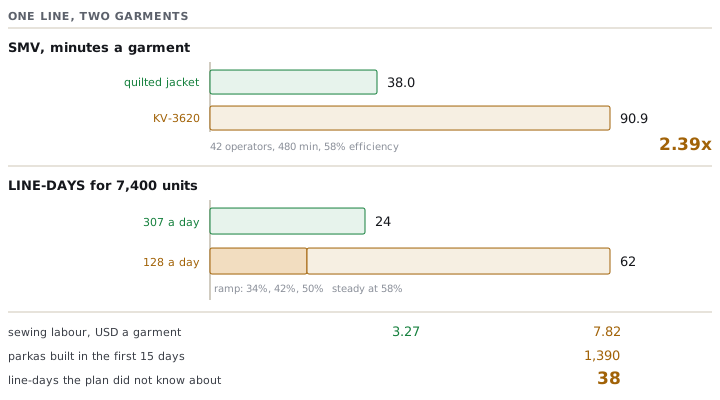
And 58 is the optimistic figure, because it assumes the line reaches 58% on the first morning. It does not, and the reason is the multiplier again. A 90.9-minute garment has more operations to learn than a 38.0-minute one, and two of them — down filling and seam taping — nobody on line 3 has ever done.
| Line efficiency | Parkas a day | Parkas built | |
|---|---|---|---|
| First 5 days | 34% | 75 | 375 |
| Days 6 to 10 | 42% | 93 | 465 |
| Days 11 to 15 | 50% | 110 | 550 |
| Remaining 47 days | 58% | 128 | 6,010 |
| Order | 7,400 |
62 line-days, not 24. Course 5.6 owns the learning curve itself. What this table is for is the number at the bottom of the last column.
The mistake nobody made
The cost sheet was right. Bo Ha's industrial engineer, Khanh, built the 90.9-minute SMV in February from the proto sample, and it went into the FOB as USD 7.82. That is the correct number, correctly used.
The plan was also right, in the only sense the planner could check. Bo Ha's planning sheet books sewing lines in pieces per line-day, and line 3's figure was 300 a day, taken from the outerwear it had been running. Booking 7,400 parkas at 300 a day gives 25 days. That was rounded to a 24-day window against an ex-factory of 21 August, so cutting was scheduled to start on 24 July.
Two people used the same factory correctly, and the SMV never crossed between them. A cost sheet consumes an SMV. A plan consumes a rate. And nothing in most factories converts one into the other.
It was found on 26 May, by the merchandiser Phuong, who reconciled the operation bulletin against the booking sheet because the taping capacity work in lesson 4 had made her look. At 62 line-days on a six-day week — 72 calendar days — cutting has to start on 8 June to reach ex-factory on 19 August. The plan had it starting on 24 July. That is six and a half weeks of difference, found eleven days before the true start date and seven weeks before the plan's.
Found in May, it is a rescheduling problem. Found on 24 July, it is a cancelled order.
What the 38 days actually cost
Line 3 was booked to somebody else for the 38 days the plan did not know about. Price that at the factory's own costed minute. Thirty-eight days of line 3 is 38 multiplied by 11,692.8 earned minutes, which is 444,326 minutes, or USD 38,212 of sellable capacity. That is the number to put in front of a planning meeting, because "the line is busy" is not a number and this is.
Recovering it, and the option that makes it worse
Three levers, priced:
- A second line. Line 7 is free from 22 June. It adds capacity, and it starts its own learning curve from 34%, with the same two unfamiliar operations. So the first fortnight of a second line delivers roughly 60% of what the arithmetic suggests. Adding people to a late job adds coordination before it adds output. Fred Brooks made that point about software projects, and it transfers exactly.
- Overtime. Two hours a day on line 3 is 25% more minutes at a premium rate. It is the cleanest lever, and it is capped by fatigue and by law.
- Air freight. Read the number before you reach for this one.
A packed KV-3620 occupies 40 by 32 by 11 cm, which is 14,080 cm³. Air freight charges on the greater of actual weight and volumetric weight — the weight the shipment is charged at because of the space it takes up. At the conventional divisor of 6,000 cm³ to the kilogram, this parka's volumetric weight is 2.35 kg against an actual weight of 0.62 kg. You pay for 3.8 times the garment you are shipping.
- Air at USD 4.60 a kilogram: USD 10.81 a parka, which is 12.8% of the FOB.
- Sea, at 0.016 m³ a parka packed, is 118.4 m³. That is two 40-foot high-cube containers at USD 3,100: USD 0.84 a parka.
- Air is 12.9 times sea on this garment, against roughly four to six times on a folded knitted garment of the same value.
Track 7 owns freight and the chargeback that follows a late shipment. What belongs here is that loft is the thing you are shipping. So the standard recovery lever is several times more expensive in this category than in the ones you have priced before. Down garments can be compression-packed to cut the volume. That reduces the bill and starts a different argument about how long down should be held compressed and what the retailer will accept out of the carton.
Check yourselfYour factory quotes a rate of 300 pieces a line-day and your last three orders with them all shipped on time at that rate. Why is quoting it for a down parka still wrong?Show the answer
Because the rate is not a fact about the line. It is a fact about the line and a garment together: earned minutes divided by SMV. The three orders that shipped on time shared a garment of roughly the same SMV, so the rate held and looked like a property of the factory. A 90.9-minute parka on the same line at the same efficiency is 128 a day. The 300 was never wrong. It was answering a question about a different garment. Ask for the line's earned minutes a day and this style's SMV, and do the division yourself.
Prompt · Turn a technical outerwear spec into machine-days and line-days
Before you confirm a delivery date on anything taped, bonded or filled — the moment somebody quotes you a rate in pieces per line-day.
Act as an industrial engineer in a technical outerwear factory. I need to know whether this order fits the window, not what it costs. Order facts: style [STYLE], quantity [QTY], size break [LIST], ex-factory [DATE], sewing window [DAYS], working week [DAYS]. Sewing line: [N] operators, [MIN] minutes a day, line efficiency [PERCENT]. SMV, the standard minute value, meaning the work content of the garment in minutes: [PASTE THE OPERATION BULLETIN, OR GIVE THE TOTAL SMV AND THE OPERATIONS THAT ARE NEW TO THIS LINE]. Seam sealing: [M] of taped seam a garment, measured machine speed [M PER MIN] on this style, handling time a garment [MIN], [N] machines available, [HOURS] a shift. Do the following. First, convert the sewing line's earned minutes a day into pieces a day using THIS style's SMV, and give me the steady-state line-days for the order. Second, add a learning ramp based on the operations that are new to the line, in blocks of five days, and give me the realistic line-days. Third, work the taping separately: metres a garment divided by measured speed, plus handling, times quantity, into machine-hours, machine-days and days on the machines available. Fourth, tell me which of the two is the binding constraint and by how many days, and back-calculate the date cutting must start. Fifth, if it does not fit, price four levers — a seam review that removes seams outside the waterproof envelope, an extra machine with its lead time, overtime, and a second line with its own ramp — and say what each one buys in DAYS, not only in money. Sixth, state the capacity I am consuming in earned minutes so I can price it against what the line was booked for. Name every assumption.
AI can make mistakes — check anything you act on.
What to do on Monday
- Book capacity in minutes, not pieces, and convert at the moment of booking with this style's SMV.
- Ask which operations on the bulletin are new to that line, and add a ramp for them rather than a contingency percentage.
- Reconcile the cost sheet's SMV against the planning rate on every order. They are the same number used twice, and they are almost never checked against each other.
- Price air freight on volumetric weight before you rely on it, because in this category it is not the lever it is elsewhere.