Lessons · Lesson 3 of 6
- 01 · Down is bought by weight and specified by volume
- 02 · Filling the garment: the dose, the drift and the tolerance
- 03 · The baffle is a cost decision before it is a warmth decision
- 04 · Seam sealing is a machine, not a step
- 05 · The labour multiplier, and the calendar it breaks
- 06 · Inspecting what you cannot see
The baffle is a cost decision before it is a warmth decision
Price three chamber constructions on one parka, and follow a five-millimetre wall change to the down bill it created.
Lesson 3 of 6 · 22 min
What a baffle is for
A down chamber has one job. It holds a measured quantity of down in one place, at a thickness, for the life of the garment. Down does not stay where you put it. It is loose fibre with no structure. In an open cavity it settles to the bottom, so the top of the garment goes empty and the hem goes heavy. Every chamber in a parka exists to stop that.
There are three ways to build one. They are not variations on a theme. They are three different cost structures.
Sewn-through. The outer cloth is stitched straight to the inner cloth along the chamber line. It is the cheapest and the fastest. Along every one of those lines the two cloths touch, so the loft there is zero.
Karo-step, or offset. Two sewn-through layers with their stitch lines offset, so the cold line of one is covered by the loft of the other. Cheaper than a wall. It costs an extra layer of cloth and the weight of it.
Box wall. A strip of light mesh is sewn between the two cloths. It stands the chamber open to a set height. The loft is continuous across the whole garment. It is the most expensive by a distance, and it is the only construction where the wall height is a number you control.
The cold line, measured
KV-3620 has 9.4 m of chamber line in a size M, and its insulated surface is 1.62 m². A sewn-through line kills the loft over a band about 15 mm wide. So the zero-loft area is 9.4 multiplied by 0.015, which is 0.141 m². That is 8.7% of the insulated surface.
That sounds survivable, and it would be if it were scattered. It is not. It arrives as continuous lines running across the body. A line conducts heat away along its whole length, in a way the same area in scattered patches does not. So this is not a garment that is 8.7% less warm. It is a garment a wearer describes as "cold in stripes", which is the complaint sewn-through actually generates.
There is one more thing you cannot buy your way out of. More down does not fix a stitch line. Adding fill raises the loft on either side of the line and leaves the line exactly where it was.
| Sewn-through | Karo-step | Box wall | |
|---|---|---|---|
| Chamber wall material | none | none | 0.53 m² mesh, USD 1.11 |
| Chamber-building SMV | 8.4 min | 14.1 min | 24.6 min |
| Continuous zero-loft lines | yes | no | no |
| Wall height controllable | no | no | yes |
| Extra over sewn-through | USD 0.49 | USD 2.50 |
SMV is the standard minute value: the work content of the job in minutes, which is how sewing labour is costed. The extras above are the SMV difference at Bo Ha's costed minute of USD 0.086, plus the mesh where there is mesh. Karo-step is 5.7 minutes more. Box wall is 16.2 minutes more, plus USD 1.11 of mesh. Across the order, choosing box wall over sewn-through is USD 18,500. It also adds 11.7 g of mesh to a garment sold on its weight.
That is the whole trade, and it is a judgement. What comes next is not a judgement.
The number nobody writes down
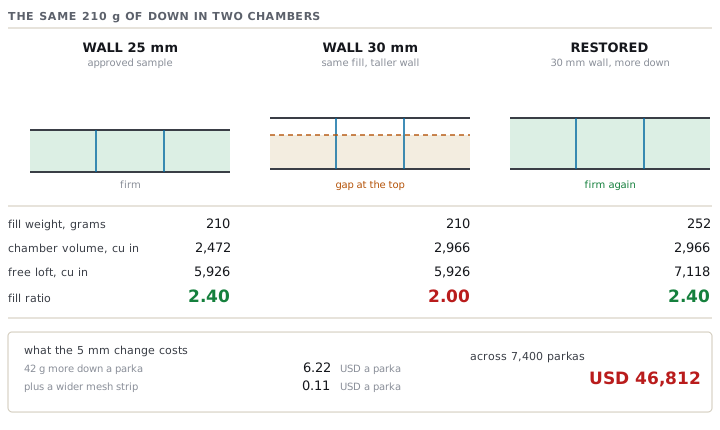
Lesson 1 established that KV-3620's 210 g of 800 fill-power down occupies 5,926 cubic inches when it is free to expand. A chamber does not give it that much room. Chamber volume is the insulated area multiplied by the wall height:
- At a 25 mm wall: 1.62 m² multiplied by 0.025 m is 0.0405 m³, which is 2,472 cubic inches.
- At a 30 mm wall: 2,966 cubic inches.
So the down in this parka is squeezed into somewhere between a half and a third of its free loft. The ratio between the two volumes is a real design quantity, even though no tech pack carries it. Call it the fill ratio for this lesson: free loft divided by chamber volume.
| Wall height | Chamber volume | Fill ratio | The chamber |
|---|---|---|---|
| 20 mm | 1,977 cubic inches | 3.00 | Hard, over-packed, the down is doing nothing for you |
| 25 mm | 2,472 cubic inches | 2.40 | Firm and full — the approved sample |
| 30 mm | 2,966 cubic inches | 2.00 | Soft, under-filled, the down can move |
| 40 mm | 3,954 cubic inches | 1.50 | Empty; cold gaps at the top of every chamber |
The fill ratio at a 20 mm wall is 5,926 divided by 1,977. Read the table as a spending guide. Below about 2.0 the chamber is not full. The down migrates inside it, and the garment develops the thin patches the chambers were built to prevent. Well above 2.4 you are paying for down that is squashed flat and returning nothing.
The mistake nobody made
11 March, fit sample review at Corrievreckan. The designer's comment, in full: "Reads flat against the competitor. Needs more presence through the body."
That is a correct observation, and it was correctly answered. Bo Ha's pattern room raised the baffle wall on the body from 25 mm to 30 mm. That is exactly the variable that sets how open a chamber stands. The change was drawn on the construction page, approved, and issued.
Nobody touched the fill page, and nobody was wrong not to. The warmth target had not changed. The fill weight was still 210 g. And no cost sheet line has "wall height" written on it.
The pre-production sample came back and read flatter than before. The chamber was 20% bigger and held the same down, so it was less full rather than more. The fill ratio had dropped from 2.40 to 2.00. The correct fix, correctly executed, produced the opposite of what it was for.
Putting it right is arithmetic, not opinion. To hold a fill ratio of 2.40 at a 30 mm wall you need a free loft of 2.40 multiplied by 2,966, which is 7,118 cubic inches. At 800 fill power that is 252 g, which is 42 g more down a parka.
- Down: 42 g at USD 148.00 a kilogram is USD 6.22 a parka. Across the order that is 310.8 kg and USD 45,998.
- Mesh: a 30 mm wall needs a 55 mm cut strip instead of 50 mm. So the mesh goes from 0.53 m² to 0.58 m², and USD 1.11 to USD 1.22. Across the order that is USD 814.
- USD 46,812 in total, from a five-millimetre change to a line on a drawing.
Course 16.6 makes the general point that a specification change re-opens every claim that was validated on the old specification. This is the material version of it. In this category a construction change is a bill of materials change, because the construction decides how much of the expensive material fits.
Down-proofness, and the stitch that leaks
A chamber only holds down if the cloth around it does. Down works its way through anything with an open enough structure, and out through every needle hole. That is why the shell and lining of a down garment are calendered — pressed flat and smooth between hot rollers to close the weave — or tightly constructed, and then tested for it.
Two decisions follow, and they pull against each other:
- Stitch density. More stitches per centimetre gives a stronger, neater chamber line, and more holes for down to escape through. Fewer stitches gives fewer holes, and a seam that grins open under load. Bo Ha runs the chamber lines at the density agreed on the approved sample. That density belongs in the specification, not in an operator's preference.
- Needle size. Use the finest needle that will carry the thread, always. A needle one size up is a measurably bigger hole, repeated along 9.4 m of chamber line. The leakage is not discovered until the garment has been worn and washed.
The construction of this parka helps here, and it is worth seeing why. KV-3620's waterproof shell is a separate outer layer from the down chambers, so the chamber stitching never pierces it. If it did, every chamber line would be a hole through the waterproof envelope and would need sealing. That is lesson 4's problem multiplied by 9.4 m a garment. It is a design decision made for waterproofing and paid for in labour, which is lesson 5.
Check yourselfA supplier offers to save you USD 2.50 a parka by moving from box wall to sewn-through, and points out that the garment will still hold its specified 210 g of down. Is that a saving?Show the answer
The down is unchanged and the garment is not. Sewn-through delivers that 210 g with 8.7% of the insulated surface at zero loft, in continuous lines, and no amount of fill corrects a stitch line. It also removes the wall height, which was the only control you had over the chamber. The fill ratio is now whatever the two cloths happen to allow. So the USD 2.50 is real, and it is the price of a different product. That product may be exactly the right one at a lower retail price. It is the wrong one to substitute into a garment whose sample was approved on box wall.
Prompt · Cost the fill, and check the chamber can hold it
Before you sign a down or synthetic-fill garment: when the tech pack gives a fill weight and a fill power but nothing that connects them to the chambers, the size range or the price.
Act as an outerwear technologist and costing engineer. Build me the fill file for one down garment. Order facts: buyer [BUYER], PO [NUMBER], style [STYLE], quantity [QTY], FOB [PRICE], ship [DATE]. Fill specification: [FILL POWER] fill power, composition [90/10 OR OTHER], [WEIGHT] g in size [SIZE], measured by [METHOD IF STATED]. Construction: [SEWN-THROUGH / KARO-STEP / BOX WALL], baffle wall height [MM], chamber count [N], chamber line length [M], insulated surface area [M2]. Size break: [LIST SIZE AND QUANTITY]. Down prices available to me, per kilogram: [LIST FILL POWER AND PRICE]. Do the following, showing every division. First, convert the specified fill weight and fill power into a total free loft volume, and restate that as the design target. Second, build a ladder of every fill power I listed at that same loft: weight needed, price per garment, finished garment weight. Third, compute the chamber volume from the wall height and the insulated area, and give the ratio of free loft to chamber volume; tell me whether the chamber is over-packed, firm, or under-filled, and what fill weight would restore a firm chamber if the wall height changed by plus or minus 5 mm. Fourth, grade the fill across my size break and give me the total kilograms the order really needs, against the naive figure of quantity multiplied by the size M fill, and name the difference in money. Fifth, add a process loss allowance and state the number you used. Sixth, write me the three questions I should put to the down supplier before I place the order. Do not give me a range where a number is possible, and list every assumption at the end.
AI can make mistakes — check anything you act on.
What to do on Monday
- Write the chamber volume next to the fill weight on the tech pack, so a wall change cannot be approved without seeing the fill it implies.
- Treat any construction change as a costing event. Wall height, chamber count and chamber line length all move the down bill.
- Ask which construction the sample was approved on, and refuse a substitution that keeps the fill weight and changes the chamber.
- Fix stitch density and needle size in the specification, not on the floor.