Lessons · Lesson 3 of 6
- 01 · The fabric is the product, and elastane is the expensive part of it
- 02 · Recovery: the number that was measured too early
- 03 · Seamless: the machine writes the size range
- 04 · Bonding, welding and taping: the seam that is not sewn
- 05 · Flatlock, coverstitch, and the comment that changed the size
- 06 · The claim, the colour and the customer in motion
Seamless: the machine writes the size range
Plan a seamless order on machine groups rather than on a marker, and tell a costly design change apart from an impossible one.
Lesson 3 of 6 · 18 min
The situation
18 January. The seamless top SL-140 goes into planning. Nurdan Aksu, who runs Serimen's seamless hall, comes back with three answers nobody expected:
- The order takes three days of knitting. One third of her machines will stand idle for half of it.
- The XXS size the designer added on Friday cannot be made in this building at any price.
- The contrast side stripe on the new sketch is not available on this class of machine. The version that is available is a different garment.
None of that is obstruction. All three come from one fact: a seamless garment is defined by the machine that makes it, before anybody draws anything.
What a seamless machine actually is
A seamless bodywear machine is a small circular knitting machine, run by computer. It knits a whole garment body as one tube. Rib, mesh, jacquard and elastic bands are built in as it goes. There is no fabric roll, no marker, no cutting room and no side seam.
Serimen's hall holds 22 machines. All are 32 gauge, and all have eight feeds. Gauge is how many needles sit in an inch of the cylinder; a feed is one point where yarn enters, so eight feeds knit eight rows per turn.
| Cylinder | Machines | Needles | Sizes it carries |
|---|---|---|---|
| 13 inch | 6 | 1,306 | XS, S |
| 15 inch | 10 | 1,508 | M, L |
| 17 inch | 6 | 1,709 | XL, XXL |
Gauge and diameter are fixed for the life of a machine. Course 2.2 makes the same point about a fabric machine. The needle count is the cylinder circumference times the gauge, rounded to what the grooves allow.
What changes here is the consequence. On a fabric machine a fixed cylinder gives you a fixed fabric width, and the marker then absorbs it. On a seamless machine it gives you a fixed garment girth, and there is no marker to absorb anything. Stitch length moves a size a little either way. Beyond that, a size is a different machine.
So the size range is a list of machine diameters, and the size ratio is a machine allocation.
The order, planned the way this category is planned
Tarnhow's ratio on 18,000 tops: XS 8%, S 22%, M 30%, L 24%, XL 12%, XXL 4%.
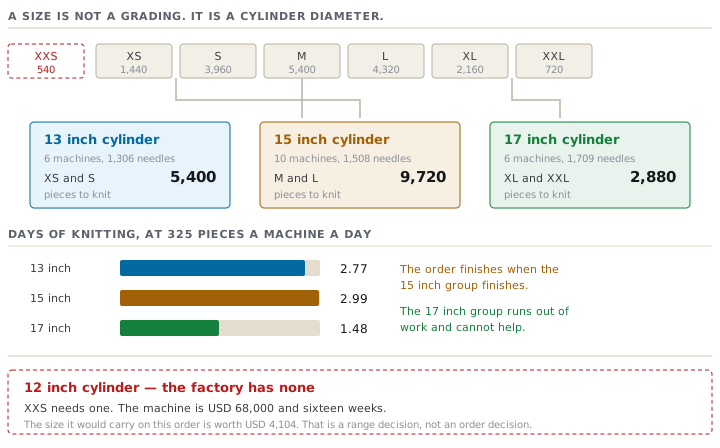
| Group | Pieces | Machines | Pieces a day | Days |
|---|---|---|---|---|
| 13 inch | 5,400 | 6 | 1,950 | 2.77 |
| 15 inch | 9,720 | 10 | 3,250 | 2.99 |
| 17 inch | 2,880 | 6 | 1,950 | 1.48 |
A blank — the knitted tube before it is dyed and finished — takes 3.4 minutes. At 20 running hours and 92% efficiency a machine makes 325 tops a day.
Read the last column. The order is finished when the 15 inch group finishes. The 17 inch group runs out of work on day one and a half, and it cannot help. There is nothing to rebalance. A 17 inch machine cannot make a size M, any more than a stenter — the machine that dries fabric and sets it to width — can sew a buttonhole.
That single table is the planning discipline of this category. A seamless factory's capacity is never one number. It is one number per cylinder diameter. A size ratio that suits one factory can be impossible in another factory with the same total machine count.
Note the inversion too. Course 2.2 says knitting is never the bottleneck and dyeing always is. That is true of fabric. One circular fabric machine, at 1.2 metres of tube a minute, makes about 3,000 tops' worth of jersey a day. One seamless machine makes 325. In seamless, knitting is the bottleneck — by roughly a factor of nine. That is why the whole category runs on booked machine time rather than on fabric lead time.
The size that is a capital purchase
The XXS the designer added needs a relaxed body girth of about 76 cm. The 13 inch cylinder, at its tightest usable stitch, stops at about 82 cm. There is no 12 inch machine in the hall. Four options, priced:
| Option | Cost | Time | What it really means |
|---|---|---|---|
| Buy a 12 inch machine | USD 68,000 | 16 weeks | Misses the ship date; a range decision, not an order decision |
| Subcontract to a unit with 12 inch machines | quoted per piece | 3 weeks | A different machine, a different dye vessel, a visible shade and hand difference on one rail |
| Force it out of the 13 inch on stitch length alone | nothing | none | Fabric drops to 172 gsm from 190; opacity and hand change, so XXS becomes a different product |
| Drop the size | nothing | none | Loses the size |
XXS was forecast at 3% of the range. That is 540 pieces and USD 4,104 of order value, against a USD 68,000 machine. Tarnhow dropped it. They put it into next season's range plan as a machine investment, to be argued on the whole range rather than on one order.
That is the shape of the answer you want to be able to give. Not "we can't", which is the answer that gets escalated, but "here is the machine, here is its price, here is what it would carry, and here is who should decide." Course 21.3 on hosiery meets the same wall in a different room. The mechanism is identical.
Costly, and impossible, are different answers
The designer's revision asks for two things: a 6 cm contrast stripe in Quartz running down the side of a Peat body, and a hem 6 cm wider than the body.
The stripe is costly. On a circular machine a yarn has three options. It knits all the way round, it floats behind the fabric, or it is swapped face-to-back by plating — two yarns fed together, one showing on the front. A float 40 cm long across the front is not a fabric. And intarsia — an isolated block of colour with nothing behind it — does not exist on this class of machine.
Reverse plating will give you the zone. But both yarns then have to be in the cloth everywhere. Body weight goes from 190 gsm to 262. Yarn in the garment goes from 125.5 g to 173 g. Yarn cost goes from USD 0.719 to USD 0.991 — USD 0.27 a piece, USD 4,860 over the order — on a top sold as the lightest thing in the range.
The flared hem is impossible. Maximum girth is the needle count times the longest usable loop. You cannot add needles to a running cylinder. On the 15 inch machine, the widest the fabric goes before it drops below the opacity floor is about 2.4 cm. A flare, a peplum or an A-line body is not a seamless product, and no budget changes that.
Costing it, and the comparison that fools people
Serimen priced SL-140 both ways:
| Seamless | Cut and sew | |
|---|---|---|
| Yarn or fabric into the garment | 0.719 | 2.003 |
| Knitting | 0.363 | in the fabric price |
| Garment dye and finish | 0.720 | in the fabric price |
| Cutting | none | 0.090 |
| Closing, neck, hems, labels or full assembly | 0.347 | 0.880 |
| Total, USD a piece | 2.149 | 2.973 |
Seamless saves USD 0.824 a piece, USD 14,832 over 18,000. Now look at the trap in the top row. The seamless route buys yarn at USD 5.73 a kilogram. The cut-and-sew route buys fabric at USD 14.60. The yarn is 60.8% cheaper per kilogram, and the finished garment is only 27.7% cheaper. Knitting, dyeing and finishing have not disappeared. They have moved out of the mill's price and into the factory's own conversion cost. Two quotations on different bases are not two prices. Course 8.2 gives the same warning about yarn.
Two minimums decide whether the saving is available at all:
- Set-up. Programming and machine trials cost USD 1,850, plus 220 trial pieces scrapped: USD 2,323, against USD 640 for a pattern, a grading and a marker. On a per-piece saving of USD 0.824 the break-even is about 2,042 pieces. Below roughly two thousand a style, seamless is the dearer route.
- The dye vessel. Blanks are garment-dyed in a 60 kg vessel. At 0.125 kg a blank, that is 480 pieces to a colour, and a colour below 480 pays for a full vessel anyway. The binding minimum in this category is usually not the machine. It is the dye pot.
Check yourselfA buyer wants a seamless style in six colours, 900 pieces each, 5,400 in total. What do you tell them?Show the answer
That the total is comfortable and the colour count is the problem. Each colour is a separate 480-piece dye vessel, so 900 pieces is two vessels, the second one part-full — six times over. And at 900 pieces a colour, the USD 1,850 set-up is spread thinly, even though the programme is the same for all six. Give them the arithmetic and two alternatives: the same 5,400 in three colours, or the same six colours with the minimum raised to a full vessel each. Do not simply quote a higher price. A buyer cannot act on a price whose cause is not named.
Prompt · Decide seamless against cut and sew on one style
When a buyer asks for a seamless version of a style, or when a factory offers one, and before anybody quotes a price.
Act as a planning manager in a factory that runs both a seamless hall and cut-and-sew lines, and has no commercial interest in either answer. I need the route decided on numbers. Style facts: [STYLE], [QTY] pieces, [COLOURS] colours and the quantity in each, size range [LIST], size ratio [PERCENTAGES], target FOB price [PRICE], required ex-factory date [DATE]. Seamless hall: machines by cylinder diameter and gauge [LIST], feeds per machine [NUMBER], cycle time per blank [MINUTES], running hours a day [NUMBER], efficiency [PERCENT], programming and trial cost per style [AMOUNT], trial pieces scrapped [NUMBER], garment-dye vessel capacity [KG] and blank weight [KG]. Yarn price [AMOUNT] per kg and yarn into the garment [GRAMS]. Cut-and-sew route: fabric price [AMOUNT] per kg, fabric into the garment [GRAMS] including cutting loss, SMV [MINUTES], loaded minute rate [AMOUNT], pattern and marker set-up [AMOUNT]. Do the following. First, map every size to a cylinder diameter and tell me which sizes have no machine at all. Second, split the order into machine groups. Give me pieces, machines, output a day and days for each group, and name which group finishes first and cannot help. Third, cost both routes per piece to a sewn and dyed garment, on a comparable basis, and warn me explicitly where a yarn price is being compared with a fabric price. Fourth, give me the break-even quantity at which seamless stops being cheaper, and the minimum the dye vessel imposes per colour. Fifth, tell me which of the buyer's design features are free, which are costly and which are not available at any price on this machine class, with a price on the middle group. Sixth, say which route you would run, and what would change your answer. Ask me for any input you need rather than assuming it.
AI can make mistakes — check anything you act on.