Lessons · Lesson 1 of 6
- 01 · The fabric is the product, and elastane is the expensive part of it
- 02 · Recovery: the number that was measured too early
- 03 · Seamless: the machine writes the size range
- 04 · Bonding, welding and taping: the seam that is not sewn
- 05 · Flatlock, coverstitch, and the comment that changed the size
- 06 · The claim, the colour and the customer in motion
The fabric is the product, and elastane is the expensive part of it
Read a stretch fabric the way the mill prices it, and see why cutting elastane content can make a garment cost more.
Lesson 1 of 6 · 20 min
The situation
11 January, 09:40, Adana. Purchase order TA-5140 from Tarnhow Athletic, a British performance brand, is confirmed at Serimen Performance. Two styles:
- TG-620, a women's training tight, cut and sewn, 24,000 pieces, FOB USD 9.90, order value USD 237,600. FOB means the price with the goods loaded at the port, before freight.
- SL-140, a women's seamless long-sleeve training top, 18,000 pieces, FOB USD 7.60, order value USD 136,800.
Total USD 374,400. The goods leave the factory on 24 April.
At 09:40 the brand's sourcing manager sends one line: "Can we take the elastane in TG-620 from 22% down to 16%? Elastane is the expensive fibre, so it should save us something."
Every word of that sentence is true. The conclusion is wrong. This lesson is the arithmetic that shows why.
Where the money sits in this category
The tight's fabric line reads: 78% recycled polyamide 6.6 / 22% elastane, warp-knit tricot, 250 gsm, 152 cm finished. Warp knitting feeds many yarns down the length of the cloth at once; gsm is grams per square metre, the fabric weight.
Baran Warp Knit quotes USD 16.82 a kilogram. Asked for the build-up, the mill opens it:
| Line | USD per kg |
|---|---|
| Recycled polyamide 6.6 textured yarn, 78% at USD 5.20 | 4.06 |
| Elastane 40 denier, 22% at USD 9.60 | 2.11 |
| Warp knitting | 2.30 |
| Scour, pre-set, dye, final set | 4.35 |
| Wicking finish | 0.55 |
| Relaxation, inspection, testing | 0.40 |
| Mill overhead and margin | 3.05 |
| Delivered | 16.82 |
A size M tight holds 0.2125 kg of fabric. Cutting loss is 13.3%, so it consumes 0.245 kg. That makes the fabric USD 4.12 a garment. Now build the rest:
| Line | USD | Share of FOB |
|---|---|---|
| Fabric | 4.12 | 41.6% |
| Trims: waistband tape, bonding film, drawcord, labels, packing | 1.35 | 13.6% |
| Materials subtotal | 5.47 | 55.3% |
| Cutting, sewing and bonding | 2.05 | 20.7% |
| Finishing, pressing, packing | 0.48 | 4.8% |
| Testing and approvals, spread over the order | 0.35 | 3.5% |
| Factory overhead and margin | 1.55 | 15.7% |
| FOB | 9.90 |
Read the two shares against each other. Materials are 55.3% of this price. Making is 20.7%. On a cotton jersey tee those two numbers are much closer together. That is why a merchandiser trained on knitted tops reaches for the sewing minute first when a price has to move. Here, one point off the making cost is worth a fifth of one point off the fabric. Course 8.1 builds the cost sheet itself. The point for this category is which line on it carries the weight.
Elastane is a small share of the weight and a third of the yarn bill
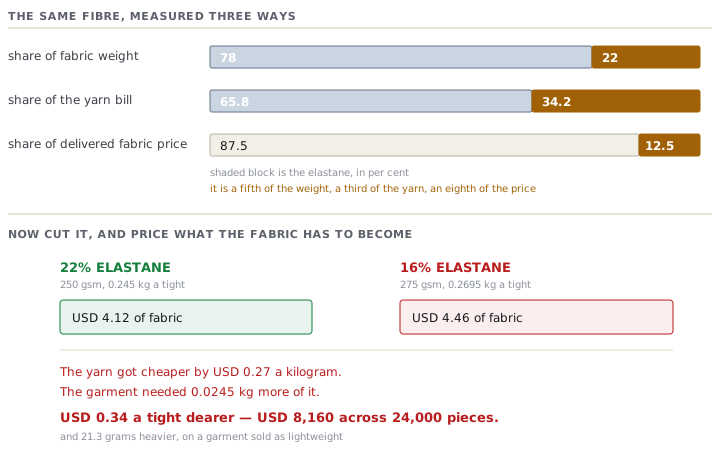
Take the two yarn lines on their own. The polyamide is USD 4.06 and the elastane USD 2.11. So the yarn costs USD 6.17 a kilogram, and elastane, at 22% of the weight, is 34.2% of it. Across the whole delivered price it is 12.5%. In the garment it is USD 0.52, which is 5.2% of FOB.
So the sourcing manager is right that elastane is the expensive fibre. Now do the substitution properly.
Drop the content to 16% and the yarn falls to USD 5.90 a kilogram, a saving of USD 0.27. The fabric falls to USD 16.55. That is the whole of the saving, and it is real.
Then ask the mill the second question, the one nobody asks: what does the fabric have to become to do the same job? Baran's answer: to pull back with the same force and stay as opaque in a squat, the base weight has to rise from 250 gsm to 275. Consumption goes from 0.245 kg to 0.2695 kg.
| 22% elastane, 250 gsm | 16% elastane, 275 gsm | |
|---|---|---|
| Yarn, USD per kg | 6.17 | 5.90 |
| Delivered fabric, USD per kg | 16.82 | 16.55 |
| Consumption, kg per tight | 0.245 | 0.2695 |
| Fabric, USD per tight | 4.12 | 4.46 |
| Fabric in the finished garment, grams | 212.5 | 233.8 |
The cheaper fabric costs USD 0.34 more a tight — USD 8,160 across 24,000 pieces. It also adds 21.3 grams to a garment sold under the word lightweight. The saving was real, and it was applied to the wrong unit: the price per kilogram fell, and the number of kilograms rose by more.
The number the tech pack does not carry
Here is what separates this category from every other one. On a cotton poplin, the fibre content line is a fair description of the cloth. On an elastic fabric it is not. What a wearer actually feels is not how much elastane is in there. It is how hard the cloth pulls back. Three things set that, and the content line mentions none of them:
- The denier of the elastane. Denier measures how thick a filament is; a higher number is a thicker filament. A 40 denier filament and a 20 denier filament at the same percentage of the weight are a different number of filaments doing different work.
- The draft ratio at which it was fed. Elastane is stretched as it enters the machine, usually to three or four times its relaxed length. Feed the same yarn at a higher draft and less of it ends up in the cloth by weight, but each filament works harder.
- The loop or runner length. This is how much yarn goes into each loop. The same slack-off that moves a jersey's weight, which course 2.2 works through on a circular knit, moves an elastic fabric's power at the same time.
Baran ran two rolls off the same beam within a week of each other. Both were correctly labelled 78/22. Measured on a 50 mm strip at 40% extension, one pulled back at 8.4 N and the other at 5.6 N. N is newtons, the unit of force. Both are the fabric you bought. One of them is a training tight and the other is a pair of pyjamas.
The instruction that follows is short, and it belongs in every activewear tech pack you write:
Retractive force at 40% extension, 50 mm strip: 7.5 to 9.5 N. Elastane 40 denier. Fabric weight 250 gsm plus or minus 5%.
Three lines. The first is the property. The second and third are the recipe. A tech pack carrying only "78% polyamide, 22% elastane" has specified a shopping list, not a fabric. Every argument you will have about this order in April traces back to that.
Bare and covered, and why it changes the bill
One more thing to read on a quotation. Elastane reaches a knitting machine in two ways.
Bare. The naked filament is fed in beside the ground yarn and trapped by the loop. It is the cheapest and the lightest. The elastane sits partly on the surface, where a shoe, a saddle or a gym bench will rub it away, and where it meets whatever the wearer puts on their skin.
Covered. The filament is wrapped in a fine polyamide or polyester yarn, single or double covered, or tangled together with a jet of air. The wrap protects it and makes it easier to knit and to dye. It also adds cost: covering is a separate process, and a covered yarn usually costs a third to a half more per kilogram than the bare filament plus its wrap yarn.
TG-620 is a bare-fed warp knit. That is normal for a tricot tight, and it is one reason the seat is where it will fail. The seamless top SL-140 uses covered elastane, because a seamless machine handles a covered yarn far more forgivingly at 32 gauge. Two garments on one purchase order, two constructions of the same fibre, two different prices per kilogram. A merchandiser who compares those two prices without asking which is which will draw exactly the wrong conclusion.
Check yourselfA supplier offers you the identical fabric specification at USD 15.40 a kilogram against your current USD 16.82. What do you ask for before you compare them?Show the answer
The retractive force at a stated extension, on a stated strip width, and the elastane denier. A content percentage and a weight do not pin the fabric down, so two quotations against the same content line are not two prices for the same thing. It is the same trap course 8.2 sets out for yarn. Ask also what the base weight and the runner length are, and whether the elastane is bare or covered. If the answer to any of it is "same as your current supplier", you have been quoted a price for a fabric nobody has specified.
Prompt · Write a stretch fabric specification that can actually be bought
Before you approve any elastic fabric, and the moment a buyer asks to change the elastane content to save money.
Act as a technical manager at a knitted activewear factory who has been burned by content-only fabric specifications. I need a buyable specification, and an honest answer on a content change. Facts: buyer [BUYER], style [STYLE], garment type [TYPE], quantity [QTY], FOB price [PRICE]. Current fabric line as written in the tech pack: [PASTE IT EXACTLY]. Mill quotation [AMOUNT] per kilogram. Yarn prices if known: base yarn [AMOUNT] per kg, elastane [AMOUNT] per kg, elastane denier [NUMBER], bare or covered [WHICH]. Net fabric in the garment [GRAMS] and cutting loss [PERCENT]. The buyer has asked to change elastane content from [PERCENT] to [PERCENT]. Do the following. First, tell me everything the current fabric line does NOT specify, and for each gap say what could legitimately arrive that would still meet the line as written. Second, write me a replacement fabric line that pins the fabric down. Include retractive force at a stated extension on a stated strip width, elastane denier, whether it is bare or covered, base weight with a tolerance, and the wash-cycle counts at which each property is to be reported. Third, cost the content change properly: ask the mill what base weight is needed to hold the same retractive force and opacity, recompute consumption in kilograms per garment, and give me the cost per garment BOTH ways and the difference across the order. State plainly whether the change saves money. Fourth, tell me what the change does to garment weight in grams, and whether that conflicts with anything on the hangtag. Fifth, list what I must ask the mill before agreeing, as questions I can paste into one email. Do not give me a range where a number is possible, and name every assumption in a list at the end.
AI can make mistakes — check anything you act on.