Lessons · Lesson 2 of 6
- 01 · The fabric is the product, and elastane is the expensive part of it
- 02 · Recovery: the number that was measured too early
- 03 · Seamless: the machine writes the size range
- 04 · Bonding, welding and taping: the seam that is not sewn
- 05 · Flatlock, coverstitch, and the comment that changed the size
- 06 · The claim, the colour and the customer in motion
Recovery: the number that was measured too early
Tell three different failures apart when they share one word, and put the long wash test in the month where it still costs nothing.
Lesson 2 of 6 · 19 min
The situation
The following February, thirteen months after the order was raised, Rhiannon Fenwick at Tarnhow forwards a customer-service summary and a photograph. TG-620 tights, bought in April, worn since. The knees stand out from the leg. The waistband sits lower than it did. Nobody says the garment tore, shrank or faded. They say it went slack.
Serimen's technical manager, Okan Demiray, pulls the file. Every test on it passed.
| Property | Limit | Result | |
|---|---|---|---|
| Growth, 30 minutes at 50% extension | 5.0% maximum | 3.4% | pass |
| Dimensional change, length | 3.0% maximum | 1.8% | pass |
| Dimensional change, width | 3.0% maximum | 1.1% | pass |
| Retractive force, 40% extension, 50 mm strip | 7.5 to 9.5 N | 8.4 N | pass |
The laboratory was right. The mill was right. The buyer's standard was applied exactly as written. And the garment failed anyway. This lesson is why, and it is the most useful thing in the course to carry into other categories.
Three failures wearing one word
Start by separating what a customer, a lab and a mill all call "stretch problems". They are three different measurements, and they point in three different directions.
- Dimensional change. The garment gets smaller after washing. This is leftover shrinkage. Every category has it, and course 2.2 covers it on knits.
- Growth. The garment gets bigger and stays bigger, because after being stretched it did not come all the way back. It is measured as a percentage of the original marked length, after a stated stretch and a stated resting time.
- Power loss. The garment is exactly the right size and pulls back with less force than it did. Nothing about it is out of measurement. It simply stopped holding.
A tight can shrink 1.8%, grow 8.9% and lose over a third of its power, all at once, all on the same garment. On a cotton tee only the first of the three exists. That is why a merchandiser who came up through knitted tops has one word for a three-part problem.
The test that was run, and the test that mattered
Tarnhow's standard names one wash cycle. Okan sent the retained bulk fabric back to the laboratory in February and asked for the same two tests at 1, 5, 10 and 20 cycles.
| Wash cycles | Growth | Retractive force |
|---|---|---|
| 1 | 3.4% | 8.4 N |
| 5 | 4.6% | 7.6 N |
| 10 | 6.1% | 6.5 N |
| 20 | 8.9% | 5.3 N |
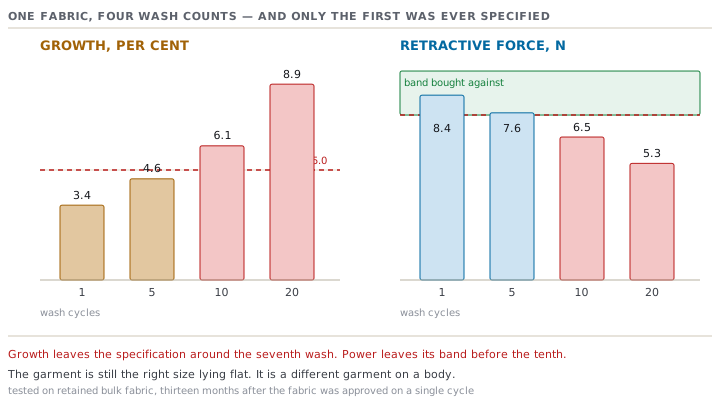
Growth crosses the 5.0% limit somewhere around the seventh wash. A customer who trains twice a week and washes after every session is outside the specification inside a month.
The force number is worse, because nobody looks at it. At 20 cycles the fabric pulls back at 5.3 N. That is 36.9% below where it started, and 29.3% below the bottom of the band it was bought against. The tight is still the right size lying on a table. It is not the same garment on a body.
Why elastane ages, and what the wearer does to it
Elastane is not a textile fibre in the way cotton or polyamide is. It is a polyurethane, chemically much nearer a foam or a paint binder, and it fails chemically rather than mechanically:
- Hydrolysis. Hot water and heat break the chain apart. A 60 degree wash and a hot tumble dry are the two most destructive things a garment meets, and it meets them weekly.
- Chlorine. Free chlorine in pool water attacks it directly. Chlorine-resistant elastane grades exist and cost more. A training tight is not usually specified with one, and this is where course 21.6 on swimwear picks the subject up.
- Oils and cosmetics. Body oils, sunscreens and insect repellents swell the polyurethane and soften it. No standard test package looks for this.
- Heat in processing. A fabric that was set too hot at the mill arrives already partly aged, and its one-cycle test still passes.
That last one is not theoretical here. Of the four bulk fabric batches, batches 3 and 4 were final-set at 190 degrees Celsius instead of 175, to pull the width back to 152 cm after a slack delivery. That was a correct, documented, signed corrective action, and it fixed the defect it was raised against. Retested at 20 cycles, those two batches grew 11.2% against 8.9% for the first two. The fabric that was corrected to pass its width specification is the fabric that aged fastest, and neither test in the standard could see it.
The fix is a date, not a laboratory
Nothing about the twenty-cycle test is expensive or slow in itself. It is expensive and slow in February. Move it to the place in the calendar where five days are free, and the whole problem disappears.
Three fabric qualities across two colourways is six specimens at USD 180 each. That is USD 1,080 and five working days, booked in the development window in October, when the ship date was six months away.
Against that, what the missing test cost:
- A negotiated quality claim of USD 0.55 a unit on 24,000 tights: USD 13,200.
- The following season's repeat, 31,000 tights at USD 9.90, placed elsewhere: USD 306,900.
The claim alone is 12.2 times the cost of the test. With the repeat, 296 times.
So the rule to take away is a calendar rule, and it belongs on the critical path next to the fabric approval milestone:
Long-cycle wash testing is a development activity. Run it on development fabric, from the mill you intend to use, in the construction you intend to buy, before the fabric is approved. Bulk testing at pre-production confirms that bulk matches what was approved. It can never discover something the approval never looked for.
Course 6.3 covers the test package and its price. Course 7.1 covers the critical path. What this category adds is that its most important test is longer than the window normally left for testing, so it has to be moved rather than bought.
What to write into the standard
Two changes to Tarnhow's stretch-fabric standard, both one line:
- Growth and retractive force are reported at 1 and 20 cycles, not at one. The 1-cycle number stays, because it is the one you can run on bulk in a hurry and it catches a wrong batch.
- A floor on retractive force after 20 cycles. Tarnhow set 6.5 N against an as-received band of 7.5 to 9.5 N. That single number is what a customer means when they say the tight went slack, and until it is written down, nobody is testing it.
Check yourselfYour buyer's standard says 'dimensional change maximum 3%, washed to ISO 6330'. Is that a complete specification?Show the answer
No, and the gap is the number of cycles. ISO 6330 fixes the machine, the load, the detergent, the temperature and the drying method. It is a procedure other tests use to prepare specimens, and it sets no requirement at all. The cycle count and the acceptance limit are both the buyer's decision. If the standard does not state the cycle count, the laboratory chooses it, which usually means one. Ask for the cycle count in writing before you approve a fabric, and for a stretch fabric ask for a long-cycle result as well.