Lessons · Lesson 3 of 6
Bright at noon, invisible at midnight
Read a high-visibility garment as two materials doing two different jobs at two different times of day, and find which of the two is really setting the garment's life.
Lesson 3 of 6 · 19 min
The situation
7 May. Tunca's development meeting on the HV-620 jacket has been running for two hours, and every minute of it has been about the reflective tape. Two articles are on the table, one nearly twice the price of the other. The argument is well informed: someone has the wash-durability data, someone has the width and the seam allowance it forces, someone has the minimum order quantity.
Nobody in the room mentions the fluorescent cloth. It is the fabric. It has one line on the cost sheet, and it was settled in February.
By the end of this lesson you will know that the tape argument was about a component with eighteen points of headroom, and that the garment's whole service life was being set by the component nobody raised.
Two materials, and neither works at the other's time of day
A high-visibility garment is not one bright thing. It is two materials with different physics, doing different jobs, at different hours.
Fluorescent background material — the orange or yellow cloth — absorbs ultraviolet light (UV, the invisible light in sunlight) and short-wavelength visible light, then gives it back out at a longer wavelength. So it returns more visible light than falls on it. That is why a fluorescent orange looks impossibly bright next to an ordinary orange, and why no dye that only reflects can match it.
It needs UV to do this. There is almost no UV at night. At midnight a fluorescent jacket is an ordinary orange jacket.
Retroreflective material — the silver tape — is built from glass beads or tiny corner-shaped prisms. They send light back along the path it arrived on, towards its source. To a driver whose headlamps light the wearer, the tape is startlingly bright, because the driver's eye is a few centimetres from the lamp. To a bystander standing to one side of that car, the same tape is dull grey. And at noon, with light arriving from everywhere, retroreflection returns nothing anybody notices. At midday the tape does nothing.
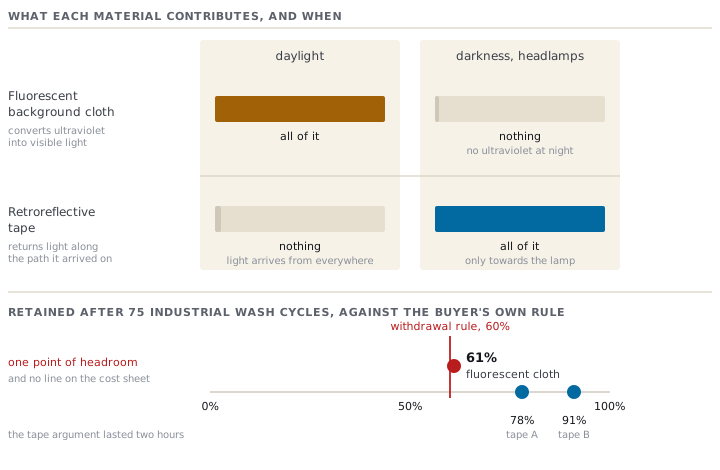
So the garment does two jobs with two components, and each one is completely idle while the other works. That has three consequences a merchandiser has to act on.
- A garment inspected in a lit sample room tells you almost nothing about either one. The fluorescence needs a light source with UV in it. The retroreflection needs a light beside your eye. Judge them with instruments, or with a torch held at your temple in a dark room. Never off a hanger.
- The two age at different speeds and in different ways. Fluorescence is destroyed by UV exposure and by laundry chemistry. Retroreflection is destroyed by rubbing, by the bond letting go, and by the beads filling with detergent residue.
- Whichever of the two dies first ends the garment's life, however healthy the other one is.
The shade rule inverts here
Course 3.3 sets out the discipline for colour approval: a sealed standard, a light box, named illuminants, a tolerance written as a colour difference. All of it is right. What changes in this category is the criterion it serves.
For high-visibility material, the requirement is not a match to a sealed swatch. It is a window. The material's colour and its luminance — how much light it gives back — have to fall inside a defined region, and the standard for high-visibility clothing sets that region. Inside the window is a pass. Outside is a fail. There is no sealed standard to match, because the point is not that the garment looks like a reference. The point is how it behaves in traffic.
Two consequences will feel wrong to anyone trained on retail shade discipline.
A defect here is a reject elsewhere. Torvale's first bulk delivery had a visible difference between the body cloth and the sleeve cloth on part of the run — two dye lots, plainly different in the light box. On a fashion order that is a rejection and a re-dye. Here both lots were measured, both were inside the window, and both were accepted. They are equally visible to a driver, and that is the only thing being bought.
A reject here is fine elsewhere. A later lot matched the reference swatch better than anything before it, and it was refused. Its luminance had come down, and it had drifted just outside the window. It was a beautiful match to the wrong thing.
The tape argument, priced
Back to the meeting. Torvale's contract sets its own field rule for withdrawal, and it is stated in the tender: a garment is withdrawn when either material falls below 60% of its as-new performance. That is Torvale's number, written by Torvale, not a threshold from any standard.
Tunca's laboratory has run both tape articles and the background cloth through the industrial-laundering procedure to 75 cycles.
| Component | Cost in the jacket | Retained at 75 cycles | Headroom over the rule |
|---|---|---|---|
| Reflective tape, article A | USD 6.08 | 78% | 18 points |
| Reflective tape, article B | USD 10.88 | 91% | 31 points |
| Fluorescent background cloth | inside the fabric line | 61% | 1 point |
The jacket carries 3.2 metres of tape, so the two articles work out at USD 1.90 and USD 3.40 a metre, and the choice is worth USD 4.80 a jacket — around USD 38,500 across the contract. It is a real argument, and the room was right to have it.
It is also an argument about a component that could lose eighteen more points and still pass. The garment's life is set by the background cloth, at one point of headroom. And the background cloth was never on the agenda, because it is not a component. It is the fabric.
What one point of headroom actually meant
Lesson 1 worked out that the bid stopped winning at 61.7 wash cycles, against a certified 75 — 13.3 cycles of commercial headroom.
Now put the two headrooms side by side. They are different things, and both are real. The commercial headroom says how far the life can fall before Torvale would have been better off with the cheaper jacket. The technical headroom says how close the binding component is to the rule that withdraws the garment. Tunca's bid had 17.7% of the first and one point of the second, and nobody had ever drawn them on the same page.
That is not a criticism of the bid. A cloth at 61% against a 60% rule passes, and a supplier may sell a garment that passes. It is a statement about where the risk sits: all of it was in one component, and that component had no owner. The tape had an owner, a price, a datasheet and two hours of meeting. The cloth had a fabric line.
Lesson 5 is what happened at Depot 4 in month nineteen.
Check yourselfA depot manager says the jackets 'still look fine' at two years and asks to extend the withdrawal date. What do you tell him, and what do you offer instead?Show the answer
Tell him that looking fine is exactly what a worn-out fluorescent garment does. The light it has stopped making is not a colour the eye can miss. The retroreflective tape is the one component he could partly judge by eye, with a torch held at his temple in the dark, and even that is a rough check. Then offer him something instead of a refusal: pull a small sample of garments at the wash count he is asking about, measure them, and extend or refuse on the measurement. If the cloth really is still above Torvale's own rule, he has won a real extension worth real money — and you have found out that the certified life is cautious, which is worth more than the extension.
What to take to your own order
- Treat a high-visibility garment as two products in one shell, and never judge either one by looking at it.
- Build the headroom table before the component meeting, sorted by distance from the limit, not by price.
- Say out loud which component is binding. If nobody in the room can name it, the meeting is about the wrong component.
- When a shade argument starts in this category, ask what the instrument said. If nobody measured it, there is nothing to argue about yet.