Lessons · Lesson 6 of 6
Three years at one price
Take a multi-year workwear contract's margin apart, from tender to year three, and write the four clauses that would have held it.
Lesson 6 of 6 · 18 min
The situation
Month thirty-two. Torvale's renewal tender will be published in eleven weeks. Tunca's finance director has asked one question: did we make money on the jacket?
The answer takes four lines and none of them is a mistake anybody made.
The bridge
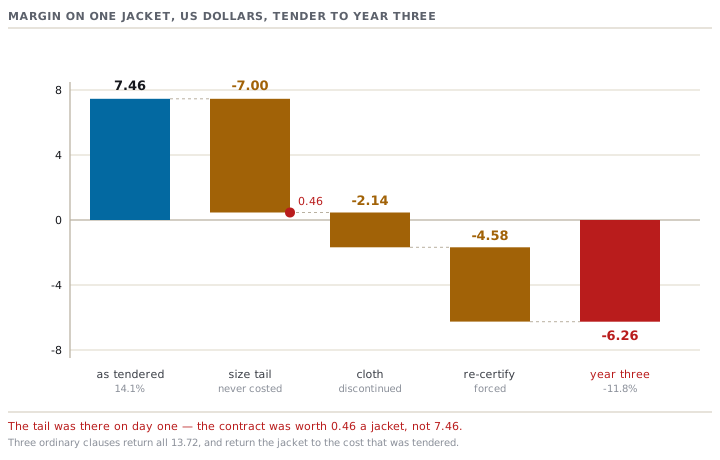
The jacket was tendered at USD 52.90 against a costed USD 45.44. That is a margin of USD 7.46 — 14.1%. It is a good number for a workwear contract, and it was signed off as one.
| Per jacket | Running cost | Margin | |
|---|---|---|---|
| As tendered | USD 45.44 | USD 7.46 | |
| The size tail nobody costed, from lesson 2 | USD 7.00 | USD 52.44 | USD 0.46 |
| The cloth substitution, from lesson 4 | USD 2.14 | USD 54.58 | minus USD 1.68 |
| Re-certification, spread over the jackets left | USD 4.58 | USD 59.16 | minus USD 6.26 |
From 14.1% to minus 11.8%, on a garment nobody changed and a price nobody moved.
Now read the three steps for what they are, because they are not the same kind of thing.
The tail was never an erosion. It was there from the first day. The correct statement is not that the contract lost USD 7.00 a jacket in year two. It is that the contract was never worth 14.1%. It was worth 0.9%, from the first day, and nobody knew.
The cloth and the certification were the contract working exactly as written. A mill discontinued an article. A certification body charged its fee. Neither party did anything wrong, and neither event could have been avoided. In a three-year fixed price, events of this kind are not risks. They are the near-certain consequence of the term.
That gives the lesson its real finding. The omission did not cause the loss. It removed the cushion that would have absorbed it. A jacket carrying 14.1% absorbs USD 2.14 of cloth and USD 4.58 of certification and still returns 1.4%. A jacket carrying 0.9% absorbs nothing at all. Two separate problems — a costing omission, and a three-year price with no protection — were each survivable, and were fatal together.
Four clauses, and one of them is not for you
Each step above has a clause that would have held it. Each clause is ordinary, cheap to ask for, and routinely granted when it is asked for at tender.
A materials index clause. The cloth price is reviewed every year against a published index, or against the mill's own published list, and movement is passed through both ways. Worth USD 2.14 a jacket. Buyers accept this far more readily than suppliers expect. A supplier who has to guess three years of fibre prices prices that guess into year one, and the buyer pays for it whether or not the movement happens.
A re-certification pass-through. Where a change to the certified product is forced — by a discontinued material, a revised standard, or the buyer's own specification change — the assessment cost is shared or recovered. Where the supplier chooses the change, the supplier pays. Worth USD 4.58 a jacket. Note how the clause is written: not "certification costs are recoverable", which no buyer signs, but a split based on who caused it, which looks fair and is therefore signable.
A size-mix line. The tail is priced as its own line instead of being buried in an average, and the mix is reviewed every year against the measured population. Worth USD 7.00 a jacket. This is the one a supplier is most reluctant to raise, because raising it means admitting you have a cost you did not know about. Raise it anyway. The alternative is carrying it silently for three years.
Add the three: USD 13.72 a jacket. That returns the year-three cost to USD 45.44 — the number that was tendered.
That is not a coincidence, and it is worth saying plainly. A clause of this kind does not create margin. It returns each risk to the party who can actually manage it — the mill's price to the mill, the certification to whoever forced it, the population to the buyer who employs it. A contract in which the supplier holds risks it cannot influence is not a hard bargain. It is a mispriced one, and it will be re-priced eventually, by somebody defaulting.
The fourth clause is Torvale's, not Tunca's.
Headcount is not the driver. Turnover is.
Torvale's field headcount was 4,180 in year one and 4,180 in year three. So its budget for the jacket line was flat, and it was wrong.
A leaver's protective garments are destroyed, not reissued. That is not squeamishness. You cannot work out the remaining certified life of a garment whose history you cannot prove, and a garment issued to a second person on an unknown wash count is a garment nobody can stand behind. So every leaver destroys a garment with about half its life left, on average, and every starter draws a new one.
| Year 1 | Year 3 | |
|---|---|---|
| Field headcount | 4,180 | 4,180 |
| Staff turnover | 9.4% | 14.1% |
| Leavers and starters | 393 | 589 |
| Jackets consumed by ordinary replacement | 2,675 | 2,675 |
| Jackets consumed by residual life destroyed at turnover | 196 | 295 |
| Jackets issued | 2,872 | 2,970 |
An extra 98 jackets a year, a rise of 3.4%, on a headcount that did not move. At USD 61.50 delivered and issued, that is USD 6,041 a year appearing in Torvale's spend against a flat budget. And every conversation about it started from the assumption that somebody was over-ordering.
It is a small number, and it is in the lesson for its shape rather than its size. What drives consumption in this category is not how many people there are. It is how many people change. A buyer who forecasts on headcount will be wrong every year that turnover moves, and will look for the error in the wrong place. That is why the fourth clause is a turnover band with a review, and why a supplier should offer it instead of quietly enjoying the volume.
The obligation that quietly holds the stock
One more line of the contract deserves its own number, because it is the one that turns a manufacturing business into a warehouse.
Torvale's tender requires a fitted set for a new starter within ten working days. With 589 starters a year, spread unpredictably across six depots, that promise cannot be kept from production. It is kept from stock, and the stock has to be held in the size matrix from lesson 2 — 24 jacket sizes in two colours, 48 jacket SKUs.
Held as if the sizes were interchangeable, six weeks of cover on 2,970 jackets a year is 343 jackets. Held as they really are, it is 686 — almost exactly double. Forty of the forty-eight sell so slowly that six weeks of cover does not add up to even one garment, so each of those is held at a practical floor of twelve instead.
The extra 343 jackets are USD 17,987 of working capital at made cost, and they exist for one reason: a size cannot be swapped for another size. Course 18.2 covers what a slow-moving unit does to replenishment stock in general. The workwear part is that the slow units are not a tail you can drop. They are somebody's size, and the contract promises them in ten days.
Check yourselfYour three-year contract has one year to run and you now know it is losing USD 6.26 a jacket. What do you do about the renewal tender?Show the answer
Bid it, and bid it with the corrected cost sheet. There are two temptations to resist. The first is to walk away. But you now hold something no other bidder has: a measured tail, a real wash-life history across six depots, and a certified construction that survived a substitution. That is worth more than the loss you are carrying. The second is to bid the same price and hope, which is how a supplier turns one bad contract into two. What you actually do is raise the price by the three clause values, offer all three clauses in the bid, and show the buyer the arithmetic — including the turnover clause, which is worth money to them. A buyer who is shown why a price moved from USD 52.90 usually accepts it. A buyer who is shown a new price with no explanation goes to the market.
What to take to your own contract
- Before signing a multi-year fixed price, ask which costs on your sheet you can influence and which you cannot. Every cost in the second list needs a clause or a premium. Nothing else is honest.
- Find the costs that are not on the sheet. A margin smaller than you think is what makes an ordinary cost movement fatal.
- Write a pass-through based on who caused the change, not on the type of cost. The first is signable and the second is not.
- Forecast issue volume on turnover, not headcount, and offer the buyer the clause that says so. Being the supplier who explains the buyer's own spend is worth more at renewal than the volume you gave up.