Lessons · Lesson 1 of 6
The tender, not the range
Sort a tender specification into the three kinds of requirement it really contains, and price the contract on whole life instead of on the garment.
Lesson 1 of 6 · 18 min
The situation
11 February. Torvale Power Networks is a regional electricity distribution operator with 4,180 field staff working out of six depots. It publishes a tender for a three-year contract covering workwear and personal protective equipment — PPE, the clothing and kit that protects a worker against a named hazard. There are four garment lines: a high-visibility arc-protective jacket, a matching trouser, a corporate polo shirt and a thermal base layer.
Tunca Protective Garments, a workwear and PPE maker in Adana, decides to bid. The merchandiser who picks up the file has spent nine years in womenswear. She has never seen a document like this one.
There is no range plan. No season, no drop, no markdown budget, no trend. There is a written specification, a contract, a fixed price for three years, and a duty to keep making the same garment, in the same sizes, for people who have not been hired yet.
And there is one sentence on page four that changes what kind of object is being sold:
The jacket shall protect the wearer against the thermal effects of an electric arc and shall be visible in road traffic conditions in daylight and in darkness.
Everything in this course follows from that sentence.
Three kinds of requirement, and only one of them is negotiable
A tender specification arrives as a flat list. It is not flat. Sort every line into one of three boxes before you price anything.
Certified. The protective performance. A garment sold as protection against a named hazard cannot go on sale until it has passed a conformity assessment — a formal check against the relevant standard. For the more serious hazards, that check is made by an independent third-party body, not by the maker. What comes out is a certificate. It describes one particular garment, made one particular way. You cannot negotiate this line. You cannot cut its cost. You cannot ship on a concession while somebody thinks about it. In womenswear a failed test is a commercial problem with a range of settlements. Here it is a garment that may not be sold.
Course 6.5 covers the only other place in this academy where a garment becomes a different legal object: children's wear, and the point where a buyer's approval stops protecting you. The standards are different. The mechanism is the same. Read it before you meet this.
Contracted. Durability, colour, corporate identity, delivery, the service level for a new starter, the price. This is where a bid is won and lost, and it holds almost all of the money.
Preference. Lines that look mandatory but are really the previous supplier's product description, copied forward because nobody re-wrote the specification. Torvale's file asks for a two-way zip with an internal storm flap and a chest pocket with pen divisions. None of that protects anybody. It is in the document because the current supplier's jacket has it.
Why this course names standards and refuses to quote their numbers
You will meet a few real instruments here: the European regulation that governs personal protective equipment, the high-visibility clothing standard, the standard family for clothing that protects against the heat of an electric arc, and the industrial-laundering procedures used to test workwear. They are named so that you know they exist and roughly what each one governs.
You will not find a class threshold, a minimum area, a test index or an edition year anywhere in these six lessons. That is deliberate. Standards get revised. A reader who copies a number out of a course into a specification has built a garment to whichever edition the course happened to know, and nobody notices until an inspection body reads the file. Where a lesson needs a figure, it is Torvale's own contract requirement, and the text says so. For the standard's numbers, buy the standard.
The bid is not priced per garment
Torvale publishes its evaluation model with the tender. That is normal in this category and rare everywhere else. The jacket line is scored on cost per person per year, not on the price of a jacket.
That is not a procurement flourish. It is arithmetic. Torvale does not buy jackets. It keeps 4,180 people equipped for three years. A jacket is withdrawn from service when it fails its annual inspection, or when it reaches the number of industrial wash cycles its certificate is held to — whichever comes first. Torvale states its own operating assumption in the tender: a field jacket goes to the laundry 48 times a year.
So the number that governs the whole line is not the price. It is the certified wash life.
| Halsbury Workwear, the current supplier | Tunca Protective Garments | |
|---|---|---|
| Jacket price | USD 41.20 | USD 52.90 |
| Certified industrial wash cycles | 50 | 75 |
| Wash cycles a year, per Torvale's model | 48 | 48 |
| Jackets per person per year | 0.96 | 0.64 |
| Garment cost per person-year | USD 39.55 | USD 33.86 |
| Issue, fitting and disposal, at USD 8.60 an issue | USD 8.26 | USD 5.50 |
| Cost per person-year | USD 47.81 | USD 39.36 |
Tunca's jacket is USD 11.70 dearer, which is 28.4% more. It wins the line by USD 8.45 per person per year. Across 4,180 people and three years — 12,540 person-years — that is USD 105,937.92, on one of four garment lines.
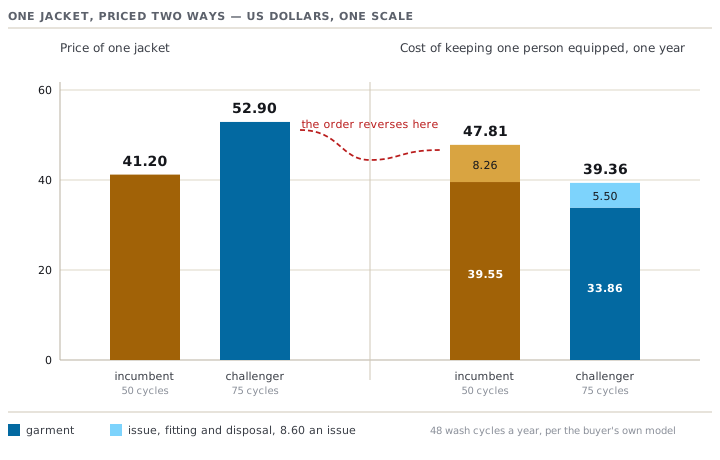
Read the middle row again. It is the whole lesson. The two bids differ by 25 wash cycles. Everything else in the table is arithmetic done on that one number.
The number the whole bid rests on is a claim
Here a merchandiser from a retail background should get uncomfortable, and should stay uncomfortable. The discomfort is correct.
The 75 is not a measurement of Torvale's jackets. It comes from a test on garments built to the certified construction, washed under a standard industrial procedure, in a laboratory, by people who followed that procedure. Torvale's jackets will be washed by an industrial laundry contractor across six depots, on equipment that contractor maintains, under a contract Tunca is not party to and cannot read.
Work out where the bid stops winning. Set Tunca's cost per person-year equal to Halsbury's and solve for the wash life. The answer is 61.7 cycles. Above that, the dearer jacket is the cheaper contract. Below it, Tunca has sold a more expensive garment that costs Torvale more money.
So the bid was won with 13.3 cycles of headroom — 17.7% of the certified life. Lesson 5 is about the month in year two when a repaired tunnel finisher at one depot took seventeen of them.
What the other three lines taught
The polo shirt is not protective equipment. It is a corporate-identity garment. It carries no certificate, and it is priced and made exactly as a retail polo is priced and made. Tunca's costing team, reasonably enough, gave it to the person with the least experience.
That was the only line Tunca lost, on price, by USD 0.34. It is worth noticing why. On a garment with no certified performance there is nothing to trade except cost, so the whole-life model collapses back into a unit price and the cheapest maker wins. The certified lines are the ones where a good supplier can be worth more than a cheap one. That is the commercial shape of this category, and it is the opposite of the instinct that says the technical lines are the risky ones to bid.
Prompt · Sort the tender, then price it on whole life
The morning a workwear or PPE tender lands and somebody asks for a price by Friday.
Act as a workwear and PPE contracts manager who has bid and lost enough public tenders to be honest about them. I have a tender document and I need it turned into a bid, not a quotation. Buyer and end user: [BUYER], [NUMBER] staff, [WHAT THEY DO], sites [NUMBER]. Contract term [YEARS], price [FIXED OR INDEXED]. Garment lines: [LIST THEM]. Here is the specification, verbatim: [PASTE IT]. Here is the evaluation model if the tender publishes one: [PASTE OR SAY NONE]. My costs so far: [PASTE THE COST SHEET FOR EACH LINE]. Do the following, in order. First, sort every requirement line into three lists — CERTIFIED (protective performance that must be assessed against a standard before the garment may be sold), CONTRACTED (durability, colour, delivery, service level, anything I can negotiate) and PREFERENCE (lines that look mandatory and would fail no test if removed) — and for each preference line write the exact clarification question I should send before the deadline. Second, name every standard the certified lines invoke, say plainly which of them require a third party rather than my own declaration, and list what the certification will cost me in fees and in weeks. Do not quote me any class threshold, test index or edition year: name the standard and tell me to read the current edition. Third, build the whole-life cost per person per year for each line: garment price, expected service life in the unit the buyer actually uses (wash cycles, months, or issues), issue and fitting cost, and disposal. Fourth, find the single claim the whole-life arithmetic depends on most, and work out the value at which my bid stops being the cheapest. That is my headroom, and I want it as a number. Fifth, tell me which costs are NOT on my sheet: the sizes outside my standard matrix, the stock I must hold to meet the service level, the re-certification I will face if a material is discontinued during the term. Sixth, list the contract clauses I should ask for, with the value of each in money per garment. Show every calculation and name every assumption in a list at the end. Where a figure should come from the buyer rather than from you, say so and write me the question.
AI can make mistakes — check anything you act on.
Check yourselfA tender specifies a hi-vis jacket and lists, among thirty lines, a mandatory internal storm flap. Which box does it go in, and what do you do?Show the answer
Preference, almost certainly. A storm flap keeps weather out; it does not keep an arc off a wearer. Removing it fails no test. So it goes in box three, and it goes into your clarification questions before the deadline, in writing. Two things follow. First, if Torvale confirms it is a preference, you may price it out, and that is real money on 8,000 garments. Second, if Torvale insists, it has now been confirmed in writing as a contract requirement rather than a certified one, so a later problem with it is a commercial conversation and not a conformity one. The sorting is worth doing even when the answer is no, because the answer itself changes which kind of problem you have later.
What to take to your own tender
- Sort every line into certified, contracted or preference before you put a number anywhere.
- Find the evaluation model. If it is published, price against it. If it is not, ask. If the buyer will not say, build the whole-life number yourself and put it in your covering letter.
- Find the single claim the whole-life arithmetic rests on — here, the wash life — and work out the value at which your bid stops winning. That gap is your headroom, and it is the number you defend for three years.
- Do not give the uncertified line to your least experienced coster. It is the line with no defence.