Lessons · Lesson 3 of 3
Reading without looking
Measure a read rate on your own racking, work out what it does to a count and to a check at the door, then decide what a store this size should buy at all and in what order.
Lesson 3 of 3 · 40 min
What a radio tag changes
A barcode has to be seen to be read. Somebody points a scanner at a label, one label at a time. A radio tag does not need to be seen, and a reader can hear many of them at once. RFID is the trade name for this: radio frequency identification.
That changes what a count costs. And a count that costs almost nothing can be run almost as often as you like. This lesson asks what the cheap count is really worth.
Tafoukt's finished goods sit at the far end of the same shed as the raw material. On the day Naima Mekouar ran the trial there were 1,290 cartons on the floor, packed 24 garments to a carton, so 30,960 garments. The factory ships 1,152,000 garments a year, which at the same pack ratio is 48,000 cartons. Finished goods are carried at EUR 6.18 a garment. Carried at means the value the books hold them at. That is Tafoukt's own factory cost, and it is the rate any write-off is posted at.
Three ways to count the same goods
Naima timed all three on the same stock, on the same afternoon. A sweep is one walk of the aisles with a radio reader switched on.
| Method | What it actually counts | Time | Cost of one count |
|---|---|---|---|
| Count the cartons where they stand | Cartons | 19.35 h | 66.18 |
| Open every carton and count inside | Garments | 137.60 h | 470.59 |
| Walk the aisles with a radio reader | Garments | 2.60 h | 8.89 |
The middle row is the one that matters. A carton count tells you how many cartons there are. A carton that is one blouse short looks exactly like a full one, and it goes on looking like a full one until a buyer opens it. Only the garment count answers the question the buyer will ask.
garment count / radio sweep = 470.59 / 8.89 = 52.93
carton  count / radio sweep =  66.18 / 8.89 =  7.44
A radio sweep makes an item-level count 52.93 times cheaper. That is the whole commercial case for the technology in one number, and it is a real number rather than a brochure one.
Now spend it. At EUR 8.89 a sweep the store could count twenty times as often as it does today.
240 sweeps a year     240 x 8.89 = 2,133.60
12 carton counts       12 x 66.18 =   794.16
difference                          1,339.44
Course 23.4 worked out how often to count from a store's own rate of errors arriving, and it stopped where counting capacity ran out. A sweep of 2.6 hours very nearly removes that limit. Nearly. There is a number underneath it, and it is not in the quotation.
The number nobody quotes
A read rate is the share of the tags actually present that the reader hears. It is never all of them. It is almost never in the offer, and a vendor who is asked for one will quote a laboratory figure.
Naima measured her own. The finished-goods zone was counted by hand first, carton by carton, every carton opened, so the true figure was known: 30,960 garments. Then the sweep.
| What the sweep did | Tags |
|---|---|
| Tags heard in total | 29,965 |
| Of those, garments standing in despatch staging, outside the zone | 11 |
| Genuine reads inside the zone | 29,954 |
| Garments present in the zone and never heard | 1,006 |
| Read rate | 96.75% |
Now post that sweep to the book, which is what a system will offer to do for you.
garments the sweep says are missing   1,006
at EUR 6.18 each                      6,217.08 in one sweep
posted every month                   74,604.96 a year
garments written off in a year        12,072
Every one of those garments is on the shelf. A store that ran the cheap count monthly and believed it would write off nearly seventy-five thousand euros a year of stock it owns. Course 23.4 spent a lesson on adjusting a record to match your own noise. This is that lesson with a radio attached.
The eleven stray reads point the other way and are smaller, but they are the more dangerous kind. A missed tag says stock is absent when it is present, and the store goes and looks for it. A stray read says stock is present when it is somewhere else, and nobody looks for anything.
The same garments, every time
A read rate of 96.75% sounds like noise, and noise averages out over repeated counts. Naima tested that rather than assuming it. Four weeks later she swept the same zone again and kept both lists of missing garments.
sweep one missed                              1,006
sweep two missed                              1,043
garments missing from BOTH lists                604
if the misses were independent, expected      1,006 x 1,043 / 30,960 = 33.89
observed / expected                           604 / 33.89 = 17.82
The overlap is 17.82 times what independence predicts, and 60.0% of the first sweep's misses repeat. These are not random failures. They are a property of particular places in the building.
So Naima went and looked at them. The 604 were in the bottom cartons of pallets stacked two deep against the north wall. The tag faces into the stack, and a steel upright sits between it and the aisle. Nothing about that is a fault in the reader.
That also spoils the obvious workaround. If the sweep cannot be trusted as a level, use it to detect change instead: compare this sweep against the last one rather than against the book.
missed in sweep one, heard in sweep two   1,006 - 604 = 402
heard in sweep one, missed in sweep two   1,043 - 604 = 439
movement that is not movement                           841
Eight hundred and forty-one garments appear to move between two sweeps in which nothing moved. The change is noisy too.
What the read rate is genuinely good for at Tafoukt is a map of where its own store blocks a radio. That is worth having. The fix it points to is a putaway rule about which way a tag faces and what may stand two deep. It is not a fix you buy.
A pallet at the door
Counting is the friendly use. The one everybody actually wants is a check at the despatch door: drive the pallet through a gate, and let the gate say whether the load matches the packing list. Tafoukt ships on pallets of 40 cartons, so 960 garments.
expected unread item tags on a pallet   960 x 0.0325 = 31.2
chance the pallet reads clean           0.9675 ^ 960 = 0.0000000000000168
expected unread carton tags             40 x 0.0325 = 1.30
chance the pallet reads clean           0.9675 ^ 40  = 0.2667
At item level every single pallet reads short by about thirty-one garments. So the gate cries wolf on every load and is switched off inside a week. At carton level three pallets in four are still flagged. Neither is usable.
Turn it round and ask what read rate the gate would need for nineteen pallets in twenty to pass clean.
| Tagging level | Tags on one pallet | Read rate needed | Miss rate it allows |
|---|---|---|---|
| Item | 960 | 99.9947% | 0.0000534 |
| Carton | 40 | 99.8718% | 0.0012815 |
The carton scheme tolerates 24.0 times more missed reads than the item scheme, for the same result at the door. That is the strongest argument in this lesson for tagging the box rather than the blouse, and it has nothing to do with the price of a tag.
What the programme costs
Tafoukt holds two quotations, for the same three benefits at two levels of tagging.
| Annual cost | Tag on every garment | Tag on every carton |
|---|---|---|
| Tags | 66,816.00 | 3,408.00 |
| Encoding labour at the bench | 1,532.16 | 95.76 |
| Label printer, over five years | 856.00 | 856.00 |
| Readers, over five years | 1,708.00 | 1,260.00 |
| Software module | 1,940.00 | 1,940.00 |
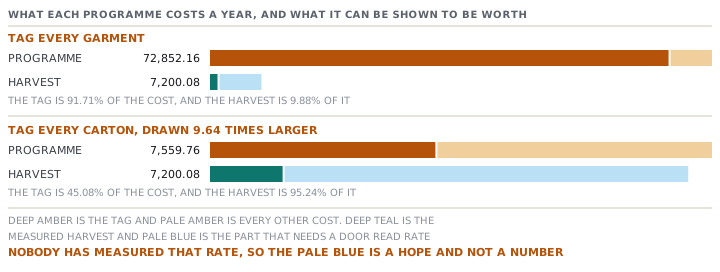
| A year | 72,852.16 | 7,559.76 |
| The tag, as a share of it | 91.71% | 45.08% |
Two things in that table are worth stopping on.
The item tag costs EUR 0.058 and the carton tag costs EUR 0.071. The price per tag went up as the volume went down, which is the opposite of the direction most people assume. Tafoukt buys 1,152,000 item tags a year and only 48,000 carton tags, and the smaller order is priced worse. Volume moves the unit price, and it moves it in the direction that makes the expensive scheme look cheap per unit.
The item programme is 9.64 times the carton programme and buys the same three things. Everything above the tag line is nearly identical. The difference is entirely the tag, and the tag is the part that scales with how many things you decide to call a thing.
What it harvests
Now the other side, and only what Tafoukt has actually measured.
| Benefit | A year | Measured? |
|---|---|---|
| Counting: hold the monthly regime, put a sweep in place of the carton count | 687.48 | Yes, timed |
| Locating: 240 searches a year for a carton in the building, half an hour each | 410.40 | Yes, logged |
| Measured harvest | 1,097.88 | |
| Despatch: three short-shipment claims settled in 2027 | 3,742.20 | Conditional |
| Despatch: two replacement consignments air-freighted at EUR 1,180 | 2,360.00 | Conditional |
| Harvest if the door check works | 7,200.08 |
The last two rows are marked conditional for the reason in the callout above. They need a door read rate nobody has measured. Put both columns against both programmes.
| Net a year | Tag every garment | Tag every carton |
|---|---|---|
| On the measured harvest alone | -71,754.28 | -6,461.88 |
| With the despatch benefit banked | -65,652.08 | -359.68 |
| Share of its own cost recovered, measured | 1.51% | 14.52% |
| Share recovered with despatch | 9.88% | 95.24% |
One of those four numbers is close to a decision and the other three are not. Tagging the carton, with the despatch benefit, misses break-even by EUR 359.68 a year. That gap is small enough that a door trial could move it either way, which is exactly why the door trial is the thing to buy. The item-level programme is not close under any assumption in this lesson.
Take the tag out altogether
The cleanest way to test whether the equipment or the consumable is the problem is to price the tag at zero.
item programme, less the tags        72,852.16 - 66,816.00 = 6,036.16
harvest with the despatch benefit                            7,200.08
net if the tags were free                                    1,163.92
break-even tag price   1,163.92 / 1,152,000 = EUR 0.0010103 a tag
quoted                                          EUR 0.058   a tag
factor                                                57.41
Even with free tags the item programme returns EUR 1,163.92 a year, and only if the unmeasured despatch benefit lands. For it to pay on its measured harvest, the tag would have to cost about a tenth of a euro cent. It costs 5.8 cents. Nothing in the readers, the printer or the software decides this question. The tag does, and it is not close.
Who reads the tag
That result should be suspicious, because item-level tagging plainly does work somewhere. It does. It works where the tag is read often, and Tafoukt is not that place.
Hasseldorp Mode's own specification lists where the tag is read after it leaves Berrechid: inbound at the distribution centre, outbound from it, goods-in at the shop, six shop counts a year, and the till. Ten reads. Tafoukt reads it twice, once to verify the encode at the packing bench and once at the despatch gate.
reads Tafoukt pays for        12
reads Tafoukt takes            2 = 16.67%
cost of a read Tafoukt takes   0.058 / 2 = EUR 0.029
cost of the other ten                      EUR 0
Item-level radio tagging in apparel is a retailer's system, and this lesson is what it looks like from the end that buys the tags. The technology is not failing. The benefit and the invoice are simply in different companies. Once that is said, the question stops being whether to buy it and becomes who is asking and what they will pay.
whole item programme per garment   72,852.16 / 1,152,000 = EUR 0.063240
as a share of factory cost         0.063240 / 6.18 = 1.02%
A buyer who wants the tag is asking for 1.02% on the garment. That is a negotiable number and a defensible one, and it is a far better conversation than refusing.
What to buy, and in what order
Put every purchase in this course on one page, at Tafoukt's size, and the order stops being a matter of opinion.
| Purchase | Net a year | Verdict |
|---|---|---|
| Location labels and a putaway rule | see below | Buy first, and it is not optional |
| Register and ledger, from lesson 1 | 5,090.14 | Pays back in 21.0 months |
| Barcode capture, from lesson 2 | 3,065.62 | Pays back in 33.8 months |
| Directed picking, from lesson 1 | -8,011.00 | Not at this size |
| Tag every carton | -359.68 | Measure the door read rate first |
| Tag every garment | -65,652.08 | Only if a buyer pays for the tags |
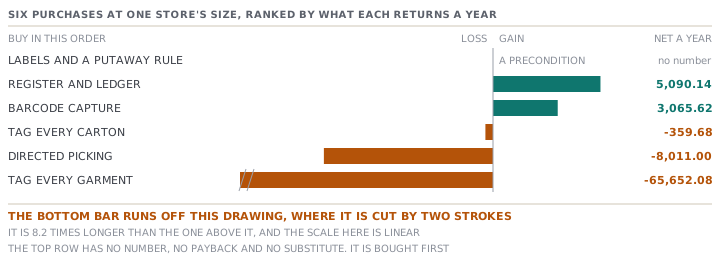
The top row has no number in it, and that is the finding this course ends on.
A system on top of a bad floor
Naima audited the store's location record: 1,208 occupied locations, checked against the book one at a time.
locations where the book was right   1,101 = 91.14%
locations where it was wrong           107 =  8.86%
Lesson 1 bought sequencing on the strength of pick travel. A sequenced round is a list of locations in walking order, and the picker follows it. If 8.86% of locations are wrong, the round sends him to the wrong place.
picks a year                       19,248
misdirected                        19,248 x 107 / 1,208 = 1,704.9
six minutes to recover each        6 x 3.42 / 60 = EUR 0.342
a year                                              EUR 583.08
sequencing benefit from lesson 1                    EUR 1,239.00
what survives                                       EUR 655.92
47.1% of the sequencing benefit is eaten by the store's own location accuracy, before a single euro of it has been earned. And there is a floor under that.
misdirections that eat the whole benefit   1,239.00 / 0.342 = 3,622.8
as a share of picks                        3,622.8 / 19,248 = 18.82%
Below 81.18% location accuracy, directed picking is worth exactly nothing. Tafoukt is at 91.14%, so it is on the right side of the line, and only halfway to the wrong one.
There is a worse effect that this arithmetic does not price, and it should be said rather than costed. An undirected picker who reaches an empty location knows he is looking for something. A directed picker has been told where it is by a screen, and a screen that has been right all morning is believed. Automation does not remove a judgement. It removes the habit of making one, and the habit is what the store was relying on.
Check yourselfHasseldorp Mode tells Tafoukt that from next season every garment must carry a radio tag, and offers nothing towards it. Younes Belkhadir asks what to say. What is the answer, and what should Tafoukt do about the readers?Show the answer
Say the price. The whole item-level programme is EUR 72,852.16 a year across 1,152,000 garments, which is EUR 0.063240 a garment, or 1.02% on a factory cost of EUR 6.18. That is a surcharge to be negotiated, not a demand to be refused, and it is defensible line by line because every part of it is a quotation Tafoukt holds. Refusing outright loses the customer. Absorbing it silently loses 1.02% of the factory cost of every garment. On the readers, the answer is different and worth separating. If Hasseldorp is paying for the tags, the tags are on the garments whether Tafoukt reads them or not. So the readers become a free-standing decision at a much lower cost. The programme less the tags is EUR 6,036.16 a year, against a measured harvest of EUR 1,097.88 and a conditional despatch benefit of EUR 6,102.20. That is a genuine maybe, rather than the flat no the full programme gets, and the thing that decides it is still the door read rate. So the sequence is to price the tag to the buyer, and separately to run a door trial before buying a single portal.
Check yourselfA supplier proposes fixing the read rate by adding a second overhead reader on the north wall, at EUR 3,150. Naima's 604 repeat misses are all in that corner. Is this the right fix?Show the answer
It might raise the read rate, and it is still the wrong thing to buy first, because the cause is known and it is not a shortage of readers. The 604 garments are in the bottom cartons of pallets stacked two deep, with the tag facing into the stack and a steel upright in the way. A putaway rule that forbids two-deep against the wall and requires the tag to face the aisle costs nothing and addresses the cause. Buy the reader first and the store has paid EUR 3,150 to shout through its own pallets, and the rule is still needed. There is also an argument about measurement. Until the putaway is fixed, nobody knows what the building's read rate actually is, so the second reader would be bought against a figure that the fix is about to change. Fix the physical arrangement, sweep again, and then see what is left. If a real blind spot survives a correct putaway, that is when a reader is the answer, and it will be a smaller and better-aimed purchase.
Prompt · Decide what my store should buy at all, and in what order
When a radio tagging pilot is on the table, and any time a buyer asks for tags and nobody has priced what that costs you.
Help me decide what to buy for my store, in what order, and what to refuse at my size. Treat radio tagging as the last question rather than the first.

Start with the read rate, because everything else depends on it and nobody quotes it. Tell me to hand-count one zone completely first, then sweep it, and to report tags heard, tags heard from outside the zone, and items present but never heard. Work out the read rate from that and nothing else. Refuse to accept any figure from a vendor or a case study, and say why a rate is a property of a building.

Then show me what my own rate does to a count. Multiply the items never heard by my carrying cost. Tell me what I would write off if I posted the sweep to the book every month. Then have me sweep the same zone again a month later and keep both lists of missing items. Work out the overlap I would expect if the misses were independent, and compare it with the overlap I actually got. Tell me what a large ratio means. The same items are invisible every time, which is a fact about where they are stored rather than about the reader.

Then test the door. Ask how many cartons and how many items travel on one pallet. Work out the expected number of unread tags per pallet at my measured rate, at item level and at carton level. Then turn it round: what read rate would the gate need for most pallets to pass clean at each level. Show me the two tolerable miss rates and the ratio between them, and be blunt if my measured rate makes either unusable.

Then price two programmes side by side, tagging every item and tagging every carton, with tags, encoding labour, printer, readers and software all on an annual basis. Ask for both tag prices separately, and point it out if the smaller order is priced worse per unit, because that is the usual direction and it surprises people.

Then make me separate what is measured from what is hoped for. Count only benefits I have logged. Put claims and mis-shipments in a separate conditional line that depends on the door read rate. Give me the net both ways.

Then do the test that settles it: price the tags at zero and tell me whether the programme pays even then. Give me the break-even tag price and the factor between it and my quotation.

Then ask who else reads the tag, count the reads inside my factory and the reads downstream, and express the whole programme as a percentage on my factory cost per garment, so I can quote a surcharge instead of refusing.

Finally, before any of it, ask me for a location accuracy audit: how many occupied locations agree with the book. Work out how many of my picks a year would be sent to the wrong place, price the recovery, and subtract it from any directed picking benefit I am claiming. Tell me the accuracy below which directed picking is worth nothing at all. If my accuracy is poor, say plainly that no system on top of it is worth buying yet.
AI can make mistakes — check anything you act on.