Lessons · Lesson 1 of 3
What a warehouse system actually is
Break a warehouse system into the three separate things it is made of, and use your own store hours to work out which of them to buy.
Lesson 1 of 3 · 40 min
The factory, the order, the basis
A store can be run out of somebody's head. That works until the person is away, or until the store grows bigger than one memory. This lesson is about what replaces the memory.
The trade sells it as a warehouse management system. That is a sales phrase, not a description. Underneath it there are three separate things, and a factory needs them in a particular order.
Tafoukt Apparel is a womenswear factory in Berrechid, Morocco. It employs 1,240 people across seven sewing lines. It makes blouses, dresses and light jackets for European chains. Everything in this course happens in one building on that site: the stores, a single-storey shed of 1,900 m². Raw material sits at one end and finished goods at the other.
Four people appear.
- Naima Mekouar runs the stores. Every time study in this course is hers.
- Hicham Zerhouni is the receiving and putaway chargehand. Putaway means moving goods from the receiving bay into the place they will be stored. He is the person doing the keying.
- Salma Sqalli is the plant controller and owns the money.
- Younes Belkhadir is the plant manager and signs for capital.
The order carried through all three lessons is HM-4408 for Hasseldorp Mode, a Netherlands chain: style TF-3180, a viscose blouse, 96,000 pieces.
Say the basis once, because every figure below rests on it. All money is euros. That is what Tafoukt invoices in, and what every quotation in this course is written in. Fully loaded store labour is EUR 3.42 an hour. Fully loaded means the wage plus statutory charges plus a share of supervision. The figure comes from Tafoukt's own 2027 payroll, not from a country average. A sewing line standing idle costs EUR 96.56 an hour, which is 34 people at EUR 2.84 each. The store employs five people at 2,024 hours a year, so 10,120 store hours a year. It books 58,400 movement lines a year, of which 42,600 carry a location code and an item code. Of those movements, 19,248 are picks.
A system is three things
Strip the demonstration away and a warehouse system is three separate machines in one box. They are usually sold together. They are worth very different amounts.
| Layer | What it is | The question it answers | What it costs to have |
|---|---|---|---|
| A location register | Every place in the building has a name, and the names are a closed list | Where may a thing be? | Labels, a survey, and a rule that nothing rests anywhere else |
| A stock ledger | Every movement is an entry with a date, a person, a quantity and two locations | What is here, and how did it get here? | Discipline at the moment the goods move |
| A task rule | The system decides what the next person does next, and where | What should I do now? | Both of the above, plus a record right enough to obey |
The order matters, and it is not a matter of taste. A ledger with no register cannot say where anything is, because it has nothing to name. A task rule with no ledger is guessing. So the third layer sits on the second, and the second sits on the first. A factory that buys the third alone has bought a very expensive guess.
Course 23.1 built the first layer at a different factory, and this course starts where it left off. Tafoukt has 1,344 rack positions in one bulk zone. It has 58 more named places in receiving, quarantine, the pick face, staging and despatch. The pick face is the low shelf that picking is done from. That is 1,402 named locations, and no legitimate resting place that is not one of them.
Where the store's hours actually go
Naima Mekouar's time study ran for 20 working days and covered all five of her people. Every minute is in one of six buckets. The last column is the argument.
| What the hours go on | Hours a year | Who could remove it |
|---|---|---|
| Moving, lifting and loading | 4,860 | Nobody. This is the work |
| Travelling between locations | 1,720 | A task rule, partly, by sequencing the round |
| Searching for stock not where it should be | 968 | A register and a ledger, for the part where nothing was recorded |
| Writing, keying and re-keying movements | 1,504 | A ledger, for the copying |
| Answering "where is it" and "how much is there" | 612 | A register and a ledger, for the lookups |
| Counting and recounting | 456 | Neither. Course 23.4 is about how often |
| Total | 10,120 |
Three of those rows need splitting before anything can be claimed. The splitting is where honesty lives.
Searching, 968 hours. Naima's notes give a reason for each search. In 731 hours nothing had been recorded at all, so there was nothing to look up. In the other 237 hours the entry existed and was wrong. Only the first is a missing ledger. The second is an accuracy problem, and lessons 2 and 3 are about that.
Paperwork, 1,504 hours. A movement is written once and then copied twice, onto the stock card and onto the month-end sheet. First capture is 626 hours, which is 38.6 seconds a line across 58,400 lines. The copying is the other 878 hours, or 54.1 seconds a line. A ledger removes the copying, because a movement entered once is already everywhere. It does not remove the capture. Somebody still has to say what moved.
Answering questions, 612 hours. Of those, 508 hours are lookups: where is it, how much is there, has it arrived. The remaining 104 hours are judgement, and a system does not answer those.
removable by a register and a ledger
  731  searching where nothing was recorded
  508  lookups
  878  re-keying
2,117  hours a year, at EUR 3.42 = EUR 7,240.14
Now the third layer. Sequencing means sorting a pick list into travel order, so the round walks the store once instead of criss-crossing it. Naima timed 40 rounds picked in the order the paperwork listed them, and 40 of the same rounds re-sorted by location. The mean fell from 11.4 minutes to 7.9 minutes.
cut per round        = 3.5 / 11.4 = 30.70%
pick-round travel    = 1,180 hours a year
hours removed        = 1,180 x 0.3070 = 362.28
                       at EUR 3.42   = EUR 1,239.00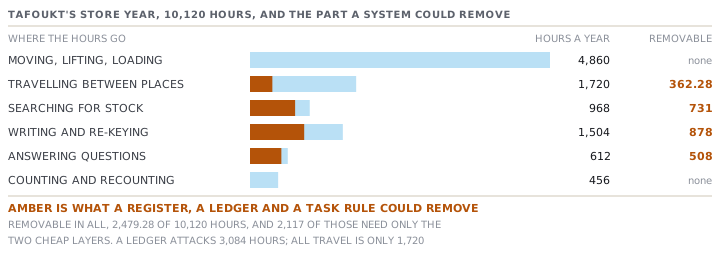
What each layer is worth
Tafoukt holds two quotations. The first is a location register and a movement ledger, built onto the plant's existing accounting system: EUR 8,900 to put in and EUR 2,150 a year to run. The second is a full warehouse management system, with directed putaway and pick sequencing on top: EUR 46,800 to put in and EUR 11,400 a year.
| The two quotations | Register and ledger | Full system, sequencing included |
|---|---|---|
| To put in | 8,900 | 46,800 |
| To run, a year | 2,150 | 11,400 |
| Hours removed a year | 2,117 | 2,479.28 |
| Labour saved a year | 7,240.14 | 8,479.14 |
| Net a year | 5,090.14 | -2,920.86 |
The small option pays for itself in 8,900 / 5,090.14 = 1.7485 years, which is 21.0 months. The full system never does, on labour. It costs EUR 11,400 a year to run and removes EUR 8,479.14 of labour, so it loses EUR 2,920.86 every year before anybody has paid the EUR 46,800.
Compare the two layers directly and the gap is wider than the totals suggest.
register and ledger  EUR 7,240.14 a year
sequencing           EUR 1,239.00 a year
ratio                7,240.14 / 1,239.00 = 5.84
The two boring layers are worth 5.84 times the clever one, and the clever one is the whole demonstration. The reason is not mysterious. Sequencing compresses travel, and travel is 1,720 hours of the 10,120. A register and a ledger attack searching, lookups and copying. The three rows those come out of hold 3,084 hours between them.
Treat sequencing as an upgrade rather than a purchase and it looks worse still. The extra cost over the small option is EUR 37,900 to put in and EUR 9,250 a year to run. The extra benefit is EUR 1,239.00 a year.
incremental net = 1,239.00 - 9,250 = -EUR 8,011.00 a yearWhere does the clever layer turn
It is not worthless. It is worth EUR 1,239.00 at this store's size, and size is the whole variable. Sequencing saves a share of pick travel, so the saving scales with pick hours.
extra running cost to cover = 9,250
saving per year today       = 1,239.00
multiple needed             = 9,250 / 1,239.00 = 7.466
pick-round hours needed     = 1,180 x 7.466 = 8,809.5
Scale the whole store in proportion and that is 75,553 store hours a year, or about 37 store staff. Tafoukt has five.
Check yourselfA vendor demonstrates directed putaway: the tablet tells the operator which empty location to use, and the operator confirms with a tap. Using this lesson's figures, what is the strongest argument for buying it, and what is the strongest argument against?Show the answer
The argument for is that directed putaway does something sequencing does not. It chooses the location. So it can keep fast-moving items near the despatch end, and it can stop a pallet going somewhere awkward to reach. That is a travel saving on every future pick of that pallet, not just on this putaway, and Tafoukt has not measured it. So the honest position is that its value is unknown, not that it is zero. The argument against is the one the numbers make. Directed putaway sits on the third layer, so it cannot be had without the ledger underneath it. The extra cost of that layer at Tafoukt is EUR 9,250 a year, against EUR 1,239.00 of measured benefit. An unmeasured extra benefit would have to be worth more than EUR 8,011.00 a year to close that gap, which is more than six times the whole measured sequencing saving. The right next step is not to buy or refuse. It is to measure putaway placement for a month, because that is the one number that could change the answer.
Check yourselfYounes Belkhadir says the store should skip the small option and go straight to the full system, because doing it twice will cost more than doing it once. Is he right?Show the answer
He is right about one thing and wrong about the arithmetic. He is right that the register and the ledger are not thrown away when the full system arrives. They are the same two layers, so the small option is a step on the path rather than a detour. The waste is the implementation, not the discipline. But the full system loses EUR 2,920.86 a year at Tafoukt's size and the small one earns EUR 5,090.14, so waiting is worth EUR 8,011.00 a year of avoided loss. The difference in implementation cost would have to beat that every year to justify going straight there, and it does not: it is paid once. There is also an argument about order that he may not have considered. A store that has never run a ledger will break the discipline in its first year. It is cheaper to learn that on a system costing EUR 2,150 a year than on one costing EUR 11,400.
Prompt · Work out which layer of a warehouse system I am actually buying
Before signing for any warehouse software, and any time a demonstration has just shown you a tablet directing a picker.
Help me take a warehouse system quotation apart into the three separate things it is made of, and price each one from my own hours.

First ask me for a time study rather than an opinion. I need my store hours a year, the number of people and the hours each works, and my fully loaded store labour rate. Then ask me to split those hours into six buckets: handling, travelling, searching for stock that is not where it should be, writing and re-keying movements, answering questions about where things are, and counting. Insist that the split comes from observation over at least two weeks, and tell me plainly that a remembered split is not evidence.

Then make me split three of those buckets further, because this is where an honest case is won or lost. For searching, ask how many hours were spent looking for something that was never recorded at all, and how many for something recorded wrongly. Only the first is a missing ledger. For paperwork, ask how many seconds the first capture of a movement takes and how many the copying takes, and remove only the copying. For questions, separate the lookups from the judgements, because no system answers a judgement.

Then sort the three layers. A location register names every place. A stock ledger records every movement. A task rule decides what the next person does next. Tell me which of my buckets each layer can reach, and refuse to credit a layer with an hour that a cheaper layer already removes.

Then price the task rule separately and honestly. Ask me to time a sample of pick rounds in paperwork order, and the same rounds re-sorted by location. Take the saving from that measurement rather than from a percentage you have read somewhere. Multiply it by my pick travel hours only, not by all my travel.

Then give me a payback for each option, and the extra cost and extra benefit of the expensive one over the cheap one, which is the number the vendor will not compute. Finally, tell me at what size the clever layer would start to pay at my own saving per round, and say clearly which way that estimate is wrong and which part of it you cannot know.

Two refusals. Do not quote me an industry benchmark for anything. And do not present a labour case as the whole case, because being wrong costs money too and it is a different calculation.
AI can make mistakes — check anything you act on.