Lessons · Lesson 2 of 6
- 01 · What a sewing machine actually reports
- 02 · Three layers, and what each one is for
- 03 · Retrofitting: the sensor decides the question you can ask
- 04 · Downtime, and the reason a machine cannot give you
- 05 · The integration nobody budgets: one bundle, five names
- 06 · The count that drifts, and the hour a week that catches it
Three layers, and what each one is for
Say what a shop-floor execution layer is actually for, what belongs above and below it, and which part of it a factory usually pays for and never uses.
Lesson 2 of 6 · 18 min
The situation
The owner of Sumilon has read the quotation and has one question: "We already have a system that knows the order. What is this second one for?"
It is the right question. Rowena's first answer, "it gives us live production data", is the wrong one. That answer gets a factory a very expensive chart.
Three layers, and the boundary between them
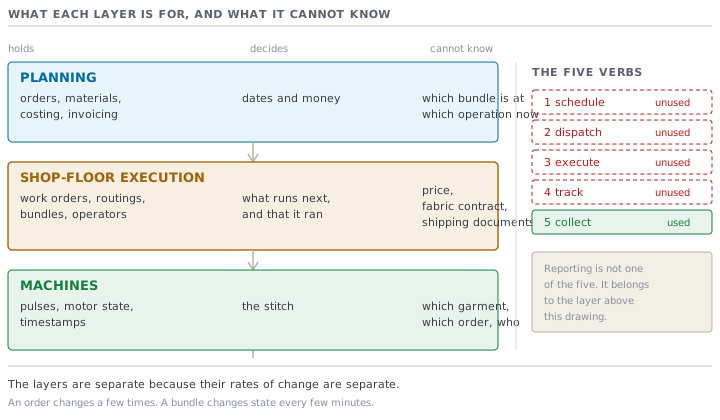
| Layer | What it holds | What it is FOR | What it cannot know |
|---|---|---|---|
| Machines and controllers | Pulses, motor state, timestamps | Making the stitch | Which garment, which order, who |
| Shop-floor execution | Work orders, routings, operations, bundles, operators | Deciding what runs next, on which machine, and proving it ran | The price, the fabric contract, the shipping documents |
| Planning | Orders, bills of material, materials, costing, invoicing | Committing the factory to dates and money | Which bundle is at which operation right now |
The boundary in the last column is the useful part. A planning system that tries to hold bundles becomes unusable within a season. The number of rows explodes, and none of them survive a re-cut. An execution layer that tries to hold prices becomes a second, worse accounting system. The two are separate because their rates of change are separate. An order changes a few times. A bundle's state changes every few minutes.
An execution layer is a scheduling system that happens to keep records
This is the correction the course exists to make. The verbs of a shop-floor execution layer, in the order they matter, are:
- Schedule — put the work orders in a sequence against the resources that exist.
- Dispatch — tell a specific line, machine or operator which bundle is next.
- Execute — hold the routing, so the system knows operation 40 comes before operation 52 and refuses a completion that arrives out of order.
- Track — know where every bundle is.
- Collect — record what happened.
Reporting is not on that list. Reporting is what course 24.3 does with the records that collection leaves behind. A factory that buys an execution layer in order to get charts has bought a scheduling engine. It has paid a scheduling engine's price for a counter.
That is exactly what Sumilon did. FL-318's routing carries 18 operations. In the first season the factory used completion recording on 3 of them: the two cycle-counted sewing operations and the final audit. It used the dispatch function on none at all. Bundles went down the line the way they always had, with a supervisor, a clipboard, and a judgement about which operator was free.
The part they paid for and did not use turned out to be the part that paid
Here is the turn, and it is worth sitting with.
To make the system accept a completion at all, somebody had to type FL-318's routing in. That is 18 operations, each with its standard minute, its machine class and the operation that comes before it. Jonalyn Amistoso did it over two afternoons in February. She complained about it, correctly, as data entry the factory did not need.
That routing is the reason lesson 6's line-balance finding was possible. Cycle counts on their own tell you a machine is busy. Cycle counts read against a routing tell you which operation is the constraint and which has slack, because the system knows what each operation is supposed to take and what comes after it. The finding was worth USD 50,438 a year, and the data it ran on was entered for a reason nobody believed in.
The general shape is this. Reporting is the cheap part of an execution layer. The scheduling model is the expensive part, and the scheduling model is where the value is. A factory that will not maintain a routing should not buy an execution layer at all. It should buy counters, which are much cheaper and honest about what they are.
What the programme cost, and where the money sat
| Line | USD |
|---|---|
| Sensors and fitting, 395 machines | 48,514 |
| Shop-floor terminals, 24 | 21,600 |
| Network, access points and cabinet | 14,300 |
| Execution-layer software and hosting, three years | 88,000 |
| Integration to the planning system | 19,600 |
| Training and rollout | 21,700 |
| Total | 213,714 |
Every figure in that table is this factory's own quotation, for one fleet in one country in one year. It is here so that the shape of the spend can be argued about: which lines are large, which are small, which are wrong. It is not a price list. Nothing in it should be carried into your own negotiation as a rate.
Read the shape rather than the numbers. The software is the largest line and the one everybody negotiates. The integration to the planning system is 9.2% of the total, and it is the one nobody looks at.
Lesson 5 is about what that line actually cost: USD 134,900, which is 41.0% of a programme that finished at USD 329,014. The line everybody negotiated was quoted correctly. The line nobody read was wrong by a factor of nearly seven.
Check yourselfYour planning system already holds the order, the sizes and the quantities. Why can it not simply hold the bundles as well and save you a second system?Show the answer
Because of the rate of change, not the volume. An order changes a handful of times. A bundle changes state every few minutes, is split, merged, re-cut and re-numbered, and most bundle records are dead within three weeks. A planning system is built to hold records that are argued over and audited, which is the opposite of what a bundle is. Factories that have tried this end up maintaining the bundle table by hand, which is where the whole idea started.