Lessons · Lesson 1 of 6
A number is a request for a decision
Check every number on a shop-floor screen against one sentence its owner has to be able to finish, and take off the ones that cannot finish it.
Lesson 1 of 6 · 19 min
The situation
Halewatte Apparel runs nine sewing lines in Kuliyapitiya. In January it finished putting counting equipment on the floor: a terminal at the end of every line, counters on the bartack machines and the buttonhole machines, and a data feed into a reporting system. A bartack is the short dense stitch that locks a pocket corner or a belt loop; a buttonhole machine cuts and sews one buttonhole at a time. Course 24.1 asks whether that counting is worth buying, and in what unit. Course 24.2 asks how far you can trust what a machine reports. This course starts the morning after both questions are answered. The numbers exist. Somebody has to decide what to do with them.
What Chandana Sooriyabandara did was hang a screen at the end of each line. Fifty-five inches, on the wall, fourteen numbers, redrawn every thirty seconds. It was the supplier's standard layout, plus four numbers the merchandising office asked for.
In April, Iresha Wickramaratne stood on Line 6 for three shifts and watched what the supervisor actually did. Iresha is the industrial engineer, and the reporting is hers. The supervisor is Kumudu Marasinghe. Kumudu looked at the screen twenty-two times in a shift. She acted on what it said twice.
That is the subject of this course. Not whether the data is right. A number on a wall is a request for a decision, and a number nobody can act on is a cost with no benefit.
The sentence
Iresha did not argue about which numbers were useful. She wrote one sentence and asked whether each of the fourteen could finish it.
When ______ crosses ______, ______ does ______ within ______.
Five blanks: the measure, the threshold, the person, the action, the time. A number that fills all five is a trigger. A number that cannot is a description. That is not an insult. Descriptions are how a factory learns anything at all. It is a statement about where the number belongs.
Three of the fourteen filled all five blanks.
| On the screen | Owner | Threshold | Named action |
|---|---|---|---|
| Pieces this hour against the hour's plan | Kumudu | yes | walk the line, find the station |
| Minutes down this shift, with the reason | Kumudu | yes | call the mechanic, log the cause |
| Work in progress at the slowest station | Kumudu | yes | move a helper across |
| Operators present against roster | Kumudu | none set | — |
| Efficiency this hour | Kumudu | the target | — |
| Efficiency, day to date | nobody named | the target | — |
| Pieces produced, day to date | nobody named | none | — |
| Pieces against plan, day to date | merchandising | yes | — |
| Downtime by reason, day to date | maintenance | none | — |
| Defects per hundred units, day to date | quality | yes | — |
| Rework queue, pieces | quality | none | — |
| Order completion, share of the purchase order | merchandising | none | — |
| Days to the ship date | merchandising | none | — |
| Machine utilisation, plant average | nobody named | none | — |
Read the empty column. Eleven numbers had no action anybody could name. Four of those eleven had a threshold anyway. A threshold with no action is the most misleading thing on a screen, because it looks like a decision has already been made.
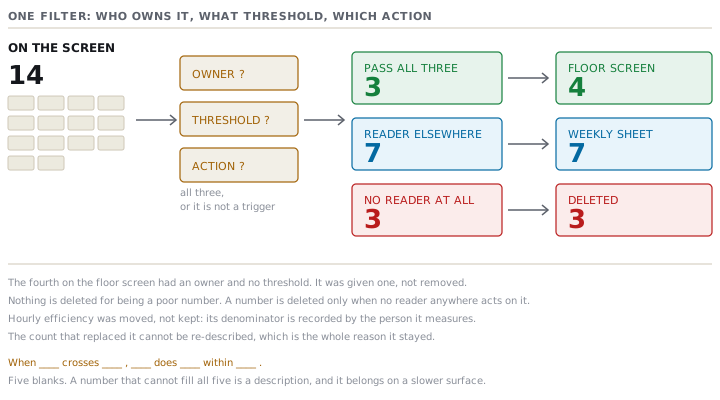
What happened to the other eleven
They were not all deleted, and this is the part factories get wrong. Three of the eleven were genuinely worthless on a floor, so they went: plant-average machine utilisation, days to the ship date, and order completion as a share of the purchase order. Nobody standing on Line 6 at 10:40 on a Tuesday can move any of them, and Kumudu confirmed she had never once looked at the last two.
The other seven were moved. Day-to-date efficiency, pieces to date, pieces against plan, downtime by reason, defects per hundred units, the rework queue and hourly efficiency all went onto a weekly sheet that the office reads on a Monday. They are good numbers. They answer a manager's question. Lesson 5 explains why that means a different surface, not a smaller font.
One of the seven is worth stopping on, because Kumudu argued about it. Hourly efficiency came off the board, and pieces this hour against plan stayed. They look like the same fact. They are not. Efficiency is a ratio, and the bottom of the ratio is booked attended time — a quantity recorded by the same person the ratio measures. Pieces against plan is a count of things that either exist or do not. Lesson 4 is entirely about what happens to a ratio when somebody draws a line on it. The decision to keep the count and drop the ratio was taken before that evidence existed. It was taken on a principle: on a surface where nobody has time to audit, prefer the number that cannot be re-described.
The rebuilt board
Four numbers. Pieces this hour against the hour's plan. Minutes down this shift with the reason. Work in progress at the worst station — the pieces sitting between stations, waiting to be sewn. Operators present against roster, which had an owner but no threshold, and now has one: any absence not covered by eight o'clock, pull somebody from the spare pool of trained operators.
The bound nobody calculates
There is a reason fourteen was always going to be too many, and it is not about attention spans.
At 10:40 on a Tuesday, Kumudu has four things she can actually do. Call the mechanic. Move an operator or a helper. Change the order in which work is fed to the line. Take it to Chandana. That is the whole set. Everything else needs a decision she does not own, or a resource she cannot reach inside the hour.
A display that separates fourteen states, given to somebody with four possible responses, cannot settle into a decision. The useful detail of a shop-floor display is limited by the number of actions available, not by the number of measurements available. The measurements were free once the counting existed, which is exactly why nobody thought to count them against anything.
What the screens cost
Iresha priced them, because the argument for taking numbers off a screen is stronger with a number attached.
The attention is the real cost, and it is the one nobody bills. Over three shifts she timed Kumudu's twenty-two glances. Eleven were readable from where she stood, at 3.6 seconds each. Eleven meant leaving her station, and that walk there and back was measured at 39 seconds. That is 468.6 seconds a shift, or 7.81 minutes. Across nine supervisors and twenty-six working days it is 30.46 supervisor-hours a month. Halewatte's cost for a supervisor, wages plus everything the factory pays on top, is USD 4.20 an hour. So the glances cost USD 1,535.13 a year.
| Line | USD a year |
|---|---|
| Supervisors' attention | 1,535.13 |
| Screens and players, USD 5,400 over four years | 1,350.00 |
| Feed and licence | 2,640.00 |
| Total | 5,525.13 |
USD 5,525.13 a year, to display three numbers that trigger something and eleven that do not.
But the money is not the finding, and a course that stopped there would teach the wrong lesson. USD 5,525.13 is nothing against a plant making 6,912 shirts a day. If the three triggering numbers save one stoppage a month, they have paid for the lot. What the eleven numbers destroyed was the habit.
Kumudu looked at the screen twenty-two times and acted twice. A supervisor who learns that most of what a screen says is not for her stops reading the screen. She stops reading all of it, not just the useless part. She does not build a filter that keeps the three good numbers and drops the eleven. By April the board on Line 6 was, in practice, off. It was still lit.
Check yourselfYour screen shows day-to-date efficiency and it is below target. Why is that not a trigger?Show the answer
Because no threshold on it can name an action. Day to date is a running total. It is dominated by what has already happened and cannot be changed, and it moves less and less as the day goes on. By the time it drops far enough to alarm you, the shift is over. Lesson 5 puts a number on how far it moves in the morning against late afternoon.
Prompt · Audit my shop-floor screen
Before you add a number to a wall screen, and once a year for the numbers already on it.
Act as an industrial engineer who has taken numbers OFF factory screens and had to defend it. I want every number on my shop-floor display audited. My situation: [NUMBER] sewing lines, [NUMBER] operators a line, [MINUTES] attended minutes a shift, [NUMBER] working days a month. The screen sits [WHERE] and the person meant to read it is [ROLE]. Here is every number currently displayed, exactly as it is labelled on screen: [LIST THEM, ONE PER LINE, WITH ITS TIME BASIS - THIS HOUR, DAY TO DATE, SHIFT, WEEK]. Things that person can actually do inside one hour without asking anybody: [LIST THEM]. Do the following. First, for each displayed number, try to complete this sentence and show your attempt: when THIS crosses THAT, THIS PERSON does THIS, within THIS LONG. Say plainly which blanks you could not fill and why. Second, sort every number into three piles - keep on the floor screen, move to a weekly management surface, delete entirely - and give the reason in one sentence each. A number nobody anywhere acts on is deleted; a number somebody acts on elsewhere is moved. Third, count the numbers left against the count of available actions I gave you, and tell me whether the display still separates more states than the reader can respond to. Fourth, for anything you kept that is a RATIO, name who records the bottom of it, and whether that is the same person the ratio measures. Flag any ratio where it is, and suggest a count that could replace it. Fifth, estimate what the screen costs a year: hardware over its life, feed and licence, and the reader's attention - ask me for the glance count and walk time if I have not measured them, rather than inventing numbers. Sixth, write the four-line specification for the rebuilt board. Do not tell me to add anything to the screen.
AI can make mistakes — check anything you act on.
What to do on Monday
- Photograph your shop-floor screen. Write out every number on it.
- For each one, try to finish the sentence. All five blanks, in writing, with a person's name in the third.
- Sort the failures into two piles: delete (nobody anywhere acts on this) and move (somebody acts on this, but not on this floor and not in this hour).
- Count what is left. If it is more than the number of things your supervisor can do inside an hour, you have not finished.
The board that survives this is smaller than anybody expects, and quieter than anybody wants. That is the point. The next lesson is about what happens when the numbers that stay are still the wrong shape.