Lessons · Lesson 4 of 6
The line drawn for information that changed the recording
Take a four-point improvement apart into the share that was real and the share that was recording, and build the audit ratio that would have caught it in the first week.
Lesson 4 of 6 · 18 min
The memo
On 3 March, Iresha drew a red horizontal line at 82.0% across the hourly board at the end of every line. The memo attached to it is worth quoting, because it is the reason this lesson exists:
The line marks the plan rate for the current style. It is shown for information. No line and no supervisor is being measured against it. Nothing about pay, ranking or reporting changes.
Every word of that was true and meant. Nobody was asked to do anything.
What happened
Over the ten working days before the line went up, reported efficiency across the nine lines averaged 79.8%. Over the ten working days from 23 March, it averaged 83.7%. A rise of 3.9 points in three weeks, with no equipment bought, no method changed and nobody trained.
The share of hours at or above the line went from 31.4% to 58.2%.
Chandana was pleased and asked what had been done differently. The honest answer was nothing, which is the point at which Iresha went looking for the shirts.
The independent count
Efficiency at Halewatte is earned minutes divided by booked attended minutes, and both of those come from the same feed. So Iresha checked it against a record that comes from somewhere else entirely: pieces receipted into the finished-goods store, counted by two storekeepers against a packing list, in a building the line feed does not reach.
| Ten days before | Ten days after | |
|---|---|---|
| Reported efficiency | 79.8% | 83.7% |
| Pieces booked off the lines | 66,304 | 66,912 |
| Pieces receipted into the store | 65,041 | 65,301 |
Receipts rose by 260 shirts. That is 0.40%.
So the factory produced four tenths of one per cent more shirts, and reported a 3.9-point improvement in how efficiently it produced them. Those two facts have to be reconciled, and reconciling them is the whole of this lesson.
Where the 3.9 points came from
Efficiency is a fraction. There are exactly three places a fraction can move: the top can rise because more was genuinely made, the top can rise because more was booked, or the bottom can fall. Iresha put one change at a time into the before-period arithmetic.
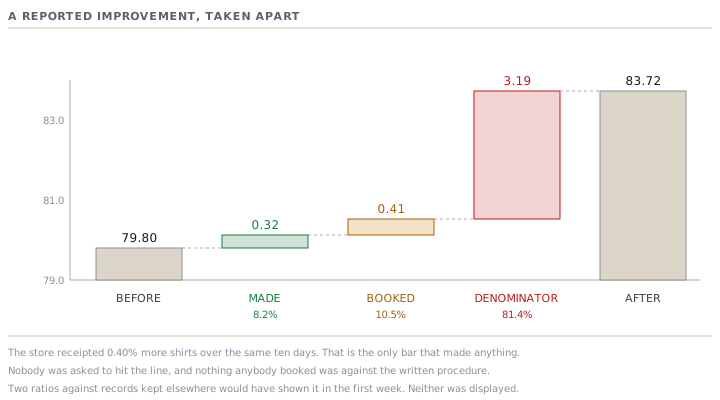
Step one — real output. Hold the booking behaviour and the bottom of the fraction exactly as they were before, and put in only the extra shirts the store actually received. Reported efficiency moves from 79.8% to 80.1%: 0.32 points.
Step two — over-booking. Before the line went up, lines booked 1.0194 pieces off for every one the store receipted. The gap is repairs held back and work still on its way, and it had been steady for months. After, the ratio was 1.0247. At the old ratio the lines should have booked 66,569. They booked 66,912. The excess is 343 shirts, 0.51% of what was booked — garments booked as complete when they left the last operation rather than when they passed end-of-line inspection, and a handful of repaired garments booked a second time on their way back through. Reported efficiency moves to 80.5%: 0.41 points.
Step three — the bottom of the fraction. Booked "no work" and "waiting" time per operator rose from 18.4 minutes a day to 36.0 minutes a day. That is time taken out of the bottom of the fraction, and taking it out raises the fraction without touching a single shirt. Reported efficiency moves to 83.7%: 3.19 points.
| Where the movement came from | Points | Share |
|---|---|---|
| Shirts genuinely made | 0.32 | 8.2% |
| Shirts booked but not received | 0.41 | 10.5% |
| Time taken out of the bottom | 3.19 | 81.4% |
| Total reported | 3.92 |
Eight per cent of the improvement was real.
Why this is not cheating, and why calling it cheating is the mistake
Read the third row again and ask who did anything wrong.
Booking starved time as "no work" is what Halewatte's own procedure tells a supervisor to do when the cutting room is late. The line is not being given work, so the time is not the line's to answer for. Every one of those 36.0 minutes was booked against a reason code by a supervisor who could point at the reason. Booking a garment off when it leaves the last operation is defensible too. That is when the operation is finished.
What changed was not honesty. What changed was that a red line appeared, and every borderline booking that could reasonably go one of two ways began going the way that put the hour above it. Nobody was told the line mattered. Everybody correctly worked out that it did, because a number displayed at the end of your line with a red mark on it is a statement about what is being watched, and no memo can take that statement back.
This is the finding, and it is bigger than a garment factory. A number displayed becomes a target, whether or not you say it is one. What follows is a design rule with teeth: display only numbers you would be content to have people push up, and prefer the ones that are hardest to push up by re-describing them.
That is why lesson 1 kept the count of shirts on the board and took hourly efficiency off it. A supervisor cannot re-describe a shirt.
The audit ratio that would have caught it in week one
Nothing in the reporting could see this, because everything in the reporting came from the same feed. What catches it is a ratio between two records that are produced by different people and should move together.
| Ratio | Ten days before | Ten days after |
|---|---|---|
| Pieces booked off the lines, per piece receipted | 1.0194 | 1.0247 |
| Booked attended minutes, as a share of payroll-clock minutes | 96.2% | 92.5% |
The second is the loud one. Booked attended time fell 3.7 points against the payroll clock in a fortnight, with no change in rostering, no shortened shifts and no absence. Course 24.1 covers what to do when tracking and payroll disagree about attendance as a subject in its own right. Here it is being used differently: not as a dispute to settle, but as a check on a displayed number, a second record that the displayed number's own bottom line cannot influence.
Both ratios are one line of arithmetic a week. Neither needs a system. Iresha now prints both at the top of the Monday sheet, immediately above the efficiency figures they protect, with a note giving the twelve-month range of each — because the useful thing about a ratio is not its value, it is when it moves.
What Halewatte did next
Not remove the line. Removing it puts you back where lesson 1 started, with a board nobody reads, and it would also have taught the factory that improvement is unwelcome.
Three things. The bottom of the fraction was defined again, in one sentence a supervisor and a payroll clerk would both read the same way, with the four permissible exclusion codes named and every other minute counted as attended by definition. The booking point was fixed at end-of-line inspection rather than the last operation, so booked and receipted move together. And the two ratios went on the Monday sheet.
The red line stayed. Six weeks later, on the corrected definitions, reported efficiency was 80.9% — 1.1 points above the figure before the line went up, and this time the store receipts agreed.
Check yourselfA number improves sharply and nothing about the process changed. What do you check first?Show the answer
Whether the movement is in the top of the fraction or the bottom, and then whether the top agrees with a count made by somebody who is not measured on it. Almost every unbelievable improvement in a factory number is a bottom line that got smaller, because the bottom is usually a booked quantity, and a booked quantity is a description rather than a thing.
What to do on Monday
- Write down which of your displayed numbers are ratios, and for each one, who records the bottom of it.
- For any ratio whose bottom is recorded by the people it measures, find a second count of the top made elsewhere — the store, the packing hall, the invoice.
- Work out the ratio between the two counts for each of the last twelve months. That range is your normal.
- Print it above the number, every week, whether or not anything looks wrong.