Lessons · Lesson 1 of 6
- 01 · Why one ply of cloth is the hard part
- 02 · What automates, and how to tell before you ask for a price
- 03 · The payback that has to survive a change of style
- 04 · The gain the rating does not give you
- 05 · What it does to the people, and what the people cost
- 06 · Year three, and the part that stops it
Why one ply of cloth is the hard part
Say the one physical fact that decides every automation choice in a garment factory, measure it, and show why it makes a cloth-handling cell expensive rather than impossible.
Lesson 1 of 6 · 19 min
The factory, the order, the basis
Most of what is written about automation in clothing is written by someone selling it, or by someone afraid of it. This course is neither. It starts from one physical fact. From that fact alone it works out what can and cannot be automated. Then it prices a real decision three ways.
Akbulut Giyim is a woven-outerwear factory at Bilecik, in north-western Turkey. It has 640 people on six sewing lines. It makes chore jackets, overshirts and five-pocket trousers for four European buyers. Last year it ran 47 different styles. Everything in this course happens inside that building.
Four people appear.
- Orhan Bayraktar is the managing director. He signs for machines.
- Nurten Aydemir is the industrial engineer. Every measurement in this course is hers.
- Sevim Duran runs line 3.
- Kadir Demirkol is the mechatronics technician, and lesson 5 is partly about what he costs.
The work followed through all six lessons is PO AG-4471 from Aldergate, a British casualwear chain: 38,400 pieces of AK-1180, a cotton-canvas chore jacket with four patch pockets, two at the chest and two at the hip.
Say the basis once, because every figure in this course is built on it. All money is US dollars. A sewing operator costs USD 4.86 an hour fully loaded. Fully loaded means the wage plus everything else the factory pays for that person: statutory contributions, and a share of supervision and floor overhead. It comes from Akbulut's own payroll, not from a country average. That is USD 0.0810 for each minute the operator is at the machine. The lines run at a measured 62% efficiency. So one standard minute of work — one minute at the pace the time study assumes — takes more than one attended minute, and costs 0.0810 divided by 0.62 = USD 0.1306. A mechatronics technician costs USD 14.10 an hour fully loaded. A machine is charged at its purchase price spread evenly over 7 years, with nothing left at the end. A machine year is 1,880 productive hours: 235 working days at 8 hours. An operator year is 110,450 attended minutes. A cut canvas front panel — cloth and cutting, nothing else — is worth USD 1.42. AK-1180 takes 24.06 standard minutes to sew, and that total is called its standard minute value, or SMV.
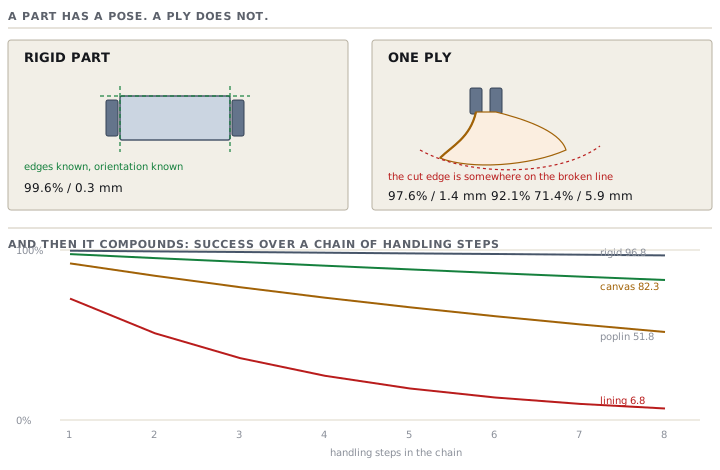
A rigid part has a pose. A ply of cloth does not.
Industrial robots became ordinary in car plants, electronics assembly and food packing. Those industries share one property that clothing does not have. The thing being handled keeps its shape.
A bracket, a connector, a bottle: put it in a fixture and it has a pose — a position and a direction that stay true while the machine works on it. A gripper closes on it, and the part is where the gripper is. Every later step can be planned in advance, because the geometry does not change between the pick and the place.
Now pick up one ply of cut canvas by a corner. A ply is one single layer of cloth.
It changes shape the moment you touch it. The corner lifts. The rest of it hangs. The cut edge you meant to line the piece up against has moved somewhere the machine cannot predict. And a second ply may have come up with it. Put it down and it settles into whatever shape the friction of the table gives it. A ply of cloth has no pose. Its shape is the result of gravity, its own bending stiffness, the surface it lies on, and whatever the gripper has just done to it.
That one fact is the subject of this whole course. Every difficulty, every price and every failed project in clothing automation comes from it. So does every success — because the successes are exactly the operations where something is holding the cloth still.
The bench trial
In March, Aydemir borrowed a small pick-and-place arm with a vacuum gripper from a supplier's demonstration room. She ran the same test on four materials: pick exactly one item from a stack of fifty, move it 400 mm, and place it on a printed mark. 400 attempts on each. She also had the mill run the cantilever stiffness test on each cloth. In that test a strip of cloth is pushed out over the edge of a bench until it bends under its own weight, and it gives a bending length. The higher the number, the stiffer the cloth.
| Material | Bending length | Picked exactly one, first attempt | Mean placement error |
|---|---|---|---|
| Moulded plastic button card | rigid | 99.6% | 0.3 mm |
| Cotton canvas, AK-1180 shell | 34.1 mm | 97.6% | 1.4 mm |
| Cotton poplin, a shirt style | 21.6 mm | 92.1% | 2.6 mm |
| Viscose lining | 12.8 mm | 71.4% | 5.9 mm |
Read the first column and the third together. The softer the cloth, the worse the pick. And the ranking is exactly the ranking of a test the mill can run on a bench in one afternoon. Stiffness is not an opinion. It is a measured property with a standard method, and it tells you how a fabric will behave in a gripper before anybody buys one.
Two smaller findings sit inside that table, and both matter later.
A placement error is not the same failure as a missed pick. A missed pick stops the machine, and everybody sees it. A 5.9 mm placement error stops nothing. It makes a pocket that sits 5.9 mm off, and that arrives at final audit three days later. So a cloth-handling cell needs sensors that check what it has just done, and that checking is a large part of why such a cell costs what it costs.
Two plies are a different problem from one. A vacuum cup that lifts one canvas ply reliably will lift two lining plies together, because lining is lighter and clings. Every ply-separation device in the trade — the needle grippers, the air knives, the rolling separators — exists to solve a problem that does not exist in any industry handling rigid parts.
Reliability compounds, and that is where the money goes
A single pick at 97.6% sounds excellent. It is not, because an operation is never one pick.
Preparing a patch pocket for sewing means: separate one pocket blank from the stack, lift it, present it to a folding former, fold three edges, move the folded pocket, separate one front panel, line the panel up, place the pocket on the panel, and hold it while it is tacked. That is a chain, and every link has to work.
| Material | One step | Four steps | Six steps | Eight steps |
|---|---|---|---|---|
| Rigid part | 99.6% | 98.4% | 97.6% | 96.8% |
| Cotton canvas | 97.6% | 90.7% | 86.4% | 82.3% |
| Cotton poplin | 92.1% | 72.0% | 61.0% | 51.8% |
| Viscose lining | 71.4% | 26.0% | 13.2% | 6.8% |
On canvas, a six-step handling sequence finishes without help 86.4% of the time. That means roughly one garment in seven needs a person. That is not automation. It is a machine with a nurse. On viscose lining it is 13.2%, which is why nobody is offering to automate lining assembly.
Turn the arithmetic round and it gives you the design target. To finish a six-step sequence unattended 99% of the time, each step has to succeed 99.8326% of the time. Over four steps the bar is 99.7491%.
That is the honest engineering statement of the problem. A cloth-handling cell is not asked to be good. It is asked to be about a hundred times more reliable per step than a good human hand feels like being, and to be that reliable on a material with no pose. It is not impossible: the vacuum cup, the ply separator, the vision system and the checking sensor get there between them. But every one of those devices is money, and the money is the reason the answer to "should we automate this?" is so often no, even when the engineering plainly works.
The demonstration that was honest and beside the point
In April the supplier ran a demonstration for Bayraktar and Aydemir on a cell set up for pocket preparation. Over an hour it placed pockets with no help at all, and the supplier's own logged figure for the session was 97.6% first-attempt picks.
Aydemir then asked for the same cell to be run on two rolls of Akbulut's own cloth and on Akbulut's own cut panels. On the poplin overshirt the same cell picked at 92.1%.
Nobody misled anybody. The demonstration was honest, carefully run, and beside the point, because the number it produced belongs to the cloth it was produced on. The supplier had set the cell up for a mid-weight canvas, because that is the material most of its customers run, and on that material the figure was true. Akbulut's problem is that it runs 47 styles a year across four cloth weights, and the cell has to survive all of them.
What the principle predicts
If cloth automates badly because it has no pose, then the operations that automate well should be exactly the ones where something is holding the cloth still — under tension, under vacuum, in a clamp, over a former, or on a hanger. That is a prediction, and you can test it against your own factory's operation list.
Lesson 2 does the test.
Check yourselfA supplier offers a cell that separates interlining and places it on shirt front panels. Interlining is the stiffening layer fused inside a collar or a cuff. It is stiffer than the shell cloth, and it is fed from a roll rather than a stack. Before any figures arrive, what would you expect about its reliability, and what would you still measure?Show the answer
Expect it to be better than a shell-cloth cell on both counts, for two separate reasons. Stiffer material keeps its shape in the gripper and lines up against an edge more repeatably, which is the bending-length ranking in the trial table. And feeding from a roll removes the ply-separation problem altogether: there is no stack, so there is no chance of lifting two. What still has to be measured is placement error, not pick rate. Interlining that is 4 mm out of position is a fusing defect, and it is invisible until the garment is pressed. Roll-fed material also brings a failure of its own: a cut length that creeps as the roll tension changes. So ask for the mean and the spread of placement error over at least 400 cycles on your own interlining. Do not ask for the pick rate. It will look excellent, and it is not the thing that will go wrong.