Lessons · Lesson 4 of 6
- 01 · Why one ply of cloth is the hard part
- 02 · What automates, and how to tell before you ask for a price
- 03 · The payback that has to survive a change of style
- 04 · The gain the rating does not give you
- 05 · What it does to the people, and what the people cost
- 06 · Year three, and the part that stops it
The gain the rating does not give you
Show why speeding up one operation moves the bottleneck instead of removing it, work out the real output gain before the machine is bought, and find where the rest of the money actually is.
Lesson 4 of 6 · 18 min
A second machine, and a claim that is true
The overhead transporter on line 3 was a separate decision from the cell in lesson 3, and it is the better behaved of the two. It moves a garment clamped to a hanger, which lesson 2 showed is a package with a handle rather than a ply of cloth.
What a transporter removes is handling — untie the bundle, pick the piece out of the box, turn it the right way round, put it in the next box, tie the bundle. Aydemir measured that element separately at every one of line 3's twenty-two stations. It comes to 3.04 standard minutes of AK-1180's 24.06, which is 12.64% of the garment.
The supplier's claim is that number, and the number is correct. Aydemir measured it herself.
The line will not produce 12.64% more.
Why a paced line does not care about most of your savings
A line's output is set by its slowest station. Everybody knows this, and almost nobody applies it to an automation proposal, because the proposal arrives as a total, and a total is the wrong unit.
| Station | Standard minutes | Handling element | After removal |
|---|---|---|---|
| 4 — topstitch front edges and facings | 1.42 | 0.07 | 1.35 |
| 11 — set second sleeve | 1.35 | 0.18 | 1.17 |
| 8 — attach collar to neckline | 1.33 | 0.13 | 1.20 |
| 2 — position and mark two chest pockets | 1.31 | 0.24 | 1.07 |
| 18 — attach cuffs | 1.29 | 0.15 | 1.14 |
| 3 — topstitch two chest pockets | 1.28 | 0.17 | 1.11 |
| 15 — close side and underarm seam | 1.26 | 0.20 | 1.06 |
| 6 — set first sleeve | 1.21 | 0.20 | 1.01 |
| the other fourteen stations, combined | 13.61 | 1.70 | 11.91 |
| Line total | 24.06 | 3.04 | 21.02 |
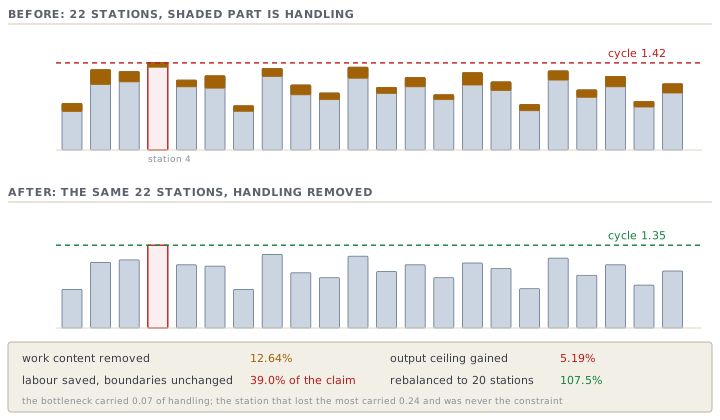
Look at station 4, then at station 11 under it. The bottleneck is station 4, and station 4 has almost no handling in it, because it is a long machine-paced run of topstitching in which the operator picks up once and puts down once. Removing handling takes it from 1.42 to 1.35 minutes and no further. Station 2 loses 0.24 minutes, but station 2 was never the constraint, so its saved seconds turn into waiting.
Line 3 runs 470 productive minutes a shift.
output ceiling before   470 / 1.42 = 330.99 pieces a shift
output ceiling after    470 / 1.35 = 348.15 pieces a shift
gain                                 5.19%
5.19% against a claim of 12.64%. Both figures are honest. They are answers to different questions. 12.64% is how much work left the garment. 5.19% is how much faster the line can now run, and only the second one makes garments.
The line does not reach its ceiling. It makes 266.45 pieces a shift, which is 80.5% of the ceiling and is what a measured 62% efficiency across twenty-two stations comes to. That ratio comes from absence, quality stops and machine breakdowns. The transporter touches none of them, so it survives the change: afterwards the line makes 280.27 pieces.
What that is worth, and what it is not
Twenty-two operators for 470 minutes each at USD 0.0810 an attended minute is USD 837.54 a shift of direct labour, whatever the line produces.
before      USD 837.54 / 266.45 pieces = USD 3.1433 a garment
after       USD 837.54 / 280.27 pieces = USD 2.9884 a garment
saving                                   USD 0.1550 a garment
Against the claim, which is 3.04 standard minutes at USD 0.1306 = USD 0.3970 a garment:
The machine delivered 39.0% of its rating, and the shortfall could have been worked out from one column of an existing time study before anybody asked for a price.
The rest of the money is in the rebalance, and it is bigger
There is a second number in that table that has been sitting there unused. Total work content fell from 24.06 to 21.02 standard minutes. Balance efficiency — work content divided by the number of stations times the bottleneck time — tells you what the line is doing with it.
before                24.06 / (22 x 1.42) = 77.0%
after, unrebalanced   21.02 / (22 x 1.35) = 70.8%
The machine made the line's balance worse, and it was always going to, because it removed work unevenly: 0.24 minutes from one station and 0.07 from another. That is not a fault in the machine. It is what happens when you subtract different amounts from different stations and leave the station boundaries where they were.
Move the boundaries. At the new cycle of 1.35 minutes, 21.02 minutes of work fits into twenty stations at a balance efficiency of 77.9% — slightly better than the line had before the machine arrived.
22 stations, after   USD 837.54 / 280.27 = USD 2.9884 a garment
20 stations, after USD 761.40 / 280.27 = USD 2.7167 a garment| Labour a garment | Saving against before | Share of the claim | |
|---|---|---|---|
| Before the transporter, 22 stations | USD 3.1433 | ||
| After, 22 stations, boundaries unchanged | USD 2.9884 | USD 0.1550 | 39.0% |
| After, rebalanced to 20 stations | USD 2.7167 | USD 0.4266 | 107.5% |
The rebalance is worth USD 0.2717 a garment and the machine is worth USD 0.1550. The rebalance is worth 1.75 times the machine. It also takes the total past the supplier's own claim, and that is not a mistake: rebalancing recovers balance loss that was there before the transporter arrived and had nothing to do with it. The machine created the occasion for the rebalance. It did not create most of the value.
Now price the machine on both readings. The transporter for line 3 is USD 96,000 installed, over seven years, plus USD 3,100 a year to run: a fixed charge of USD 16,814.29 a year. Line 3 makes 280.27 pieces a shift over 235 days, 65,863 garments a year.
unrebalanced   65,863 x USD 0.1550 = USD 10,208.77   less USD 16,814.29 = minus USD 6,605.52
rebalanced     65,863 x USD 0.4266 = USD 28,097.16   less USD 16,814.29 = plus  USD 11,282.87
The same machine at the same price loses USD 6,605.52 a year or makes USD 11,282.87 a year, and the difference is entirely in whether anybody moves the station boundaries afterwards.
Which is a training problem wearing a machine's clothes
Moving station boundaries means giving operators work they did not do yesterday. Of the twenty-two on line 3, 9 are trained on more than one operation and 13 are not. So the rebalance that is worth USD 11,282.87 a year is limited by a cross-training programme that nobody costed and that nobody put in the capital request.
Sevim Duran's estimate for training the thirteen to a second operation each is 26 hours of a trainer, plus roughly three weeks of reduced output on the operations being learned. She priced it at USD 4,180 all in. Against a gain of USD 17,888.39 a year — the difference between the two readings above — it is the highest-returning line item in the whole project, and it is the only one that was not on the form.
Check yourselfThe same transporter is offered for line 5, which makes a simpler overshirt. Line 5's bottleneck is a pocket-setting station at 1.18 minutes carrying 0.21 of handling, and its next-longest station is 1.09 minutes carrying 0.06. Total handling on line 5 is 2.42 standard minutes of an 18.90 SMV. Is line 5 a better or a worse case than line 3?Show the answer
Better, and by more than the totals suggest. On line 3 the constraint carried almost no handling, so removing handling barely moved it. On line 5 the constraint carries 0.21, so it drops from 1.18 to 0.97 — except that the next station only drops from 1.09 to 1.03, and 1.03 is now the highest. So the new cycle is 1.03, not 0.97, and the ceiling goes from 470 divided by 1.18 = 398.31 pieces to 470 divided by 1.03 = 456.31 pieces. That is a gain of 14.56%. Against a claim of 2.42 divided by 18.90 = 12.80%, line 5 gets more than its rating on output, while line 3 got 39.0% of it. That is the general shape: the gain depends on where the handling sits relative to the constraint, not on how much of it there is. Note also what the second station did. It became the new constraint and capped the gain at 14.56% instead of 21.65%, which is the same mechanism as line 3 in miniature, and the reason you check the top two or three stations rather than only the top one.