Lessons · Lesson 3 of 6
- 01 · Why one ply of cloth is the hard part
- 02 · What automates, and how to tell before you ask for a price
- 03 · The payback that has to survive a change of style
- 04 · The gain the rating does not give you
- 05 · What it does to the people, and what the people cost
- 06 · Year three, and the part that stops it
The payback that has to survive a change of style
Price one handling cell twice, at two plants with the same price, the same volume and the same cycle time, and find the quantity that really decides the answer.
Lesson 3 of 6 · 19 min
The proposal
Lesson 2 put 6.56 standard minutes of AK-1180 — the four patch pockets — at the top of the candidate list. This lesson prices the machine that goes after part of it.
The proposal is a panel preparation cell. It separates one pocket blank from a stack, folds it over a former, separates one front panel, lines the panel up against two reference edges, places the folded pocket on the marked position, and tacks it with two stitches. The panel then goes to a sewing operator who topstitches the pocket down as before. The cell automates the preparation, not the stitching, which is exactly what lesson 2 predicted would be automatable.
It replaces two operations from the time study: creasing four pockets at 1.68 standard minutes, and positioning and marking them at 2.64. That is 4.32 standard minutes a garment. It needs an operator to keep the stacks fed and to clear jams, measured at 0.30 attended minutes a garment. And it removes a defect: 3.4% of jackets currently need a pocket unpicked and reset, at 1.35 standard minutes, and the cell has not produced one.
The quoted machine is USD 112,000, and its cycle is 1.16 machine-minutes a garment.
What it is worth, per garment
labour removed   4.32 standard minutes x USD 0.1306 = USD 0.5642
tending added    0.30 attended minutes x USD 0.0810 = USD 0.0243
rework avoided   0.034 x 1.35 standard minutes x USD 0.1306 = USD 0.0060
benefit                                             = USD 0.5459
Note which rate each line uses. The work removed is in standard minutes and is charged at the standard-minute rate, because that is what it costs the factory to get it done at 62% efficiency. The tending added is in attended minutes, because somebody is standing there whether the cell is producing or not. Getting those two rates the wrong way round is the commonest arithmetic mistake in an automation case, and it flatters the machine by about a third.
Akbulut runs 31 styles a year with patch pockets, 78,000 garments in total, and those are the only ones the cell can serve.
gross benefit 78,000 x USD 0.5459 = USD 42,580.20 a yearWhat it costs to own, including the cost nobody puts on the capital request
depreciation     USD 112,000 over 7 years          = USD 16,000.00
power, air, service contract, consumables          = USD  6,400.00
half of one mechatronics technician                = USD 12,977.88
fixed charge                                       = USD 35,377.88 a year
Depreciation is simply the purchase price spread over the seven years the machine is expected to work.
The third line is the one that gets left out. Kadir Demirkol costs USD 14.10 an hour fully loaded, which over a working year is USD 25,955.75, and the cell needs about half of him — for the daily checks, the calibration, the style changes and the failures in lesson 6. The person costs 81.1% of the machine's yearly depreciation, and on the capital request that landed on Bayraktar's desk he did not appear at all.
Subtract, and the cell looks like a good machine: USD 42,580.20 against USD 35,377.88 is USD 7,202.32 a year of net benefit, on a USD 112,000 asset. Nobody would refuse that.
It is also wrong, because it assumes the cell runs one style forever.
The style change, and the part of it nobody counts
Akbulut's 31 pocketed styles are not one style. Each change costs three things.
Cell time. A new pocket shape needs its former changed, its gripper offsets adjusted, and its placement programme taught again against a new panel shape. Measured average over nineteen new-style starts: 300 minutes of cell time. And 300 minutes of Demirkol at USD 14.10 an hour is USD 70.50.
Panels. 34 cut panels are scrapped getting to the first good one, at USD 1.42 = USD 48.28.
And then the ramp, which is the one that is never on anybody's list. After a change, the cell does not go straight back to its steady rate. Lesson 1 explained why: the pick, the fold and the placement all depend on the cloth and on the panel's exact shape, and every one of the offsets has to be walked back inside tolerance while real production goes through. Aydemir measured the recovery over all nineteen starts. For the first 1,100 pieces of a new style the cell delivers 44% of its steady output. The rest of the work goes through by hand at no saving, and 2.1% of the panels the cell does touch in that period are marked and have to be re-cut.
benefit a piece during the ramp
  0.44 x USD 0.5459                    = USD 0.2402
  less 0.44 x 0.021 x USD 1.42         = USD 0.0131
                                       = USD 0.2271
shortfall against steady state           USD 0.5459 - USD 0.2271 = USD 0.3188 a piece
over 1,100 pieces                      = USD 350.68
one NEW style on this cell
technician USD 70.50
panels USD 48.28
ramp USD 350.68
total USD 469.46The ramp is 74.7% of the cost of a style change, and it is the part nobody sees, because it does not appear as a stoppage, a scrap ticket or an overtime hour. It appears as a machine that simply was not saving very much for a fortnight, and nobody writes that down.
A repeat style is much cheaper, because the programme and the former already exist. Demirkol reloads the stored programme and checks it again: 40 minutes, USD 9.40; 12 test panels, USD 17.04; and a shorter ramp of 400 pieces, USD 127.52. Total USD 153.96.
The same cell, at two plants, on the same day
Akbulut has a second plant at Karaman, making programme workwear for two accounts. Same group, same wages, same technician rate, same quotation, same cycle time. Its pocketed volume is also 78,000 garments a year. The only thing that differs is variety. Karaman runs 6 pocketed styles a year, of which two are new. Bilecik runs 31, of which 19 are new and 12 are repeats.
| Bilecik | Karaman | |
|---|---|---|
| Pocketed garments a year | 78,000 | 78,000 |
| Styles a year | 31 | 6 |
| New styles a year | 19 | 2 |
| Average run length | 2,516 pieces | 13,000 pieces |
| Ramp as a share of the average run | 43.7% | 8.5% |
| Gross benefit | USD 42,580.20 | USD 42,580.20 |
| Cost of style changes | USD 10,767.26 | USD 1,554.76 |
| Net benefit | USD 31,812.94 | USD 41,025.44 |
| Less fixed charge | USD 35,377.88 | USD 35,377.88 |
| Result a year | minus USD 3,564.94 | plus USD 5,647.56 |
Same machine, same price, same volume, same cycle time — and the answer is no at one plant and yes at the other. Bilecik is right to refuse the cell that Karaman is right to buy. The whole of the difference is that one plant's work arrives in runs of 13,000 and the other's in runs of 2,516.
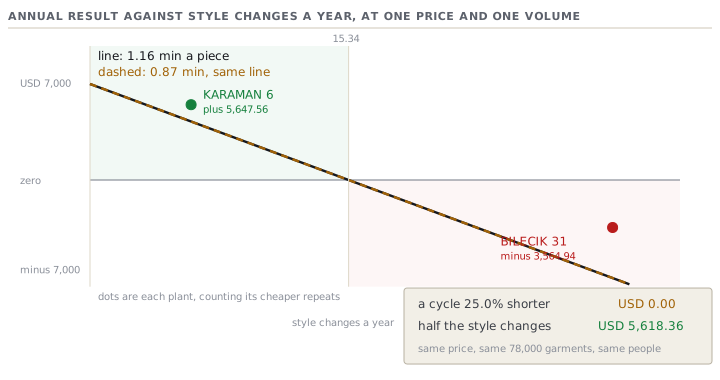
The number that decides, and the number that does not
Set the yearly result to zero and solve for the style count, holding Bilecik's twelve repeats:
USD 42,580.20 - USD 35,377.88 - (12 x USD 153.96) = USD 5,354.80
USD 5,354.80 / USD 469.46 = 11.41 new styles a year
The cell pays at Bilecik up to 11.41 new styles a year. Bilecik ran 19. Read it the other way: if every style were new, the cell needs an average run of 5,085 pieces. Bilecik's average run is 2,516. So the cell needed runs about twice as long, not a machine twice as fast.
Now test that last clause, because it is the finding of this course and it should not be taken on trust.
The supplier offers a faster set-up: the same cell at the same price, with a cycle of 0.87 machine-minutes instead of 1.16. That is a cycle 25.0% shorter.
Work through what changes. The benefit a garment is set by the labour removed, which is the same 4.32 standard minutes whatever the cell's cycle. The ramp is counted in pieces, not in minutes, so it does not change. The style change takes 300 minutes of teaching and adjustment, which is human work and does not change. Nothing in the yearly result moves at all. Bilecik still loses USD 3,564.94 a year.
What the faster cell does change is capacity, and Bilecik does not need any. At 1.16 minutes the cell uses 88.5% of its 1,880-hour year. At 0.87 it uses 68.4%. The supplier is offering spare room to a factory whose problem is not spare room.
Against that, halve the variety instead. Suppose Bilecik brings its pocketed styles down to fifteen a year, nine of them new, with the same 78,000 garments:
9 x USD 469.46 + 6 x USD 153.96 = USD 5,148.90
USD 42,580.20 - USD 5,148.90 - USD 35,377.88 = plus USD 2,053.42
A swing of USD 5,618.36 a year from halving the style count, against USD 0.00 from a cycle 25.0% shorter. That is the whole argument in two lines, and both lines were available before the quotation was signed.
The lever the arithmetic actually hands you
Look once more at where Bilecik's USD 10,767.26 goes: USD 8,919.74 of it is the nineteen new styles, and USD 1,847.52 is the twelve repeats. A repeat costs 32.8% of what a new style costs, because the programme, the former and the tolerances already exist.
So the quantity that decides is not styles a year. It is new shapes a year, and that is a commercial quantity rather than an engineering one. Every repeat order, every carried-over colourway, every buyer persuaded to keep a pocket shape across two seasons moves the number. Bilecik needed to be at 11.41 new styles and was at 19. Seven or eight orders of the year, out of a book of forty-seven, would have made a USD 112,000 machine pay.
That is a merchandising decision showing up inside a capital decision, and it is why this lesson is in a course about machines.
Prompt · Build the payback on style changes rather than on cycle time
The moment a quotation arrives for any dedicated machine or cell, and before the cycle time is discussed at all.
Act as a factory financial controller who has been burned by an automation payback that ignored variety. Build me the case properly and tell me plainly whether to buy. Facts: machine or cell [DESCRIBE], quoted price [AMOUNT], depreciation life [YEARS], running cost a year for power, air, consumables and service [AMOUNT], the share of a technician it needs and that technician's fully loaded hourly cost [NUMBERS]. Operation replaced: standard minutes removed [NUMBER], attended minutes of tending added [NUMBER], defect rate avoided and its rework time [NUMBERS], my loaded operator rate an hour [AMOUNT] and my measured line efficiency [PERCENT]. Volume: garments a year that could go through it [NUMBER], number of different styles a year [NUMBER], how many of those are new shapes and how many are repeats [NUMBERS], and the average run length [NUMBER]. Style change: machine minutes lost [NUMBER], technician hours [NUMBER], panels or pieces scrapped and their value [NUMBERS], and — ask me for this if I have not given it — the ramp, meaning how many pieces of a new style go through before the machine reaches its steady rate, and what share of its steady output it delivers during that period. Do the following. First, work out the benefit a garment, using the STANDARD minute rate for work removed and the ATTENDED minute rate for tending added, and say which rate you used on each line. Second, work out the full cost of one new-style change and one repeat change, with the ramp shown as its own line. Third, give the annual result. Fourth, solve for the break-even number of new styles a year and the break-even average run length. Fifth, hold everything else fixed and tell me what a cycle time 25 percent shorter would change, and separately what halving the style count would change, and put both in money. Sixth, check whether the cell has the hours to do the work at all, including style-change downtime. Finish with the single sentence you would say to the owner.
AI can make mistakes — check anything you act on.
Check yourselfA supplier says the ramp is a teething problem: once your technician has learned the cell, it will go away. Aydemir's 1,100-piece figure is the average of nineteen starts across the year, and the last four starts averaged 1,040 pieces against 1,190 for the first four. Is the supplier right?Show the answer
Partly, and nowhere near enough to change the answer. There is a learning effect and it is real: 1,190 down to 1,040 is a fall of 12.6% across a year of practice. But carry it forward honestly. Even if the ramp fell to zero — which it cannot, because a new pocket shape needs its offsets found no matter how skilled the technician is — the cost of a new style would fall from USD 469.46 to USD 118.78. Nineteen of those plus twelve repeats is USD 2,574.10, giving a net result of plus USD 4,628.22. So the perfect case is worth USD 8,193.16 a year against today, and it cannot be reached. The realistic case, extending the learning that was actually observed to a floor of perhaps 800 pieces, gives a ramp cost of USD 255.04 and a style-change bill of USD 8,950.10, which still leaves the plant losing USD 1,747.78 a year. Ask for the supplier's figure to be written into the acceptance test in lesson 6 with money attached, and see whether it survives contact with a signature.