Lessons · Lesson 1 of 3
Reading a slip from the outside
See a supplier's delay from the buyer's chair while it is still cheap to act, price what a week of earlier knowledge is worth, and learn why a correct escalation can make a recovery slower.
Lesson 1 of 3 · 40 min
Monday 22 June 2026
A factory falling behind rarely says so. That is usually not dishonesty. A problem admitted early belongs to the factory for months. The same problem admitted late is shared with the customer. So you have to read the delay from outside the building, from things that are not statements about the date. This lesson sets out what counts as real evidence that an order is in trouble.
You are the merchandiser at Beckwold, a British outdoor-clothing brand. One word about that job title first, because this course uses it in one sense only. In a European retailer a merchandiser is the numbers role and a buyer picks the product. Here the word means what it means on the supply side: the person who gets what was bought actually made. At Beckwold that is you.
The order on your screen is purchase order BW-40217. 24,000 pieces of HZ-6042, a men's half-zip knit in a merino-wool blend, 12 gauge, four colours. It is made by Turag Knitwear in Gazipur, Bangladesh. The price is FOB Chattogram USD 12.60. FOB means free on board: Beckwold pays for everything from the moment the goods are loaded onto the ship, and Turag pays for everything before that. Order value USD 302,400. The goods go on board on 12 September.
What makes this a buyer's order rather than a factory's is what sits on the other side of it. Beckwold has already sold 21,300 of those pieces to 84 independent shops at USD 27.00 wholesale. Every order confirmation promises delivery between 5 and 20 November. The remaining 2,700 are for Beckwold's own online shop at USD 62.00.
By the time the garment reaches Beckwold's warehouse it has cost USD 15.04. That is the landed cost: the FOB price of USD 12.60, sea freight and handling USD 0.31, duty and customs clearance USD 1.94, and trucking from the port USD 0.19. The duty line comes from Beckwold's own landed-cost model and is here to make the sums work. How a duty rate attaches to a garment is course 8.5's subject, not this one.
So the plan earns USD 381,540 of gross profit. Every number in this course is measured against that.
Nothing on your screen is red. This lesson is about the fact that the order is already about a month late, and the only person who could tell you so has not been asked a question that makes it awkward to say yes.
A buyer sees different signals, and they arrive earlier
Course 7.5 teaches the factory's own early-warning signals: the status that has not moved, the spare time that shrank in silence. Do not expect to see those. You are not in the building. What a buyer gets instead is the supplier's behaviour. Behaviour moves before a forecast does, because a forecast is a commitment and behaviour is not.
Four things are on your desk this morning. None of them says anything is wrong.
How long replies take. Farhana at Turag used to answer inside four working hours. Over the last five weeks the middle value has moved to 31 hours, and three of the last six replies came from somebody else in her team. Nobody has gone quiet. The answers have simply moved further from the person who knows.
The shape of the answer. Of your last twelve exchanges with Turag, nine contained a specific date. Of the last six, two do. The rest contain verbs: following up, pushing, arranging. A supplier who has a date gives you a date, because it is the cheapest thing they own.
The asks. Three requests in five weeks. Extend the size-set approval deadline by a week. Accept a different yarn thickness on one colour. Split the shipment "for our planning". Each of those buys the supplier days from you before they tell you they need days. Count the asks. The count is the signal, not any one of them.
Evidence you can get and a factory cannot. Beckwold chose the spinner, the mill that turns fibre into yarn. That is a buyer's privilege and almost nobody uses it. You can telephone Hemayetpur Spinning and ask about your own yarn without going through Turag at all. You do that at 11:00. The answer is that Beckwold's four colours have not entered dyeing, they are queued behind two other lots, and the earliest they enter is 6 July.
Your calendar needs that yarn at Turag on 3 July.
The supplier's forecast is the last thing to move
This is the single most useful thing to understand about a delay seen from outside. A factory's reported ship date does not track the goods. It tracks the factory's willingness to admit a change. It moves after the fact, not before it, and it moves in one step, when hiding the problem stops being possible.
So it is worthless as an early warning, and on its own it is not evidence of anything. What counts as evidence is narrow, and it is the same test in every country.
- A date with a machine behind it. The dyeing date at the spinner with a batch reference. The number of knitting machines set aside for you and from when. The date linking starts, which is the operation that joins knitted panels into a garment. Whose order is in front of yours.
- A document a third party could check. A yarn contract number, a dye-lot card, a booking reference, an inspection appointment.
- A quantity that moved since last week, stated as a number rather than as progress.
"We will catch up" is not evidence. Neither is a managing director's assurance. A revised cutting date with machine time behind it is evidence. Everything else is intention. It is honestly meant and it is worth nothing.
What the record says to expect
You are not guessing. Turag has run 14 orders for Beckwold over eight quarters and delivered 12 of them inside the window. How that record is built is course 27.5's subject. Here you only read it. What matters is the line underneath: in 3 of those 14 orders the yarn had not left the spinner eleven weeks before the ship date, and all three shipped late, by 18, 24 and 31 days.
Today you are twelve weeks out and the yarn has not entered dyeing.
Be honest about what that is. Three orders is not a reliable rate. It is three orders. But you do not need a reliable rate to make this decision, as the next section shows. You need to clear a very low bar, and three out of three clears it without having to be precise.
What a week of earlier knowledge is worth
Beckwold's cheapest lever has nothing to do with the factory. A lever here is a move you can still make, and each one closes on its own date. It is to ask the 84 shops to move their delivery window from 5 to 20 November to the same dates in December. Ask now, while their own season plans are still open.
It is not free. Telling a shop your delivery is a month later invites some of them to reduce their order. Last June, Beckwold moved a window on a different range and 3 of 61 shops cut their orders, worth 4% of the units. Apply that here. 4% of 21,300 is 852 pieces, at USD 11.96 of gross profit each. That is an expected cost of USD 10,190.
What it avoids is the next lesson's subject, but you can size it today. A delay of the length the record predicts puts delivery around 24 November, four days past the window. That costs Beckwold USD 98,790 in cancelled and discounted orders.
Divide one by the other. USD 10,190 against USD 98,790 is a break-even chance of 10.3%. Moving early pays if there is better than a one-in-ten chance of a delay. The evidence in front of you is three out of three.
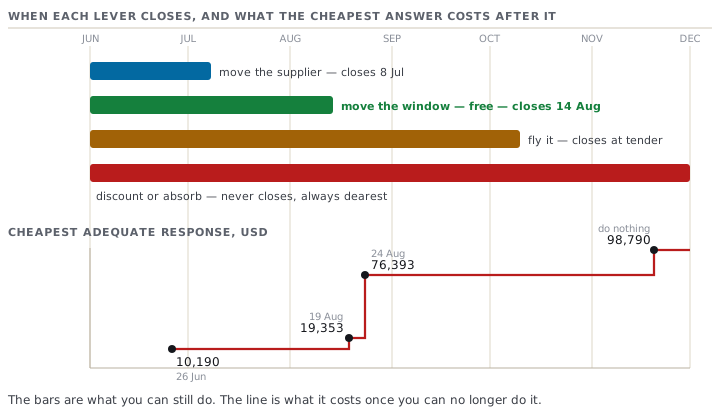
That is the whole argument for acting early. Notice what it does not require. It does not require certainty, a confession from the supplier, or a revised date. It requires only that the cheap action be much cheaper than the expensive one, which it almost always is. The cheap action is bought from your own customers. The expensive one is bought from an airline.
The reason people do not take it has nothing to do with the arithmetic. The early cost is certain, visible and yours. The late cost is uncertain, invisible in June and, in most companies, somebody else's in November.
The escalation that was correct, and made it worse
On Wednesday 24 June you escalate, and you do it properly.
You write to Imran, Turag's managing director. You copy Marta, Beckwold's sourcing director. You state the facts with dates: yarn not in dyeing, the spinner's own earliest date 6 July, your requirement 3 July, the ship date at risk. You attach the spinner's reply. You ask for a written recovery plan by Friday 26 June. There is no accusation in it and no threat.
Every part of that is correct practice, and it made the recovery slower.
The plan arrived on 8 July, twelve days later instead of two. It said on board 12 September. It contained no dyeing date, no machine numbers and no linking start. There was nothing behind it at all. And Farhana could no longer answer without clearance. On a Thursday telephone call she would have told you the yarn was still queued, because saying so cost her nothing.
That is what escalation does inside a supplier. It raises the price of admitting a delay. A status report becomes a negotiating document, and a negotiating document contains the date the customer wants to hear. You did not get a better answer. You got a more expensive one, and you got it later.
The second effect was worse, and it was on Beckwold's side of the wall. From 26 June the window move sat "pending Turag's recovery plan". When the plan arrived on 8 July saying 12 September, it was believed, because it came from a managing director. By 14 August, when the truth came out, the shops' own season plans were set and the free lever was gone.
The escalation cost no time at all. It cost the option, and the option was worth USD 88,600 on the arithmetic available in June.
When escalation is the right tool
It is right when the constraint sits inside the supplier's own control and they are not using it: a production line given to another buyer, a subcontractor not booked, an approval sitting on a desk. It is right when you need a commitment the working level cannot give, such as reserved capacity or a price. It is right when the failure is one of conduct rather than capacity, because hiding a problem is a director's business and not a merchandiser's. And it is right when you are about to spend money and need a signature against it.
When you send it, put a named decision and a date in it rather than "please advise". An escalation that asks for a plan gets a document. An escalation that asks a named person to confirm one thing by a stated day gets an answer.
Prompt · Test a reassurance against evidence, from outside the factory
When a supplier's reports still say the date is safe and you cannot say why you do not believe them.
Act as an experienced sourcing manager at a brand, who buys from factories and has never worked inside one. I need to decide whether an order is slipping, using only what a buyer can see. Order facts: buyer [BRAND], PO [NUMBER], style [STYLE], quantity [QTY] pieces, FOB [PRICE], supplier [FACTORY] in [COUNTRY], contracted ship date [DATE]. My own downstream commitment: [WHOLESALE ORDER BOOK / STORE LAUNCH / DELIVERY WINDOW AND ITS DATES]. Nominated suppliers I appointed myself: [SPINNER / MILL / TRIM SUPPLIERS AND WHAT THEY OWE ME]. Do the following. First, list the buyer-side signals I should measure and give me the actual measurement for each from the data I paste below: reply latency over time, how many of my last exchanges contained a specific date, the number and nature of requests the supplier has made of me, and any deadline they have asked to move. Second, sort every claim my supplier has made into EVIDENCE and INTENTION, where evidence means a date with a named machine behind it, a document a third party could check, or a quantity that has moved since last week — and say plainly which claims have nothing behind them. Third, write the exact questions I should put to each nominated supplier directly, without going through the factory. Fourth, tell me which of MY OWN decisions are still reversible and on what date each stops being cheap — and price the cheapest one. Fifth, give me the break-even probability at which acting early pays, as a single percentage, from the cost of the early action and the cost of the slip. Do not tell me to ask the factory whether the date is safe. Here is what I have: [PASTE THE LAST SIX WEEKS OF CORRESPONDENCE, THE WEEKLY REPORTS AND THE CRITICAL PATH].
AI can make mistakes — check anything you act on.
Check yourselfYour factory's weekly report has said the ship date is safe for six weeks and it is still saying so. Is that reassuring, worrying, or neither?Show the answer
Neither, on its own. A reported ship date is not an observation of your goods. It is a statement of what the supplier is currently willing to commit to, and it moves after the fact rather than before it. Go and find something with a machine behind it: the dyeing date at the spinner with a batch reference, the number of knitting machines set aside for you and from when, whose order is in front of yours. If nobody can produce one, the progress being described does not exist. And use the source a factory cannot use. Telephone the supplier you nominated yourself.
Check yourselfMoving your customers' delivery window costs an expected USD 10,190 in reduced orders. Doing nothing costs USD 98,790 if the order is late. How likely does the delay have to be before you move the window?Show the answer
About one in ten. USD 10,190 divided by USD 98,790 is 10.3%. That is the whole calculation, and it is why acting early on incomplete information beats acting late on certainty almost every time: the early move is bought from your own customers and the late one is bought from an airline. On this order the evidence available was three comparable orders, all three of which shipped late, so the bar was cleared many times over. Note what the arithmetic does not need: a confession, a revised date, or certainty of any kind.
What you own by Friday
Three things. A dated note of every independent source you called this week and what each one said, with a blank where nobody could evidence a claim, because the blanks are the report. A written statement of your own side's cheap, reversible decision, the window move, with the date it stops being cheap written on it. And, if you escalate, a message naming one person, one decision and one date.
The next lesson is 19 August, when the free lever is gone and the menu costs money.