Lessons · Lesson 2 of 3
The options, priced
Price every move a buyer can make on a late order — air, split, short-ship, move the window, move the supplier, discount — on one order book, and find the rule that says which unit belongs on an aeroplane.
Lesson 2 of 3 · 44 min
Wednesday 19 August 2026
Once a delay is certain, every remaining choice costs money. They cost it in kinds you cannot compare as they stand. A discount is not a freight bill, and a freight bill is not a customer walking away. The work here is to turn them all into one figure, so that a decision can be made at all. Then it asks which garments are worth putting on an aeroplane.
Turag's revised plan arrives, and this one is evidence. Yarn into dyeing 26 July. Yarn onto the knitting floor 24 August, with 46 knitting machines set aside from that date. Linking from 7 September. Out of the factory 6 October, on board 10 October. Twenty-eight days late, with machine time behind every line of it.
Follow it through Beckwold's own calendar rather than Turag's. Twenty-six days at sea puts the container in Felixstowe on 5 November and in the warehouse on 12 November. Beckwold's warehouse needs twelve days to receive the goods, pick them and send them out to 84 shops. The first deliveries leave on 24 November, four days past the window written into every order confirmation.
The original plan had nine days of spare time in it. On board 12 September, into the warehouse 15 October, deliveries able to start 27 October against a window opening 5 November. That spare time is gone, and thirty-two days of exposure are sitting behind it.
Your order book is not one customer
The first move is not a decision. It is a measurement. Twenty-one thousand three hundred units of exposure is not one exposure. It is three, and until you split it you cannot price a single option on the menu.
Petra's sales team asks all 84 shops, in writing, one question: what is the last date you can receive this and still get it onto the shop floor. Two days, and the book comes back in three pieces.
- 19 shops, 6,400 units. They cancel if it is not delivered by 20 November. Their Christmas floor plans are printed and a substitute is already ordered.
- 44 shops, 11,700 units. They will accept up to 30 November at full price if you ask in advance. After that they cancel too.
- 21 shops, 3,200 units. They will take it any time up to 20 December.
And 2,700 units for Beckwold's own online shop, which has no cancellation clause at all, because you cannot cancel on yourself. The only part of an order book that cannot walk away is the part you sell direct. That is worth remembering when a range is being planned, not when it is late.
That answer is evidence because it is written down. "They will be fine" is not a segment. It is a hope.
The menu
| Option | What it costs | Loss against plan |
|---|---|---|
| Do nothing; deliver from 24 November | nothing directly | USD 98,790 |
| Ask the book to accept 24 November | nothing | USD 67,200 |
| Blanket 10% discount to hold the whole book | USD 57,510 in discount | USD 57,510 |
| Air the whole order | USD 81,920 of freight | USD 74,480 |
| Air the 6,400 that will cancel; ask the rest to accept 24 November | USD 26,793 of freight | USD 19,353 |
| Air the 18,100 that could cancel; ask the rest | USD 65,143 of freight | USD 57,703 |
| Short-ship 7,100 and cancel the balance | USD 74,360 of yarn liability | USD 371,176 |
| Move the order to Karabel Konfeksiyon | USD 148,800 and fourteen weeks | it cannot be done in time |
Everything below is that table explained. The second column and the third are different kinds of money made comparable, and that conversion is the whole job.
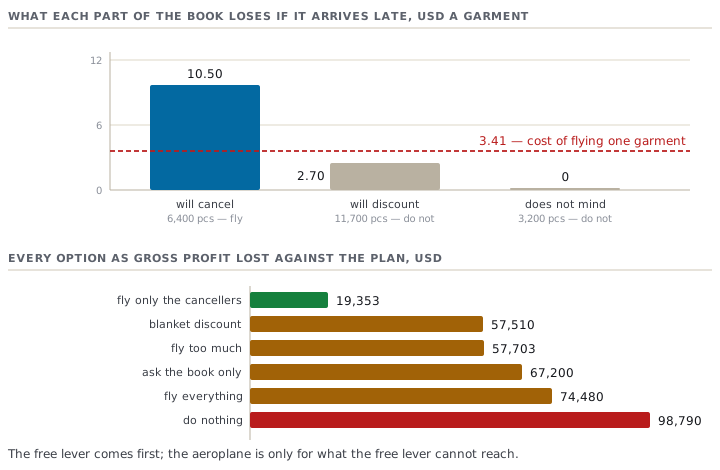
Doing nothing is not free. Nobody sends you a bill for it. The 6,400 cancel and the goods go to Lindhurst Trading, a wholesaler that buys unsold stock cheaply, at USD 16.50 against a landed cost of USD 15.04. They still make USD 1.46 instead of USD 11.96, so each one loses USD 10.50. The 11,700 receive late goods against a written window and take the contractual 10% late discount, which is USD 2.70 a unit. The 3,200 pay in full. Add it up and doing nothing costs USD 98,790.
Asking is the same delivery with a different piece of paper. Segments two and three agree in advance to 24 November and pay in full. The 19 hard shops refuse. It costs nothing and saves USD 31,590 against doing nothing, which is the difference between a late delivery and a revised one. Always spend the free lever before the expensive one. Most people reach for the aeroplane first, because it feels like action.
Which unit belongs on an aeroplane
Air freight is charged on chargeable weight, which is the greater of what the shipment weighs and what its volume would weigh at a standard rate. On this garment the box beats the scale. A carton holds 24 pieces and measures 60 by 40 by 32 centimetres, so its volumetric weight is 12.8 kg against an actual 10.08 kg. The whole order is 131 kg to the cubic metre, well under the density at which air charges by the scale. Course 8.4 works all of that out and this course simply uses it: 1,000 cartons, 12,800 chargeable kg, and at an all-in USD 6.40 a kilo the aeroplane costs USD 3.41 a piece.
Now put that number beside the loss each unit avoids.
| Segment | Units | Loss per unit if late | Cost to fly it | Fly it? |
|---|---|---|---|---|
| Will cancel | 6,400 | USD 10.50 | USD 3.41 | yes |
| Will discount | 11,700 | USD 2.70 | USD 3.41 | no |
| Does not mind | 3,200 | nothing | USD 3.41 | no |
Air a unit only when the loss it avoids is bigger than USD 3.41, and only after the free lever has taken everything it can reach. Applied here that is 6,400 pieces, 267 cartons, 3,417.6 kg, USD 21,873. The other 17,600 go in one forty-foot container for USD 3,720, with USD 1,200 for the second set of documents and the second warehouse delivery. Total freight USD 26,793 against a planned USD 7,440, and a loss of USD 19,353. That is the best row on the menu by USD 38,157.
The rows nobody chooses, priced anyway
Short-shipping, which means sending only part of the order and cancelling the rest. Turag can finish 7,100 pieces on the yarn already dyed, and Beckwold cancels the balance. What Beckwold owes is the yarn: 0.32 kg a piece at USD 13.75 a kilo is USD 4.40, so 16,900 pieces cost USD 74,360. Gross profit falls to USD 10,364 and the loss is USD 371,176, nearly four times doing nothing. The lesson is where the damage sits. It is not what you owe on the yarn. It is the sale you have lost on goods you had already sold.
That row also gives you the rule for every future version of the question. Take the late goods unless you would have to sell them off below landed cost. At USD 15.04 landed against USD 27.00 wholesale, the break-even discount is 44.3%. The worst channel Beckwold has is Lindhurst at 38.9% off. Even the embarrassing outlet is above cost, which is why buyers accept late goods far more often than their contracts oblige them to. Cancelling is right only when the goods will not sell above the landed cost. It is also right when the money tied up in them is worth more elsewhere, which is a planning question this course does not price and tracks 16 and 17 will.
Moving the supplier. Karabel Konfeksiyon in Luleburgaz can knit it, and cannot help. Five weeks of yarn plus nine weeks of making is fourteen weeks from today: out of the factory 25 November, which is later than doing nothing. On top of that sit USD 105,600 of dyed yarn at Turag and USD 1.80 a piece more on the FOB price, which is USD 148,800 for a delivery that is worse.
The date it closed matters more than the price. On 26 June the same fourteen weeks put it out of the factory on 1 October, and Turkey is twelve days by road rather than twenty-six by sea, so it was in the warehouse on 17 October and inside the plan. It cost the same USD 148,800 then, which was more than the exposure, so it was never right. But it was an answer. An option does not only get more expensive as an order runs. It disappears, and moving the supplier disappears earliest of all.
The blanket discount. Offer all 21,300 units the 10% in advance in exchange for a written waiver: USD 57,510. Better than doing nothing and much worse than asking for free. It also carries a cost this course refuses to put a number on, because any number would be invented. You have told 84 shops that a Beckwold delivery date is worth 10% to them, and they will remember next season.
Airing everything. USD 81,920 of freight, everything on the shelf on 3 November, a loss of USD 74,480. On 19 August that is USD 55,127 worse than the clever answer and it looks like panic. Hold that thought.
The decision that was right on the day
Iris books the aeroplane for 6,400 pieces. The forwarder offers it two ways.
- A fixed allocation at USD 6.40 a kilo all-in, which she cannot give back once the goods are tendered, meaning handed over to the airline.
- A releasable block of 10,000 kg at USD 7.10, which she can give back free of charge up to 96 hours before tender.
On the 3,417.6 kg she is certain to fly, the block costs USD 2,392 more. That is about 11% of the air bill, for a right she has no reason to think she needs. She takes the fixed allocation, and on 19 August that is the correct decision on every number in front of her.
Friday 21 August. Turag reports that two of the four colours slipped eight days at the dye-house. Out of the factory 14 October, on board 18 October, into the warehouse 20 November, first deliveries 2 December.
Segment two's own limit is 30 November. Eleven thousand seven hundred units have just moved from "will accept at full price" to "cancel", and their loss per unit has moved from USD 2.70 to USD 10.50, above the USD 3.41 threshold. The aeroplane is now right for them as well.
On Monday 24 August she books 488 more cartons, 6,246.4 kg. October out of Dhaka is peak season and the all-in spot rate is USD 9.20, so that is USD 57,467 instead of the USD 39,977 the same weight would have cost five days earlier.
| Fixed allocation, as booked | Releasable block | |
|---|---|---|
| First tranche, 3,417.6 kg | USD 21,873 | USD 24,265 |
| Second tranche, 6,246.4 kg | USD 57,467 | USD 44,350 |
| Sea for the remaining 5,900 pieces | USD 2,093 | USD 2,093 |
| Two split-shipment charges | USD 2,400 | USD 2,400 |
| Total freight | USD 83,833 | USD 73,108 |
| Loss against plan | USD 76,393 | USD 65,668 |
USD 2,392 of visible extra cost would have bought a USD 10,725 better answer.
And now come back to the row that looked like panic. Airing the whole order on 19 August, rejected because it was USD 55,127 worse, would have finished at a loss of USD 74,480. That is USD 1,913 less than the clever answer actually cost.
What a menu has to have
Three things. A menu missing any one of them will not produce a decision.
- Every option, including the ones nobody chooses. You cannot know that short-shipping is wrong until it is priced. And USD 371,176 is also the number that tells you the conditions under which it would be right.
- One comparable figure on every row. Gross profit lost against the plan, never "cost". A discount, a freight bill and a cancelled order are three kinds of money, and you cannot decide between them until they are turned into one.
- The date each row closes. An option with no expiry date on it is a lie, and moving the supplier proves it: priced in June and impossible in August, at the same price.
Prompt · Price every option on a slipping order, including the ones nobody picks
The morning a revised ship date arrives and somebody asks you what you want to do about it.
Act as a commercial director at a brand who has to choose between imperfect options and wants a board, not advice. Build me a priced recovery menu for one late order. Order facts: [QTY] pieces of [STYLE], FOB [PRICE], landed cost [AMOUNT] a piece broken into FOB, freight, duty and inbound, original ship date [DATE], revised ship date [DATE], transit [DAYS] days, warehouse handling [DAYS] days. My downstream commitment: [ORDER BOOK OR LAUNCH], selling price [AMOUNT], and my planned gross profit is [AMOUNT]. Packing: [PIECES] a carton, carton [L] by [W] by [H] cm, [KG] a carton actual. Air quotation [RATE] a kilo all-in; sea [AMOUNT] for the whole order. Do the following. First, split my customers into segments by the LAST DATE each can actually receive the goods, and tell me what each segment does if it misses that date — cancels, discounts, or does not mind — and what that costs per unit. Second, compute the chargeable weight properly, actual against volumetric, say which one governs and give me the air cost PER PIECE. Third, build a table of every option, each priced as gross profit lost against the plan: do nothing, ask the customers to accept the revised date, discount to hold them, fly everything, fly only the segment that would cancel, fly more than that, short-ship and cancel the balance, and move the order to another supplier. Include the options I would never choose and price them anyway. Fourth, give me the per-unit rule: fly a unit only when the loss it avoids exceeds the cost of flying it, with the threshold as a number. Fifth, for each row give the DATE it closes. Sixth, tell me which step of my supplier's revised plan has no evidence behind it, and whether I should be buying releasable freight instead of the cheapest rate — with the premium priced. Never give me a range where a number is possible, and list every assumption at the end.
AI can make mistakes — check anything you act on.
Check yourselfFlying a piece of HZ-6042 costs USD 3.41. One group of shops will cancel if the goods are late; another will take them with a 10% discount. Which do you fly?Show the answer
The cancellers, and only them, and only after asking everybody whether they will accept the revised date for nothing. A cancelled unit loses USD 10.50, comfortably above USD 3.41, so flying it pays. A discounted unit loses USD 2.70, below USD 3.41, so flying it destroys USD 0.71 a piece. And the shops that will simply accept a revised date cost nothing at all to protect, which is why the free lever always comes first. The test is one line: fly a unit only when the loss it avoids is bigger than the cost of flying it.
Check yourselfYour supplier's revised plan names the knitting machines and their start date but says nothing about how the two remaining colours will be dyed. How firm is the plan?Show the answer
As firm as the dyeing step, which is to say not firm at all. A plan is only as firm as its least-evidenced step, and here the step with nothing behind it is the one that has already failed once. Two consequences. First, do not treat the new date as settled. Read the plan step by step and stop at the first step with no machine behind it. Second, buy your recovery in a form you can change: a releasable air booking, a container not yet tendered, a discount offered subject to confirmation. On this order an extra USD 2,392 would have bought a USD 10,725 better answer.
What you decide
Fly the shops that will cancel. Ask everybody else to accept the revised date for nothing. Buy the air space in a form you can give back. If the plan's weakest step is a step that has failed before, price the blunt option too and see how far apart they really are. On this order the gap between clever and blunt was USD 55,127 on paper, and USD 1,913 the wrong way in the event.
The next lesson is what happens when the goods have landed and somebody has to decide what to claim.