Lessons · Lesson 3 of 3
Shade, lot and money
Cost a shade by its depth, hold shade across dye lots, and take a priced decision on a repeat order that has come back visibly different.
Lesson 3 of 3 · 43 min
The situation
Two runs of the same colour, ordered months apart against one recipe, will not be identical. When the second run arrives visibly greener, nobody has made a mistake. The dye itself is sold to a tolerance. The cotton crop is different. The water is different. This lesson treats an off-shade repeat as a priced decision, not a hunt for someone to blame. It ends on planning, because a deep colour needs far more dye than a pale one.
It is 9 September, 11:40. Kellermann have repeated TS-340: 3,200 tees, Storm Navy, FOB USD 3.95, invoice value USD 12,640.00, on the water by 20 October. The May order shipped clean and sold through. That is why the repeat exists.
The fabric comes out of the dyehouse on the 8th, and the mill's own colour lab passes it: grey scale 4 against the retained standard, a colour difference of 0.9 under D65. Inside tolerance, on paper.
Then the merchandiser puts a September tee next to a May tee under the store's TL84 lamps. That is exactly what the buyer's distribution centre will do. The difference reads 1.8. Side by side on a rail, one is a shade greener than the other, and anybody can see it.
Nobody made a mistake. This is what a different dye lot looks like, and every merchandiser meets it. The job now is not to find the guilty party. The job is to pick the cheapest option the buyer will accept, today. Then to stop it happening on the next repeat.
Why a repeat is always a different lot
The recipe was identical. Almost nothing else was.
- The dyestuff came from a different production lot at the dye supplier. Commercial dyes are sold to a strength tolerance of roughly plus or minus 3 percent. A navy is a blend of three or four dyes. So the errors do not cancel out. They add up, in a direction nobody can predict.
- The fabric was knitted from a different cotton lot, with different fibre maturity and a different amount of leftover wax and seed fragment. Dye uptake follows the fabric underneath it.
- The pre-treatment ran on a different day: scouring, bleaching and, on some qualities, mercerising (a caustic treatment that adds lustre and dye uptake). A fabric that was prepared unevenly cannot be dyed evenly. More shade problems are born in preparation than in dyeing.
- The water was softer or harder. The machine was a different machine. The batch was a different weight.
This is why a professional colour instruction never says "same as last time". It says: match the retained physical standard. It names the lights — D65 first, then the store light. And it states the tolerance under both. A mill dyeing to the previous shipment is dyeing to a copy of a copy. By the fourth repeat, the shade has walked somewhere nobody approved.
One more thing worth knowing: the May order was never one lot either. TS-340 was 2,304 kg of fabric, and the jet takes 480 kg. So it ran as five batches, the last one part-loaded. Five lots left that dyehouse in May. They matched each other closely enough that nobody looked. But the practice that made that safe is the one to insist on. The mill grades every batch against the standard into shade bands A, B and C, and marks the roll ends. The cutting room then cuts and packs by band. No garment gets a body from one band and a sleeve from another. No carton mixes bands.
The four options, costed
The fabric is dyed, inspected and not yet cut. Here is the whole decision, in money.
| Option | Direct cost | Days | What you are actually betting on |
|---|---|---|---|
| Ship as it is | Nothing now. USD 1,011.20 if the 8 percent off-shade chargeback is applied | 0 | That the two lots never meet in one store. A bet you do not control |
| Correct the shade on the fabric | USD 844.80 at USD 1.10 per kg | 6 | That a shading addition lands nearer, not further. It can go the wrong way, and the fabric loses strength each time |
| Re-knit and re-dye from new yarn | USD 3,225.60 at USD 4.20 per kg, plus knitting time | 21 | Nothing. It works, and it misses the 20 October vessel, so add air freight or a late-delivery claim |
| Ship as a declared separate lot | USD 448.00 at USD 0.14 a piece for lot-coded cartons and a packing instruction | 1 | The buyer's written agreement to allocate the two lots to different doors |
The fourth option is the one experienced merchandisers reach for, and the one juniors never propose, because it needs a conversation rather than a purchase order. It costs the least. It is honest. And it works, because a shade difference is only a defect when the two lots are seen together. Retailers allocate by lot all the time. They simply need to be told, early, in writing, with a physical sample of each lot in the buyer's hands before the cartons are sealed.
The first option is the one to be most careful about. Its real cost is not USD 1,011.20. It is USD 1,011.20 if the chargeback clause is applied as written. If a store manager complains, it becomes a return of the whole repeat plus the cost of the goodwill, and the number on the invoice stops mattering.
Levelness: a bar in the fabric, and who pays for it
Uneven colour has two families, and one test settles them.
Born in the yarn. Mixed cotton lots in one blend. A difference in micronaire or fibre maturity. A count or twist variation. Two suppliers' yarn in one knitting run. Or nylon and polyester whose dye uptake differs between deliveries. The fibres take dye differently, so the fabric shows horizontal bars — called barré — that no dyehouse can remove. This is a yarn or knitting fault.
Born at the machine. A temperature ramp that climbs too fast. Poor liquor circulation. An under-loaded or over-loaded machine. Salt dosed in one shot instead of step by step. Or pH drifting during fixation, a cold spot in a winch, a tangled rope. Or — most often of all — uneven preparation, where scouring or bleaching left patches that absorb differently. This is a dyeing fault, and a re-dye will usually fix it.
The test that separates them is simple, and it decides who pays. Take a swatch, strip the colour out of it in the lab, and re-dye it flat under controlled conditions. If the bar disappears, the fabric itself is uniform, and the fault was in the dyeing. If the bar is still there after stripping and re-dyeing, the difference is in the fibre, and the fault came from upstream. Ask for that test by name, before the argument starts. Ask for it on a swatch that includes the bar and clean fabric on both sides of it.
Piece, yarn or garment: where the colour goes in
| Route | Colour committed at | Lead time from the colour decision | Minimum a mill will run per colour | Typical dyeing cost USD per kg | Where it wins |
|---|---|---|---|---|---|
| Yarn dyeing | Before knitting or weaving | 25 to 35 days | 200 kg | 1.90 | Stripes, checks, marls, and the best fastness of the three |
| Piece dyeing | After the fabric, before cutting | 12 to 18 days | 300 kg | 1.55 | The default for solid-colour knits and wovens |
| Garment dyeing | After sewing | 5 to 8 days | 40 kg | 2.40 | Late colour calls, small colour runs, washed and lived-in looks |
The cost column is the least interesting one. What you are really buying is how late you can decide the colour, and how small a colour can be.
Yarn dyeing is the earliest commitment, and the least forgiving. The colour is fixed before the fabric exists. A colour cancelled in week six is yarn nobody can use. In exchange, it is the only way to get a woven check, a yarn-dyed stripe or a heather marl. The dye also gets deeper into a loose yarn package than into a tight fabric, so fastness is usually a grade better.
Piece dyeing is the default. It is the cheapest, and the colour decision sits at a sensible point: the undyed fabric is one common stock that can still become any colour.
Garment dyeing moves the decision to the last possible moment, and drops the minimum to 40 kg, which is roughly 160 tees. That is a real commercial weapon for a retailer chasing a colour trend. It comes with a long list of conditions that must be designed in from day one. The fabric must be prepared for dyeing, not optically brightened. The sewing thread must be dyeable, and it must be the same fibre as the fabric, or it stays white. Fusible interlinings and trims must survive the bath. The pattern must carry the extra shrinkage. Retrofitting a garment-dye onto a style that was engineered for piece-dye does not work, and finding that out on the first bulk lot is expensive.
Costing a shade: depth is the price
Here is the fact most cost sheets get wrong. A black and a pale blue are not the same price per kilogram. The dye is dosed as a percentage of the fibre's weight, and a deep shade needs many times more of it.
| Shade | Depth on weight of fibre | Dye needed | Dye price USD per kg | Dyestuff USD for the batch | Dyestuff USD per kg of fabric |
|---|---|---|---|---|---|
| Ecru, very pale | 0.15% | 0.72 kg | 18.00 | 12.96 | 0.03 |
| Pale blue | 0.60% | 2.88 kg | 18.00 | 51.84 | 0.11 |
| Mid blue | 2.00% | 9.60 kg | 18.00 | 172.80 | 0.36 |
| Storm Navy | 4.50% | 21.60 kg | 16.00 | 345.60 | 0.72 |
| Deep red | 5.50% | 26.40 kg | 26.00 | 686.40 | 1.43 |
| Reactive black | 7.00% | 33.60 kg | 14.00 | 470.40 | 0.98 |
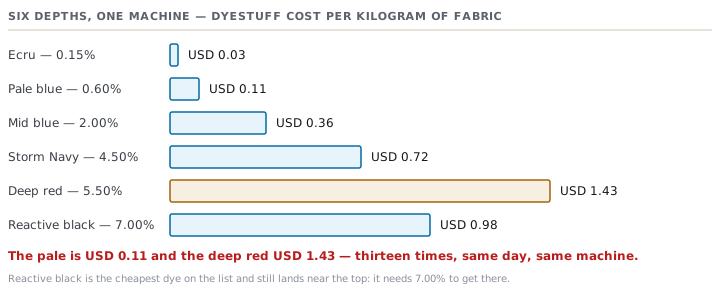
The pale blue costs USD 0.11 per kilogram in dye. The deep red costs USD 1.43. Thirteen times as much, on the same fabric, in the same machine, on the same day. Reactive black is the cheapest dye on the list at USD 14.00 per kg, and it still lands at USD 0.98, because it needs 7.00% to get there. And if the fastness specification allows it, the same black run on sulphur at 12.00%, with dye at USD 4.00 per kg, costs USD 0.48 per kilogram of fabric. Half the reactive black. That is exactly why the cheap end of the market is full of sulphur blacks, and why they rub off.
So a dyeing price list should be banded by depth. A mill that will not band it is averaging across your colour card, at your expense.
| Band | Depth on weight of fibre | All-in dyeing USD per kg |
|---|---|---|
| Bleach and optical white | No dye | 0.85 |
| Pale | Up to 0.75% | 1.15 |
| Medium | 0.76% to 2.50% | 1.55 |
| Dark | 2.51% to 5.00% | 2.10 |
| Black, navy and deep red | Above 5.00% | 2.65 |
Take the colour card for a season. Put every colour in a band. Multiply by the fabric weight in that colour. Now you have a dyeing cost that is right, instead of an average that is wrong in both directions. It usually changes which colours are worth carrying.
Check yourselfA buyer asks you to guarantee that a repeat in February will match this season's bulk exactly. What do you commit to, and what do you refuse?Show the answer
Commit to matching the retained physical standard, not the previous shipment, with the tolerance and both lights named. For example: grey scale 4 minimum, and a colour difference of no more than 1.0 under D65 and under the store light. Commit to sending a bulk-lot sample of the repeat for approval before cutting, and to lot-coded cartons so the buyer can allocate. Refuse to guarantee that two dye lots produced nine months apart, from different dyestuff lots, different cotton and different water, will look identical side by side. No dyehouse on earth can promise that. A promise you cannot keep turns a normal shade variation into a breach of contract. The professional answer is a tolerance and a lot-management plan, not a guarantee.
Check yourselfYour colour card for next season has 14 colours. Four of them are ordered in quantities of about 500 pieces each. Why is that a problem, and what are the two ways out?Show the answer
At roughly 0.24 kg of fabric per tee, 500 pieces is 120 kg. A piece-dyeing minimum is around 300 kg. So each of those four colours is a short batch. Either you pay a short-batch surcharge, or you dye 300 kg and carry 180 kg of fabric per colour that nothing needs, four times over. There are two ways out. One: consolidate the colour card so no colour falls below the floor. That is a merchandising decision the buyer has to make with you. Two: move those four small colours to a garment-dyed programme, where the minimum is about 40 kg — provided the style was engineered for it, with prepared-for-dye fabric, dyeable thread and trims, and the shrinkage in the pattern.
Prompt · Price the four options on an off-shade lot
The morning a repeat lot comes out visibly different from the bulk it has to sit beside, and a decision is needed before the fabric is cut.
Act as a senior merchandiser who has settled shade disputes before. A dye lot has come out off-shade and I need the options priced, not an opinion. Facts: buyer [BUYER], PO [NUMBER], style [STYLE], quantity [PCS], fabric weight per piece [KG], FOB [PRICE] USD, ship date [DATE], and the goods are currently [GREIGE / DYED FABRIC ON THE ROLL / CUT PANELS / SEWN GARMENTS]. The measured result is [GREY SCALE GRADE] against the standard and a colour difference of [VALUE] under D65 and [VALUE] under [STORE ILLUMINANT]. The contract says [PASTE THE SHADE TOLERANCE AND ANY CHARGEBACK CLAUSE]. The previous bulk this must sit beside was [DESCRIBE, WITH DATE]. Do the following. First, tell me whether this is inside or outside the contractual tolerance, separately for each illuminant, and say whether the difference is likely metameric. Second, price these four options in dollars and days: ship as is with the chargeback risk stated as an expected cost, correct the shade on the fabric, remake from new fabric, and ship as a declared separate lot with lot-coded cartons. Third, for each option name what can go wrong and what it would then cost. Fourth, tell me which option to open the conversation with and draft the message to the buyer, stating the facts plainly and proposing lot allocation. Fifth, tell me the one clause to add to the next contract so this is handled before it happens. Do not recommend shipping without disclosure.
AI can make mistakes — check anything you act on.
Prompt · Turn a colour card into a shade-banded dyeing cost
When a season's colour card is set and you want the dyeing cost per colour built from depth of shade instead of one averaged rate.
Act as a garment costing specialist who understands dyehouse economics. I want the dyeing cost of a season's colour card built from depth of shade, not from an average. Facts: fabric [COMPOSITION, CONSTRUCTION, GSM], dye class [CLASS], fabric weight per garment [KG], and the colour card is: [PASTE EACH COLOUR WITH ITS QUANTITY IN PIECES AND ITS PANTONE OR SHADE NAME]. The mill's dyeing minimum per colour is [KG] and its quoted price is [PASTE THE QUOTATION]. Do the following. First, put every colour into a depth band — bleach and optical white, pale, medium, dark, and black or navy or deep red — and say which band and why, flagging any colour you are unsure about rather than guessing. Second, convert each colour's piece quantity into kilograms of fabric and mark every colour that falls below the mill's minimum, with the short-batch surcharge or the leftover fabric it implies, in dollars and per piece. Third, build a dyeing cost per kilogram and per garment for each colour from its band, and total the card. Fourth, compare that total against the mill's flat quoted rate and tell me who is winning on which colours. Fifth, list the colours that would be cheaper to consolidate or to move to a garment-dyed programme, and say what the style would need for that to be possible. Show the arithmetic for every colour.
AI can make mistakes — check anything you act on.