Lessons · Lesson 2 of 3
The machine, the liquor ratio and the bill
Work a liquor ratio through water, salt, chemicals and energy, and read a dyeing quotation as the machine decision it really is.
Lesson 2 of 3 · 42 min
The situation
Ask a dyehouse which machine your cloth is going into. The answer sounds like a scheduling detail. It is really the largest cost decision anyone will take on your fabric. It turns on one number: how much water the machine needs for each kilogram of cloth. This lesson explains that number, then follows it through the whole bill.
Same mill, next morning. The dyeing manager at Ravi has two machines free for the Kellermann cotton jersey. One is a soft-flow jet that runs at a liquor ratio of 1:8. The other is an old winch that runs at 1:20. Both will dye 500 kg. Both will produce Storm Navy. The winch is free today. The jet is free on Thursday.
Your instinct says this is a scheduling question. It is not. It is a USD 4,795.20 question on this order alone. And nobody in the room will raise it unless you do.
What a liquor ratio actually is
The liquor ratio compares the weight of dry fabric in the machine with the volume of water it is swimming in. 1:8 means eight litres of liquor for every kilogram of fabric. A 500 kg batch at 1:8 has 4,000 litres in it. The same batch at 1:20 has 10,000 litres.
That is the whole definition. And almost every running cost in a dyehouse hangs off it.
The reason is a distinction worth getting exactly right, because this is where most people's instinct fails:
- Dyestuff is dosed on the weight of the FIBRE. A navy at 4.5% on weight of fibre needs 22.5 kg of dye on a 500 kg batch. That is true whether the machine holds 4,000 litres or 10,000. Dye cost does not move with the liquor ratio at all.
- Salt, alkali and most auxiliary chemicals are dosed on the VOLUME of the bath, in grams per litre. Their job is to change the chemistry of the water. Double the water and you must double the salt to get the same effect.
- Water, effluent and the energy to heat the water clearly scale with volume too. Effluent is the used water the mill pays to discharge.
So the liquor ratio leaves the biggest line on the recipe untouched, and multiplies every other line. That is why a mill that has invested in low-liquor machines is genuinely cheaper on mid and pale shades, and barely cheaper on blacks. It is also why a buyer's sustainability team and your costing sheet want the same thing, for once.
The same recipe, two machines
Storm Navy, reactive, 4.5% on weight of fibre. Salt at 70 g/l, soda ash at 20 g/l, dye at USD 16.00 per kg.
| Line | Soft-flow jet at 1:8 | Winch at 1:20 |
|---|---|---|
| Litres in the dyebath | 4,000 | 10,000 |
| Salt required at 70 g/l | 280 kg | 700 kg |
| Soda ash required at 20 g/l | 80 kg | 200 kg |
| Total water including rinses, litres | 32,000 | 68,000 |
| Water and effluent at USD 1.10 per cubic metre | USD 35.20 | USD 74.80 |
| Salt at USD 0.09 per kg | USD 25.20 | USD 63.00 |
| Soda ash at USD 0.42 per kg | USD 33.60 | USD 84.00 |
| Steam and power | USD 66.00 | USD 138.00 |
| Dyestuff, 22.5 kg at USD 16.00 | USD 360.00 | USD 360.00 |
| Total for the batch | USD 520.00 | USD 719.80 |
| Per kilogram of fabric | USD 1.04 | USD 1.44 |
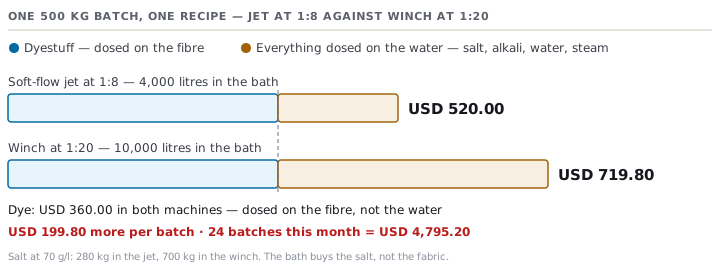
USD 199.80 per batch. The Kellermann cotton is 2,304 kg. But Ravi runs this shade for three customers this month, and the total is 12,000 kg. That is 24 batches of 500 kg. USD 4,795.20, on a decision that was framed to you as "the winch is free today".
Per garment it is small, and it is still real. USD 1.04 per kg on a tee that carries 0.24 kg of fabric is USD 0.25 of dyeing. USD 1.44 is USD 0.35. About USD 0.10 per tee, or USD 960.00 across the 9,600 pieces of TS-340.
Where the energy goes
Water takes about 4.2 kilojoules to lift one kilogram by one degree. Heating 4,000 litres from room temperature to 60 °C — call it a 30 degree lift — takes roughly 504,000 kilojoules. The same lift on 10,000 litres takes 1,260,000.
Now remember that a reactive dyeing is not one heating step. There is the dyebath itself. Then a hot rinse. Then a soaping at 95 °C to pull out the dye that reacted with the water. Then another hot rinse. The heating happens four times. On the winch you pay for two and a half times the water on every one of them. That is the steam line in the table, and it is the line that moves most when gas prices move.
The salt line matters for a second reason. It will reach you as a buyer requirement before it reaches you as a cost. Salt is not removed by a normal effluent treatment plant. It goes out with the discharge. A mill that wants to answer a brand's wastewater questionnaire honestly has exactly three levers: a lower liquor ratio, low-salt reactive dyes, or salt recovery, which almost nobody has. When a brand's sustainability standard arrives asking about discharge, it is asking about this table.
The machines, and what each is for
| Machine | What it dyes | Typical liquor ratio | Batch range | Where it earns its place |
|---|---|---|---|---|
| Soft-flow or overflow jet | Knits and polyester, in rope form | 1:5 to 1:10 | 100 to 1,200 kg | The workhorse of knit dyeing; holds pressure to 130 °C |
| Winch or beck | Delicate knits, low tension, atmospheric only | 1:15 to 1:30 | 50 to 400 kg | Cheap to buy, expensive to run, gentle on the fabric |
| Jigger | Wovens, open width, on a roll | 1:2 to 1:5 | 500 to 3,000 m | No rope creasing; high tension, so not for knits |
| Pad-batch, cold | Cotton wovens and knits, reactive only | Pick-up about 70% | Continuous | Lowest water and energy per kg by a long way |
| Package dyeing | Yarn on perforated cones | 1:8 to 1:12 | 100 to 800 kg | Yarn-dyed stripes, checks, sweater yarn |
| Beam | Warp yarn, linings, light wovens | 1:8 to 1:12 | 150 to 600 kg | Warp sets for weaving, low creasing |
| Garment machine, paddle or rotary | Made-up garments | 1:15 to 1:25 | 30 to 300 kg | Late colour, small colour runs, washed looks |
Three of those rows deserve a sentence each, because they are where a merchandiser's decision changes the answer.
Pad-batch is the cheapest cotton dyeing there is, and hardly anyone asks for it. The fabric is passed through a trough of concentrated reactive dye and alkali, wound onto a roll, wrapped, and left to turn slowly for 4 to 12 hours while the dye fixes at room temperature. No dyebath to heat. No salt at all. And the fabric picks up only about 70% of its own weight in liquid, instead of eight times its weight. The catch: it wants long, uniform runs of open-width fabric, it cannot do polyester, and the shade is set by the pad trough, so a correction means re-padding the whole roll. For a large, single-shade woven order it is the right answer. And it is almost never on the quotation unless you ask.
A jigger dyes in open width. That matters for any fabric that creases when wet and remembers the crease: poplin, viscose, satin. A woven shirting run in rope form on a jet comes out with rope marks down its length, and no finishing removes them. If your fabric is a woven and the mill's quotation is built on jet capacity, ask which machine your fabric is actually going into.
Garment dyeing is in the machine table because it belongs there. But it is a different commercial animal, and lesson 3 takes it properly. Note only the liquor ratio: 1:15 to 1:25, because loose garments need room to tumble. Garment dyeing is expensive per kilogram, and its value is never cost.
Batch size is not a rounding decision
Every one of those machines has a minimum viable load, usually around 60 percent of its rated capacity. Below it the fabric rope does not circulate properly. The fabric sits, and the result is uneven. A 500 kg jet will not dye 120 kg well. A mill that agrees to try will either run it at the correct load and charge you for 300 kg anyway, or run it badly.
That gives a hard commercial rule. A colour is a batch, and a batch has a floor. An order of 600 tees is 144 kg of fabric. If the mill's minimum for piece-dyed knit is 300 kg, the choice is simple: pay a short-batch surcharge, or dye 300 kg and carry 156 kg you did not need. At USD 4.20 per kg of finished fabric that leftover is USD 655.20. That is USD 1.09 on every one of the 600 pieces, which on a mid-market tee is most of the margin.
The lever is not to argue with the mill. It is to design the colour card so that no colour falls under the floor. Fewer colours in bigger quantities. Or group the small colours into a garment-dyed programme, where the floor is 40 kg instead of 300.
Check yourselfYour dyer says he can save you money by dropping the liquor ratio from 1:10 to 1:6 on a reactive mid-blue. Which lines on the cost sheet move, which do not, and what new risk have you taken on?Show the answer
The dyestuff line does not move. Dye is dosed on the weight of the fibre, so a 4.5% shade is the same kilograms of dye at either ratio. Everything dosed in grams per litre falls with the volume — salt and soda ash by roughly two fifths — and so do water, effluent and the steam to heat it. The new risk is levelness and repeatability. Less liquor means less room for the fabric to circulate, and a faster, harsher exchange between bath and fibre. So the circulation, the temperature ramp and the salt dosing profile all have to be controlled better than they were at 1:10. On a lightweight open knit it is usually fine. On a heavy fleece or an elastane blend, a ratio that is too tight buys you rope marks and creases that cost far more than the salt.
Check yourselfA woven viscose blouse fabric has been quoted by a knit dyehouse at their standard jet price. What is wrong, and what do you ask for?Show the answer
Viscose in a woven construction creases badly when wet, and it holds the crease permanently. A jet dyes in rope form. So the fabric will come out with rope marks down its length. No finishing removes them, and the problem only becomes visible after cutting. The fabric needs open-width dyeing — a jigger, or a beam — and the price for that is not the jet price, because the machines, the batch sizes and the speeds are different. Ask the mill to confirm in writing which machine the fabric will run on. Ask for a bulk-process trial of at least one full roll, not a lab dip. And be ready for the honest answer, which is that a knit dyehouse should not be dyeing this fabric at all.
Prompt · Audit a dyeing quotation for the machine it hides
When a mill has quoted one price per kilogram and you want the water, salt, energy and machine assumptions behind it made visible.
Act as a dyehouse cost engineer. I have a dyeing quotation and I want to know what machine and what liquor ratio it assumes. Order facts: fabric [COMPOSITION AND CONSTRUCTION], total quantity to dye [KG], number of colours [NUMBER], quantity per colour [PASTE THE SPLIT], dye class [CLASS], shade depths [LIST BY COLOUR, PALE / MEDIUM / DARK]. The mill has quoted [PRICE] USD per kg [FLAT OR BY SHADE BAND]. Local costs: water and effluent [PRICE] USD per cubic metre, salt [PRICE] USD per kg, alkali [PRICE] USD per kg, steam [PRICE] USD per tonne. Do the following. First, build the cost of one batch at a liquor ratio of 1:8 and again at 1:20, showing dyestuff, salt, alkali, water and effluent, and steam as separate lines, and state clearly which lines change with the liquor ratio and which do not. Second, tell me what the quoted price implies about the machine the mill intends to use. Third, work out the minimum viable batch for each of my colours and name every colour that falls below it, with the surcharge or the leftover fabric it will cost me. Fourth, give me the questions to put to the mill in writing, including which machine each fabric is planned on. Fifth, tell me what a shade-banded price list should look like for my colour card. Show every calculation. Do not present a single blended price per kilogram as an answer.
AI can make mistakes — check anything you act on.