Lessons · Lesson 1 of 3
Which dye goes on which fibre
Choose the dye class a fabric can really take, and price the difference between a one-bath and a two-bath route.
Lesson 1 of 3 · 40 min
The situation
Colour looks like a simple choice. You pick a shade and somebody applies it. It is not that simple. A dye must find something inside the fibre to grip. Cotton, polyester and wool each offer a completely different handhold. This lesson goes through the dye families one by one. For each family, it says what the finished garment can honestly promise on its care label.
It is 14 May, 08:20, at Ravi Textile Mills in Faisalabad. Two lots of greige knit stand on trolleys outside the dyehouse. Greige means fabric that is not yet dyed or finished. Both lots are waiting for the same colour.
The order is PO KM-4471, for the German retailer Kellermann. Two styles, one shade. The shade is Storm Navy, matched against a physical standard that the buyer's colour specialist sent in March.
- TS-340, 9,600 men's tees. 100% cotton single jersey, 165 gsm, 0.24 kg of fabric per piece. 2,304 kg to dye.
- SW-118, 6,400 sweatshirts. 65/35 polyester-cotton brushed fleece, 320 gsm, 0.62 kg per piece. 3,968 kg to dye.
Both styles will hang on the same rail in Düsseldorf. So the buyer's specification says they must match the standard, and they must match each other. That means grey scale 4 or better, and a colour difference of no more than 1.0 under D65, checked again under the store's TL84 lamps. The grey scale is a card used to grade colour change, from 5 (no change) down to 1. D65 is standard daylight in a light box. TL84 is a common store light.
One colour, one dyehouse, one week. And the two fabrics cannot be dyed the same way. Not because of the shade, but because of the fibre. If you take one sentence out of this course, take this one: the fibre chooses the dye, the dye chooses the machine and the temperature, and those choose the water, the time and the price.
A dye has to have something to hold on to
Take away the vocabulary and dyeing asks one question: does this dye molecule have a partner in this fibre?
Cotton, viscose, linen and lyocell are cellulose fibres. Cellulose carries hydroxyl groups, which are chemical handles on the fibre. A reactive dye bonds to them covalently. A covalent bond is a fixed chemical bond, so the dye becomes part of the fibre, not a passenger on it. That single fact is why reactive dyes took over cotton.
Polyester has no such handles. It is a tight polymer that repels water. The only way in is to open the structure with heat and push a small insoluble dye molecule between the polymer chains. The dye stays because it is physically trapped. That is a disperse dye, and it is the only class that dyes polyester.
Wool, silk and nylon carry amine groups. In an acid bath these take a positive charge, and they hold a negatively charged dye by electrical attraction. That is an acid dye.
None of that can be negotiated. You cannot dye polyester with a reactive dye at any price, and no helper chemical changes it. Sometimes a mill proposes a swap on a fabric that contains polyester: "we will run it reactive, same shade, cheaper". That is not a commercial offer to weigh up. It is a mistake to stop.
The four ways to colour cotton
Reactive is the default, and it is what your cotton tee gets. It bonds covalently, so wet fastness is good for the money. The cost is process. It needs a lot of salt in the bath to push the dye onto the fibre, then alkali to fix it, then a long hot wash-off. Roughly a fifth to a third of the dye reacts with the water instead of the fibre and never bonds to anything. If that wash-off is cut short to save an hour, the fabric looks perfect in the mill and bleeds in the customer's first home wash. Most "the colour ran" claims on cotton are a wash-off failure, not a dye failure.
Vat is indigo's family. The dye does not dissolve in water. So it is chemically reduced to a soluble form, moved onto the fibre, then oxidised back to its insoluble form inside it. It gives the best light and wash fastness you can buy on cellulose. It is the sensible choice for workwear, for uniforms that meet chlorine, and for anything that will be discharge printed. It costs three to five times reactive per kilogram of dye. The shade range is narrower, and the process needs a dyehouse that knows what it is doing.
Sulphur is the cheap deep-shade class: navies, blacks, olives, browns. Reduced, applied, oxidised, then aftertreated. Wash fastness is fair. Rubbing and chlorine fastness are poor. A badly aftertreated sulphur black can slowly weaken the cotton in storage as acid builds up, so the fabric goes brittle along the folds. This is the chemistry behind a very cheap black tee that leaves grey marks on a white sofa.
Direct is one bath and salt, with no fixing chemistry at all. Cheap, quick, and it comes out in the wash. It is a fair choice for a lining that will only ever be dry-cleaned, for a pocketing fabric, or for a promotional item worn twice. Never for a garment that carries a home-wash care label.
Polyester takes one class, and it takes it hot
Disperse dye goes on at 130 °C under pressure in a closed machine. That is above the boil. Or it goes on at 100 °C with a carrier, a chemical that swells the fibre open. Two consequences reach a merchandiser directly.
First, the machine must be a pressure machine. An open winch cannot reach that temperature. So a mill whose polyester capacity is fully booked cannot simply move your lot to a free machine.
Second, a deep polyester shade needs a reduction clear. Not all the dye ends up inside the fibre. Some sits on the surface, rubs off on whatever it touches, and in a blend it stains the cotton. So a deep shade gets an extra hot alkaline bath with a reducing agent to destroy the surface dye, then rinses and a neutralisation. That is another 60 to 90 minutes of machine time and two more bath fills, on every deep polyester or polyester-blend batch. It is the main reason the fleece in this order costs more to colour than the jersey, even though it uses slightly less dye.
Wool, silk and nylon: acid dyes, and a choice about levelness
Acid dyes split into families. The families trade levelness against fastness. Levelness means how evenly the colour lands. The trade is worth understanding, because it comes back in every dye class. Levelling acid dyes move freely in the bath. An uneven start evens itself out. And they wash out just as freely. Milling and metal-complex dyes hold far better and forgive far less. They strike fast and stay where they land. If the temperature rises unevenly, the unevenness is permanent.
Nylon adds its own trap. How much dye it takes up depends on the number of amine end-groups in the polymer. That number varies between yarn lots. So two deliveries of the same nylon yarn genuinely dye to different depths on the same machine with the same recipe. Anyone who has dyed swimwear has met a stripe that came from the yarn supplier and was blamed on the dyehouse.
| Dye class | Fibres it will dye | How it is applied | Wash fastness | Light fastness | Dye price USD per kg |
|---|---|---|---|---|---|
| Reactive | Cotton, viscose, linen, lyocell | Exhaust at 60 °C with salt, fix with alkali, long wash-off | 4 to 5 | 4 to 6 | 12.00 to 28.00 |
| Vat | Cotton, viscose | Reduce, exhaust, oxidise, soap at the boil | 5 | 6 to 7 | 45.00 to 95.00 |
| Sulphur | Cotton — deep navies, blacks, olives | Reduce, exhaust, oxidise, aftertreat | 3 to 4 | 4 to 5 | 3.50 to 6.00 |
| Direct | Cotton, viscose | One bath with salt, nothing to fix it | 2 to 3 | 3 to 4 | 6.00 to 11.00 |
| Disperse | Polyester, acetate | 130 °C under pressure, or 100 °C with a carrier | 4 to 5 | 5 to 7 | 14.00 to 30.00 |
| Acid | Wool, silk, nylon | Acid bath at 95 °C to 98 °C | 3 to 5 | 4 to 6 | 18.00 to 40.00 |
Read that table as a shortlist, not as a menu. The fibre column removes every row that cannot apply. What is left is a commercial choice between fastness and money. The buyer's test specification decides that choice. Not the mill, and not you.
Two fibres, one shade, two dyebaths
The fleece is 65 parts polyester to 35 parts cotton. So it needs a disperse dye for the polyester and a reactive dye for the cotton. And the two processes do not mix. Disperse wants 130 °C and a mildly acid bath. A reactive dye is destroyed at that temperature, and it needs alkali to fix. So the fleece is dyed twice, in this order:
- Disperse first, at 130 °C, for the polyester.
- Reduction clear, to take the surface dye off before it stains anything.
- Reactive second, at 60 °C with salt and soda ash, for the cotton.
- Wash off, neutralise, soften, dry.
Two baths means two recipes to hit. And the second bath lands on a fabric the first one has already tinted. The disperse dye stains the cotton a little. The reactive dye stains the polyester surface a little. The recipe has to be built expecting both. That effect is called cross-staining. It is why a blend recipe cannot be made by adding a cotton recipe to a polyester one.
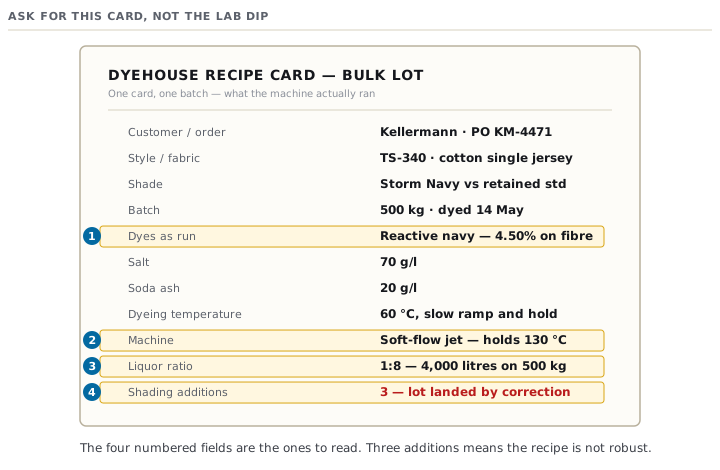
It also means two chances to go wrong. A one-bath cotton dyeing that lands off-shade can usually be corrected with a small dye addition in the same bath, in twenty minutes. A two-bath blend cannot. Correcting the cotton half shifts the balance against the polyester half, and you can no longer touch that half without going back to 130 °C. Going back will not remove the disperse dye, and it will dull everything else. The working rule in the dyehouse: get the polyester right and hold it, because it is the half you cannot revisit.
What the two routes cost
| Line | TS-340 cotton jersey, reactive | SW-118 poly-cotton fleece, disperse then reactive |
|---|---|---|
| Dyebaths | 1 | 2 plus a reduction clear |
| Machine hours a batch | 6.5 | 11.5 |
| Water, litres per kg | 60 | 105 |
| Dyestuff, USD per kg | 0.72 | 0.68 |
| Chemicals and auxiliaries, USD per kg | 0.31 | 0.66 |
| Steam and power, USD per kg | 0.24 | 0.47 |
| Labour and machine overhead, USD per kg | 0.28 | 0.49 |
| Total dyeing, USD per kg | 1.55 | 2.30 |
| Dyeing cost in one garment | 0.37 | 1.43 |
Read the dyestuff line twice. The blend uses less dye per kilogram — 0.68 against 0.72. Only 35 parts in a hundred need the expensive reactive navy, and the disperse navy on the polyester goes on at a lower depth. And colouring the blend still costs 48 percent more per kilogram. Per garment it costs almost four times as much, once the heavier fabric is counted.
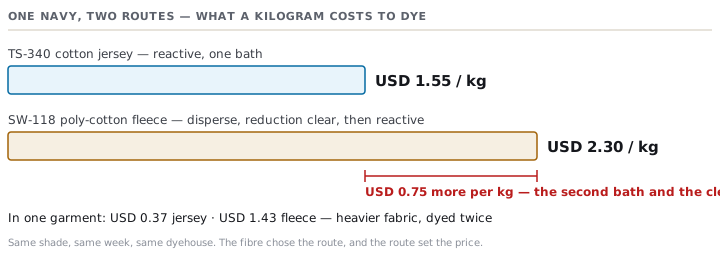
The money is not in the dye. It is in the second bath: the hours, the fills, the steam, the reduction clear. Dyeing is priced by process, not by dyestuff. So watch for one tell: a quotation that moves when you change the shade, but not when you change the fibre, has not been costed by anyone who runs a machine.
Check yourselfA mill offers to save you money on the SW-118 fleece by dyeing it in one bath instead of two. What are you being offered, and what should you ask?Show the answer
One-bath dyeing of a polyester-cotton blend is a real process. But it is only safe at pale depths, where a disperse dye and a reactive dye can be made to live together in one compromise bath. For a deep navy it usually means one of three things. The shade will be built mostly on the polyester and the cotton left pale, which reads as a washed-out fabric and fails a rub test. Or the reactive fixing step will be weak, so the colour bleeds. Or the reduction clear is being dropped, so surface dye rubs off. Ask which fibre is carrying the depth. Ask for the rubbing and wash-fastness results on a bulk-process sample, not a lab dip. And ask what happens to the price if the shade misses and there is no second bath left to correct it in.
Check yourselfA buyer's spec asks for light fastness 6 on a cotton workwear jacket in a mid olive. Reactive is quoted at USD 19.00 per kg of dye, vat at USD 62.00. Which do you take, and on what basis is it decided?Show the answer
Vat. The specification decides it, not the price. Reactive tops out around 4 to 6 on light fastness, and a mid olive is not where it performs best. Vat is the class built for exactly this: workwear, sunlight, industrial laundering, chlorine. The correct commercial move is not to argue the dye class down. Price the garment with vat dyeing in it, and put the difference in the quotation. A jacket that fades in a season comes back as a claim on the whole order, and no saving on dyestuff survives that. What you can honestly negotiate is depth, shade choice and batch size. Never the fastness the specification asks for.
Prompt · Check the dye route before the mill books the machine
When a fabric specification and a colour have both been agreed and you want to know, in writing, which dye class the fibre allows and what fastness it buys.
Act as a senior textile dyeing technologist. I need the dye route checked before a mill starts. Fabric facts: fibre composition [COMPOSITION], construction [KNIT OR WOVEN, STRUCTURE], weight [GSM] gsm, finished fabric weight per garment [KG]. Colour: [SHADE NAME], standard [PANTONE OR PHYSICAL STANDARD REFERENCE], and the approximate depth is [PALE / MEDIUM / DARK]. The buyer's test specification asks for: wash fastness [GRADE], light fastness [GRADE], dry and wet rubbing [GRADES], perspiration [GRADE], plus [ANY OTHER TEST]. Care label says [CARE INSTRUCTION]. Do the following. First, list every dye class that can chemically dye this fibre composition and cross out the ones that cannot meet the fastness specification, saying why for each. Second, if the fabric is a blend, state how many dyebaths the route needs, in what order, at what temperature, and whether a reduction clear is required. Third, tell me every point in that route where the shade can be corrected and every point after which it cannot. Fourth, name the risks specific to this route: cross-staining, metamerism between dye classes, tendering, crocking, and say which of them the buyer's test list would catch and which it would not. Fifth, tell me what I must get approved in the lab, under which illuminants, before bulk. Do not recommend a dye class the fibre cannot take, and if the fastness specification cannot be met on this fibre at this depth, say so plainly rather than proposing a compromise.
AI can make mistakes — check anything you act on.