Lessons · Lesson 3 of 3
A colour that moves
Read a fastness report against the buyer's minimums, understand why dark shades fail wet rubbing, and cost the four options once the bulk is already dyed.
Lesson 3 of 3 · 38 min
The situation
Colour does not always stay where it was put. It comes off on a white sofa. It transfers onto the shirt worn underneath. Or it leaves in the wash and takes the rest of the load with it. There is a standard laboratory test for each of those. (The trade calls this "fastness" — how firmly the colour holds on.) The first part of this lesson reads such a report, including one trap in the grading scales. The rest deals with the case where the report arrives after the cloth is already dyed.
26 September, 11:20. The navy is dyed. All 6,000 m of it, in three batches, and the shade band was approved by Hallward in writing on 19 September. Fabric is due into cutting on 8 October, and the vessel books on 14 November.
The fastness package comes back from the laboratory.
| Test | What it measures | Result | Hallward minimum | Verdict |
|---|---|---|---|---|
| ISO 105-C06 A1S | Colour change in domestic washing | 4 | 3-4 | Pass |
| ISO 105-C06 A1S | Staining, multifibre, worst fibre | 4 | 3-4 | Pass |
| ISO 105-B02 | Light, xenon arc, blue wool scale | 4 | 4 | Pass |
| ISO 105-E04 | Perspiration, acid and alkaline, staining | 4 | 3-4 | Pass |
| ISO 105-X12 | Rubbing, dry | 3-4 | 3-4 | Pass, at the line |
| ISO 105-X12 | Rubbing, wet | 2-3 | 3 | Fail |
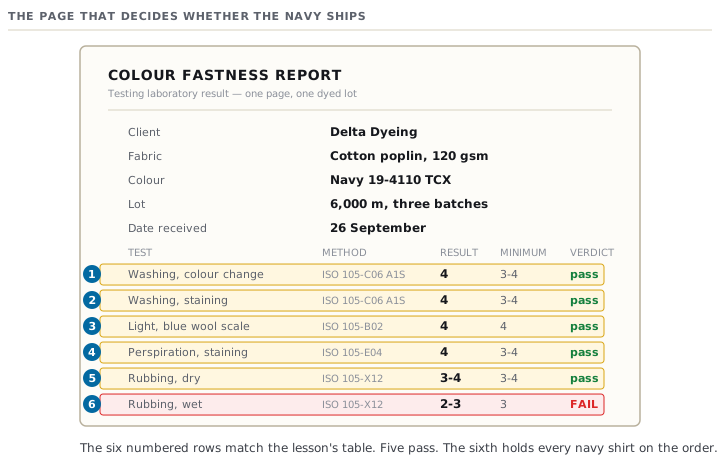
Five results out of six are comfortable. The sixth puts USD 33,620 of navy shirts on hold.
Two grading scales are in play, and it is worth being exact about them. Colour change and staining are read against grey scales, ISO 105-A02 and A03. Those run from 1 to 5, where 5 means no change at all, and half grades are allowed. Light fastness is different. It is read against the blue wool scale, which runs from 1 to 8, and each step means roughly twice the exposure of the one below. So a grade 4 wash result and a grade 4 light result are not the same kind of 4. A merchandiser who reads them as one scale will accept a light fastness that is nowhere near good enough for a display garment.
Why it is always wet rubbing, and always the dark shade
This is not bad luck. It is chemistry that follows the depth of the shade. Once you know it, you can predict the failure before the report arrives.
A heavy navy on cotton is usually dyed with reactive dyes. The dye reacts with the fibre and fixes there — but not all of it. Part of the dye reacts with the water in the dyebath instead. That part can no longer bond to anything. It simply sits on the fibre surface as loose colour. On a pale shade, very little dye is applied, so the loose residue hardly matters. On a heavy navy, the dye applied can be 5% to 8% of the weight of the cloth. Even excellent washing-off leaves some loose colour behind.
Wet rubbing is the test that finds it. The crockmeter drags a wetted white cotton square across the fabric under a fixed load, sixteen times. The water swells the cotton, loosens the surface dye, and the white square picks it up. Dry rubbing on the same fabric usually reads half a grade to a full grade better. That is exactly the pattern in the table above.
The working rule is blunt and reliable: every big step up in depth of shade costs you roughly half a grade of wet rubbing. A navy, a black, a deep red and a bottle green are the four shades every dyehouse expects to fight. If a buyer's tech pack asks for wet rub grade 3 on a black, the conversation about how to achieve that belongs in July, not in September.
| Test | What it stands for in real life | Where a failure appears |
|---|---|---|
| X12 dry rubbing | Dry friction — a car seat, a bag strap, a white sofa | Marks on light-coloured furniture, complained about within a week |
| X12 wet rubbing | Damp friction — sweat, rain, a humid day | Colour transferred onto a white t-shirt worn underneath |
| C06 washing | One test wash standing in for about five domestic washes | The shade drops, and the whole load comes out blue |
| B02 light | Daylight and shop-window exposure | Faded shoulders and folds on the display garment |
| E04 perspiration | Body acid and alkali | Collar and underarm staining |
What can still be done to fabric that is already dyed
There are three chemical routes. Each one buys a grade, at a price paid somewhere else. Most merchandisers do not know this part — and it is the part that decides which of the four commercial options is realistic.
- Extra washing-off, hot soaping. The cheapest and most honest fix: run the fabric again and remove more of the loose dye. It typically buys half a grade of wet rubbing. It costs machine time, water and energy. And it will lighten the shade — usually DE 0.40 to 0.60. That is inside the approved band on this order, but it has to be re-measured and re-declared.
- A cationic dye-fixing agent. A polymer that locks the leftover dye in place. It buys half a grade to a full grade of wet rubbing, more reliably than soaping. In exchange it costs a little wet light fastness, can yellow slightly on pale shades, and on a navy it can pull the shade a touch darker and duller.
- Silicone softener or a mechanical finish. It makes the surface slippery, so the rubbing square slides instead of scraping. It buys about half a grade. It also changes the feel of the cloth, which is a separately approved property. And heavy silicone can worsen seam slippage and needle cutting in sewing.
The real solution — dyeing the shade with a vat dye, or with a high-fixation reactive dye and a proper washing-off route — belongs to the next order. It is not available to you on 26 September, with the fabric in the warehouse.
Four options, costed
The facts to work against: 6,000 m of navy already dyed at USD 3.85 a metre delivered. 4,100 navy shirts at FOB USD 8.20, so USD 33,620 of the order value sits on this fabric. The whole order is USD 73,800, costed at an 11% margin. That is USD 8,118 of gross profit for the entire PO. Read every number below against that 8,118, not against the order value.
| Option | Direct cost | Calendar | Residual risk | Who carries it |
|---|---|---|---|---|
| A. Re-soap and after-treat the 6,000 m, then re-test | USD 1,320 at 0.22 a metre | 5 days | Roughly 70% chance of reaching grade 3. Shade moves 0.40 to 0.60 and needs re-declaring | Factory |
| B. Dye new fabric, sell the rejected lot as stock | USD 23,100 new, less USD 5,400 salvage at 0.90 a metre — net USD 17,700 | 18 days, misses the vessel | Low technical risk, certain commercial damage | Factory |
| C. Ask Hallward for a concession and ship as it is | About USD 2,476 — a 7% discount on USD 33,620 is USD 2,353, plus a care-label change at 0.03 a shirt | 3 to 5 days for an answer | Buyer may refuse. If they accept, returns liability usually transfers to them in writing | Shared, if it is in writing |
| D. Ship olive and ecru by sea now, air-freight the navy later | USD 6,027 — 1,271 kg chargeable at USD 4.60 plus a second document set | Buys about 3 weeks | Needs the buyer to accept a split delivery. Does not fix the fastness | Factory |
Read the second row again. Option B, the technically perfect answer, costs USD 17,700 against a total order margin of USD 8,118. Doing the right thing by the fabric loses more than twice everything the order was ever going to earn. That is why "just re-dye it" is not an answer a merchandiser is allowed to give before doing this arithmetic.
The sequence, which matters more than the choice
These options are not a menu you pick one item from. They are a sequence. And the sequence is chosen by which doors each move leaves open.
- Start A today. It is the cheapest and the fastest. But the real reason is this: it closes nothing. If the re-soap works, everything else becomes unnecessary. If it fails, C and D are still available, and B is no further away than it was this morning.
- Open C in parallel, this afternoon. A concession request takes Hallward three to five days to answer whatever you do. So the request costs nothing to start, and it buys a week if it is granted. Send it with the full test report, the cause, what you are doing about it, and a specific number — not "please advise".
- Hold D as the calendar hedge. You do not book air freight on 26 September. You confirm with the forwarder that space exists on the 5th, and what it will cost. Then, if A fails on 1 October, the decision takes an hour instead of three days.
- B only if A fails and C is refused. And when you take it, take the salvage seriously. 6,000 m of good navy poplin that failed one fastness test is perfectly saleable in the local market. The difference between writing it off and selling it at USD 0.90 a metre is USD 5,400 — two thirds of the order's whole margin, recovered with three phone calls.
Prompt · Cost a fastness failure four ways
The morning a fastness report fails on fabric that is already dyed, when somebody is about to say 'just re-dye it'.
Act as a merchandising manager and a dyeing technologist at the same time. A fastness test has failed on bulk fabric that is already dyed and I need the options costed before I answer the buyer. Facts: buyer [BUYER], PO [NUMBER], style [STYLE], colour [COLOUR AND CODE], fabric [COMPOSITION AND WEIGHT], quantity dyed [METRES] at [PRICE] a metre, pieces affected [QTY] at FOB [PRICE], total order value [VALUE], costed margin [PERCENT]. Test results against the buyer's minimums: [PASTE THE FULL PACKAGE — every test, result and minimum]. Dates: fabric due in cutting [DATE], ship [DATE], vessel cut-off [DATE]. Dye class used, if known: [CLASS]. Do the following. First, explain in plain language why this specific test failed on this specific shade, and say whether the result is typical for the depth and dye class or whether something went wrong in the dyeing. Second, list the after-treatments physically available on already-dyed fabric, and for each one say how much fastness it buys, what it costs per metre, how many days it takes, and what property it damages in exchange — shade, hand, light fastness, seam performance. Third, cost four commercial options: after-treat and re-test, replace the fabric with a salvage value for the rejected lot, request a concession with a specific discount figure, and split the shipment with air freight on the affected colour. Give each a direct cost, a calendar cost, a residual risk and who carries it. Fourth, compare every one of those numbers against the order's total gross margin in money, not percentage. Fifth, give me the sequence to run them in, and justify it by which options each move keeps open rather than by cost alone. Sixth, draft the note to the buyer. Never propose shipping a failed result without a written concession, and never propose an after-treatment without re-measuring the shade and re-testing.
AI can make mistakes — check anything you act on.
Check yourselfWash fastness comes back at 4 and light fastness at 4. Are those two results equally good?Show the answer
No, and reading them as one scale is a common and expensive mistake. Wash results are read on the grey scales, ISO 105-A02 for change and A03 for staining. Those run 1 to 5, so a 4 is one half-step below the top, and genuinely good. Light is read on the blue wool scale, which runs 1 to 8, and each grade means roughly double the exposure of the one below. So a 4 there sits in the middle. Grade 4 light is normally fine for a shirt that lives in a wardrobe. It is not fine for a garment that will hang in a south-facing window for six weeks. That is why some buyers ask for a higher light fastness for display pieces and for swimwear than for the same colour on a shirt.
Check yourselfA fixing agent will take wet rubbing from 2-3 to 3-4, and moves the shade 0.30 to 0.50 darker. The shade band was approved on 19 September. What do you do before treating the fabric?Show the answer
Tell the buyer, in writing, that the after-treatment is proposed and that it will move the shade within the approved band. Ask them to confirm the band still stands. Then treat one batch, not all three. Then re-measure the shade against the approved band, and re-run the wet rubbing test on the treated batch, before committing the other two. Why one batch first? Because a fixing agent behaves differently on a batch that was already at the darker edge of the band. On this order N3 was at 0.90, and another 0.50 darker puts it outside the tolerance entirely. Treating all 6,000 m in one pass, to save two days, is how a fastness problem becomes a shade problem as well.