Lessons · Lesson 1 of 3
Agreeing the colour
Set up a colour agreement that can be enforced: the right kind of standard, a submission plan that fits the calendar, and a tolerance written down before the first dip is dyed.
Lesson 1 of 3 · 40 min
The situation
Agreeing a colour sounds like the simplest thing in an order. The buyer names the colour, and the factory makes it. In practice it is a formal procedure with a calendar of its own. Nobody can hold a colour in their head. Both sides need a physical object to point at. This lesson sets up that agreement so that it can be enforced later.
14 August, 08:40, a merchandising office in Sadat City. PO HW-7742 from Hallward, a UK high-street retailer: 9,000 men's poplin shirts, style SH-2208, in three colours — navy 4,100, olive 2,400, ecru 2,500. FOB USD 8.20, order value USD 73,800. The fabric is 120 gsm cotton poplin at 1.45 m a shirt. Ship date 14 November. That puts fabric in the cutting room on 8 October, and gives the dyehouse about seven weeks from today.
An email has just arrived from Hallward's colour room. Navy lab dip 3 is rejected. Attached to the rejection is the dyehouse's own spectrophotometer report. (A spectrophotometer is the machine that measures a colour and puts a number on the difference between two samples.) The report says the dip is DE 0.85 away from the standard on CMC(2:1), inside the tolerance of 1.0 written into the purchase order.
So the number passes, and the buyer says no. Lesson 2 deals with that argument. Before you can have it, you must know exactly what was agreed: with whom, against which physical object, and under which light. Most colour arguments are not disagreements about colour. They are two parties enforcing two different specifications, and neither one was ever written down properly.
Three kinds of standard, and only one of them is a colour
A colour standard is the object everything else is judged against. Three sorts are in circulation, and each one lets you down in a different way.
| Kind of standard | What you physically receive | What it costs | How it fails |
|---|---|---|---|
| Pantone TCX | A dyed cotton swatch on a card, with a code such as 19-4110 | Card set, replaced yearly | The card fades. Two mills holding cards of different ages are matching two different navies |
| Buyer's physical swatch | A cutting of fabric, often from last season's approved bulk | Free, but unique | There is only one of it, and it ages in the envelope. It also carries the previous supplier's fabric |
| Digital standard | A file of measured values plus the full spectral curve, sent as QTX or CXF | Free to send | It cannot fade. But it cannot tell you what your own cotton will do. It is a target, not a sample |
Hallward sent all three for this order. That is good practice, and rarer than it should be. The reference code is 19-4110 TCX Dress Blues. The physical cutting comes from an earlier bulk and is marked "commercial standard". The digital standard was measured off that cutting.
Here is the trap in that sentence. A TCX code is not a colour. It points to a physical card. Pantone's own instruction is to replace the card every twelve months and keep it in the dark. The card in the dyehouse's drawer in Sadat City was bought three seasons ago, and it has sat on a bench under a window. The card in Hallward's colour room in Leeds is current. Both sides believe they are matching 19-4110. They are matching two objects that no longer agree with each other.
So the first thing to settle, before the first dip, is which physical object is the master, and where it lives. On this order the master is the digital standard, with the buyer's cutting as the visual reference. That order of authority is written on the tech pack. It is not assumed.
The chain, with dates on it
Colour runs on its own critical path underneath the order. It is the path that most often eats the fabric delivery date. Here it is for HW-7742: as planned, and as it is actually running.
| Step | Owner | Planned | Actual |
|---|---|---|---|
| Colour standard issued with tech pack | Hallward | 22 July | 22 July |
| Lab dip submission 1, three shades per colour | Delta Dyeing | 5 August | 6 August |
| Buyer verdict 1 | Hallward colour room | 12 August | 13 August — ecru approved, navy and olive rejected |
| Lab dip submission 2 | Delta Dyeing | 19 August | 14 August, running early |
| Buyer verdict 2 | Hallward colour room | 26 August | outstanding |
| Bulk dyeing starts | Delta Dyeing | 1 September | — |
| Shade band submitted | Delta Dyeing | 12 September | — |
| Bulk shade approved | Hallward | 19 September | — |
| Fabric into cutting | Nile Delta Apparel | 8 October | — |
| Ship | Nile Delta Apparel | 14 November | — |
Read the gaps, not the steps. Every verdict row takes seven days, and roughly four of those days are courier time between Egypt and the United Kingdom. A submission round is not a task. It is a week and a half of calendar, and working harder does not shrink it. Three rounds on one colour is a month. The tech pack allowed for two.
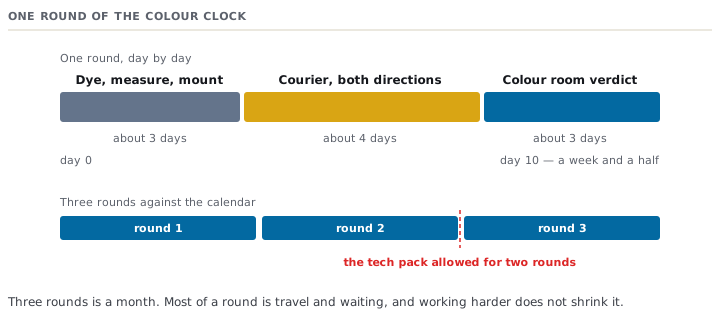
That is why the dyehouse sent round two on 14 August instead of the planned 19th, without being asked. It is also why the right question this morning is not "is the buyer being unreasonable". It is "how many rounds are left before 1 September, and what do I do differently in each one".
What a submission actually is
A lab dip is a small trial dyeing — usually 10 to 20 grams of the real bulk fabric, dyed in a laboratory machine on the recipe the dyehouse plans to scale up. It answers two questions at once. Does this recipe hit the colour? And does this colour behave on this cloth?
A submission is a set of dips, not one dip. The convention is three per colour: on shade, a touch lighter, a touch darker — spread roughly DE 1.0 either side of the target. The reason is worth understanding, not just copying.
- One dip forces a yes or a no. If the answer is no, the rejection tells you nothing about which way to move.
- Three dips ask the buyer to choose a direction. Even a rejection comes back as "closest to B, but still too red". That is an instruction.
- Three dips also show the buyer how much the shade moves for a small recipe change. That starts the conversation about a realistic tolerance.
Each dip is labelled with the recipe reference, the fabric quality, the batch, the dyehouse and the date. Each is measured before it is sent. A dyehouse that sends an unmeasured dip is asking the buyer to do its quality control for it — and it pays for that in calendar time.
The dips go out mounted on card, so the buyer can lay them against the standard without handling them. The measured values are printed beside each one. Sending the numbers with the sample is not a formality. It lets the buyer's colourist answer "no, but you are 0.4 too light" instead of just "no".
The tolerance is the specification
One line decides every future argument: the tolerance. On this order it reads:
Navy 19-4110 TCX. Tolerance DE 1.0 maximum, CMC(2:1), primary illuminant D65, secondary TL84, 10 degree observer, specular excluded, measured on four folds of fabric, four readings averaged, rotated 90 degrees between readings.
That is a specification. Every clause in it changes the number that comes out of the machine, and lesson 2 shows why. What matters here is simpler: all of it was agreed in July, in writing. Neither side can invent a new clause in September.
Compare that with what most tech packs actually say: "match to standard, commercially acceptable". There is no arithmetic in that phrase. So it means whatever the person holding the fabric wants it to mean on the day.
Who pays, and what it really costs
The cash cost of a lab dip is small, and everyone quotes it. Start there, then look past it.
| Item | Cost |
|---|---|
| Three laboratory dyeings, machine and labour | USD 165 |
| Measurement, mounting, labelling | USD 20 |
| Courier Sadat City to Leeds | USD 95 |
| Total, one round, one colour | USD 280 |
Three rounds on three colours is nine submissions — about USD 2,520, against an order worth USD 73,800. That is a rounding error. Most buyers allow two or three rounds free and charge the mill after that, and that contract argument is a distraction. A different number does the damage.
The number that hurts is the calendar. A third round on navy pushes bulk dyeing from 1 September to around the 10th. Dyeing 6,000 m of navy takes the jet machines about six days. Finishing and inspection take four more. Fabric that should reach cutting on 8 October now reaches it around the 20th. The ship date is 14 November, and an inspection and a vessel booking already hang off it. The lab dip cost USD 280. The air-freight conversation it just bought you is worth several thousand.
So the commercial rule is not "minimise dips". It is spend more on the first submission so that it becomes the last one. Send four shades instead of three on a difficult navy. Dye on the exact bulk fabric quality, not on standard lab cloth. Measure under both illuminants before sending, not just the primary. All of that costs hundreds, and it buys weeks.
Prompt · Write the colour clause the tech pack is missing
The day an order is confirmed, before a single lab dip is dyed, when the tech pack says nothing more useful than 'match to standard'.
Act as a senior textile colourist working for a garment manufacturer. I am setting up colour approval for a new order and I need a colour specification that both my dyehouse and my buyer can enforce. Order facts: buyer [BUYER], PO [NUMBER], style [STYLE], quantity [QTY] pcs split by colour as follows: [PASTE THE COLOUR SPLIT]. Fabric is [COMPOSITION], [WEIGHT] gsm, [CONSTRUCTION]. The colours as the tech pack states them are: [PASTE EXACTLY WHAT THE TECH PACK SAYS]. Ship date [DATE], fabric needed in cutting by [DATE]. Do the following. First, tell me for each colour which kind of standard I appear to have been given — a Pantone TCX code, a physical cutting, a digital standard, or nothing usable — and what is missing from each. Second, draft the full tolerance clause I should ask the buyer to confirm in writing, naming the master object, the substrate, the numerical tolerance, the equation, the primary and secondary illuminants, the observer, specular included or excluded, and the measurement conditions such as number of folds and readings. Third, tell me which of my colours are likely to be metameric risks and why, based on the shade family. Fourth, build the colour approval calendar backwards from the fabric-in-cutting date, showing every submission round, every buyer verdict, the courier time, and how many rounds I can actually afford. Fifth, list the questions I should send the buyer today, written as a numbered email I can paste. Do not invent a tolerance the buyer has not agreed; where I have not told you something, say so explicitly and mark it as an open question.
AI can make mistakes — check anything you act on.
Check yourselfYour buyer says 'just match to Pantone 19-4110'. What five things are missing, and which one will you regret most?Show the answer
Missing: the fabric the standard applies to, the light it will be judged under, the numerical tolerance, the equation the tolerance is measured with, and which physical object is the master. The one you will regret most is the master object. The other four can be argued from industry norms after the fact. A faded card in your drawer against a fresh card in theirs is an argument nobody can win. Each of you is correctly matching a different physical navy, and no document says whose is right.
Check yourselfBulk dyeing is booked for 1 September. It is 14 August and navy has just failed its first verdict. How many further submission rounds do you actually have?Show the answer
Two at most, and only if the buyer turns each one around in a week. Round two went out on 14 August, so a verdict lands around the 21st. If it fails, round three goes out by the 22nd and is answered around the 29th. That leaves one day before the booked dyeing slot, with no margin for a courier delay. In practice you plan for one more round and negotiate now. Ask the colour room for a direction on the failed dip, not just a verdict. And ask whether they will approve on measured values plus a photograph, so the courier week comes out of the loop. Both are normal requests, and both are far easier to make on 14 August than on 29 August.