Lessons · Lesson 2 of 3
The number, the light, and the shade band
Read a spectrophotometer report properly, understand what a tolerance of DE 1.0 really permits, and build a shade band that survives cutting.
Lesson 2 of 3 · 42 min
Two people, one navy, and both of them right
A machine can put a number on the difference between two colours. That number persuades people that colour disputes have been solved. They have not. This lesson takes such a report apart, down to the instrument settings that shift the answer. Then it covers the two things the number cannot see. The first is a pair of samples that matches under one lamp and separates under another.
Back to the rejection that arrived on 14 August. Delta Dyeing's report on navy lab dip 3 reads like this.
| Value | Standard | Dip 3 | Difference |
|---|---|---|---|
L* lightness | 30.2 | 30.9 | +0.7, lighter |
a* red to green | 0.5 | 0.9 | +0.4, redder |
b* yellow to blue | -13.4 | -12.7 | +0.7, less blue |
DE*ab | — | — | 1.07 |
| DE CMC(2:1) | — | — | 0.85 |
| DE CIE2000 | — | — | 0.91 |
Three coordinates describe a colour. L* runs from 0, absolute black, to 100, absolute white. a* runs green to red. b* runs blue to yellow. A navy sits low on L*, near zero on a*, and well into the negative on b*. That is exactly what 30.2, 0.5 and -13.4 say.
The plain difference, DE*ab, is just the straight-line distance between the two points:
DE*ab = sqrt( 0.7^2 + 0.4^2 + 0.7^2 )
      = sqrt( 0.49 + 0.16 + 0.49 )
      = sqrt( 1.14 )
      = 1.07
Now look at what the dip actually did. It came out lighter and less blue — a navy drifting towards a washed, slightly warm blue. On a dark shade, lightness is the axis the human eye judges hardest. Two navies that differ only in L* look like two different qualities of cloth, not two shades.
And the equation the contract named, CMC(2:1), reports 0.85 — a pass. The 2 in CMC(2:1) is a lightness weighting. It tells the equation to be *twice as forgiving on `L` as on the other two axes**, because in most textile uses lightness differences matter less. So the specification, agreed in July by both parties, told the arithmetic to discount the one axis the buyer's colourist objected to.
Nobody cheated. The number is correct. The eye is correct. The specification is the thing that was wrong.
Three equations, one pair of samples
Every colour equation is a model of how much a given difference bothers an average human. The equations disagree with each other. And they disagree most exactly where apparel lives — dark shades, low saturation.
| Equation | Reading | What it is for |
|---|---|---|
DE*ab | 1.07 | The raw geometric distance. Simple, and known to overstate differences on dark and low-saturation colours |
| CMC(2:1) | 0.85 | Built by the textile industry for textiles. The tolerance shape changes with the colour |
| CIE2000 | 0.91 | The current international default. Closer to CMC than to DE*ab, and the equation most new specifications now name |
Two consequences follow, and both are commercial rather than technical.
A tolerance means nothing without its equation. "DE 1.0" is not a specification. "DE 1.0 CMC(2:1)" is. The pair above passes under CMC and CIE2000, and fails under DE*ab. Whoever chooses the equation has chosen the outcome. On a dark navy, that choice is worth thousands of dollars.
Never compare a number from one equation with a number from another. A mill quoting 0.85 and a buyer quoting 1.07 for the same dip are not disagreeing about the fabric. They are reading two different instrument settings.
What DE 1.0 actually permits
A trained colourist, comparing two large panels edge to edge under controlled light, starts to see a difference somewhere around DE 0.8 to 1.0. The threshold is lower on a neutral grey and higher on a saturated red. Separate the panels by a few centimetres and the threshold roughly doubles. Show them one after the other and it doubles again.
| Reading | What it looks like |
|---|---|
| Below 0.5 | Invisible to almost anyone, in almost any presentation |
| 0.5 to 1.0 | A colourist sees it edge to edge. A merchandiser usually does not |
| 1.0 to 2.0 | Visible edge to edge to anyone told to look. Passes unnoticed on separate garments |
| Above 2.0 | Visible on the rail, in the shop, to a customer holding two shirts |
This is why the tolerance is not the whole answer. A tolerance is a screening rule, not a verdict. The number decides whether the sample is worth a human's look. The human decides whether it ships. Every serious mill measures before submitting, so the human only ever sees candidates that already passed.
The light box, and why the illuminant is part of the specification
Colour is not a property of a fabric. It is what happens when a light source, a fabric and an observer meet. Change any one of the three, and the answer changes.
| Illuminant | What it represents | Who asks for it |
|---|---|---|
| D65 | Average north-sky daylight, 6500 K | The primary for almost every European and Asian buyer |
| TL84 | European and Asian store fluorescent | Usually the secondary. This is the light the customer actually buys under |
| CWF or U30 | North American store fluorescent | US buyers, in place of TL84 |
| Illuminant A | Tungsten, 2856 K | The warm extreme. Home lighting, changing-room lamps |
| UV | Ultraviolet component | Whites and pastels, to reveal optical brighteners |
The box has a neutral grey interior, because a coloured surround pulls the eye and makes two matching samples look different. Samples are viewed at roughly 45 degrees to the light, both facing the same way. A napped or twill fabric is also turned end for end and looked at again, because direction changes how deep the colour appears.
Metamerism, and the olive that only fails in the shop
Now the olive on this order, 18-0625 TCX. Dip 2 was measured under all three agreed illuminants.
| Illuminant | DE CMC(2:1) | Verdict |
|---|---|---|
| D65, primary | 0.60 | Comfortable pass |
| TL84, secondary | 2.40 | Clear fail |
| Illuminant A | 3.10 | Obvious to anyone |
This is a metameric pair: two samples that match under one light and separate under another. It is not a defect in the dyeing. And it cannot be fixed by adjusting the recipe strength, because the two samples reach the same colour by different routes. The standard was dyed with one combination of dyes. The dip reaches the same point under D65 with a different combination. Their reflectance curves cross instead of lying on top of each other. Under a light with a different energy mix, the crossing points move, and the two colours pull apart.
Greys, olives, browns and beiges are where this bites. Those shades are mixed from three or four dyes, and many recipes arrive at the same D65 answer. A bright single-dye red is very hard to make metameric.
The fix is chemistry, not arithmetic: match the curve, not the number. Ask which dye class and which dye trio the standard was built on, and rebuild the recipe on the same family. A dyehouse with a spectral matching system can do it from the standard's curve alone. Where that is impossible, say so early. Ask the buyer to choose, in writing, between a compromise under D65 or under TL84.
The shade band, and the tolerance nobody writes down
Bulk is not one colour. Navy for this order is 6,000 m, dyed in three jet batches of 2,000 m. Every batch is a separate dyeing, with its own bath, its own dye weighings and its own heat history.
| Batch | Metres | DE CMC(2:1) against standard | Direction |
|---|---|---|---|
| N1 | 2,000 | 0.40 | Lighter, slightly less blue |
| N2 | 2,000 | 0.55 | On shade, marginally darker |
| N3 | 2,000 | 0.90 | Darker and bluer |
Every batch passes. The tolerance is 1.0, and the worst reading is 0.90. Sign it off as one lot, and you have made a serious mistake. N1 and N3 sit on opposite sides of the standard. Measured against each other, they are about 1.30 apart. That is far past the point where a front panel and a sleeve on the same shirt look like two different garments.
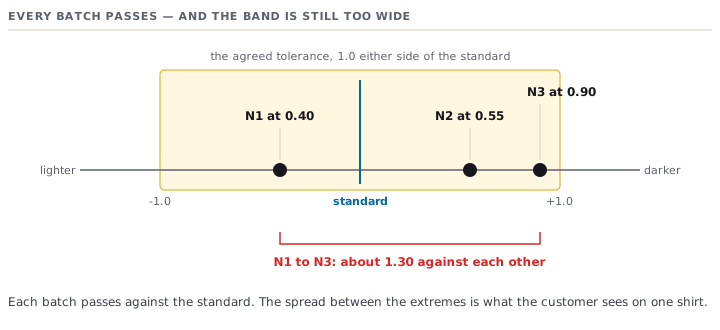
Conformance to the standard is one requirement. Continuity — batch to batch, roll to roll, selvedge to selvedge, beginning to end of a roll — is a second and independent one. And continuity is the one that produces returns, because a customer never compares a shirt to a Pantone card. They compare a sleeve to a body.
The shade band is the physical answer. It is a mounted set of cuttings, submitted before bulk is released. It shows the reference and the lightest and darkest extremes production actually made, so the buyer approves a range rather than a point. It carries a labelled cutting from every batch, taken side, centre, side across the width, because a jet or a stenter can leave the selvedges a different depth from the middle. And it carries beginning, middle, end of a long roll, which catches a shade that drifted while a continuous machine ran.
On this order, the width variation came back at 0.30 side to centre, and the length variation at 0.50 beginning to end. Both are ordinary. Together with a 1.30 spread between batches, they are not.
What you do with a shade band once you have it
The band is not paperwork. It changes how the fabric is cut.
- Shade block the cutting. Group rolls into shade lots — the trade calls them A, B and C shades — and cut each lot as its own lays. Then every panel of one garment comes from one lot.
- Bundle by lot. The bundle ticket carries the shade lot through sewing, so a body from lot A never meets a sleeve from lot C at the machine.
- Keep small parts inside the lot. Collars, cuffs, plackets and pockets are where a wrong lot shows. And that defect comes back from the customer's warehouse, not from your own inspection.
- Tell the buyer the range before you cut. Approving a shade band means the buyer accepts the spread. That approval in writing on 19 September is worth more than any argument in November.
Prompt · Read a lab dip report and decide
When a spectrophotometer report has arrived, the number passes or fails narrowly, and you have to say something defensible to the buyer today.
Act as a senior textile colourist. I have a lab dip report and I need to decide what to do with it. Standard: [NAME AND CODE], measured values [PASTE THE STANDARD'S VALUES IF YOU HAVE THEM]. The dips submitted and their measured values are: [PASTE THE FULL REPORT — every dip, every illuminant, every reading]. The agreed tolerance is [NUMBER] using [EQUATION], primary illuminant [ILLUMINANT], secondary [ILLUMINANT], observer [ANGLE], specular [INCLUDED OR EXCLUDED]. The buyer's response so far is: [PASTE IT, OR SAY NONE YET]. Do the following. First, restate each dip's difference on the three axes separately in plain words — lighter or darker, redder or greener, yellower or bluer — and say which axis dominates, because a difference that is mostly lightness on a dark shade behaves very differently from the same total difference spread across three axes. Second, say whether the reading passes the agreed tolerance, and separately whether you would expect a human colourist to accept it, and explain any disagreement between those two answers instead of hiding it. Third, check the readings across the illuminants and tell me whether this is a metameric pair, and if it is, say that a recipe strength adjustment will not fix it and what will. Fourth, recommend which dip to push for approval and exactly what direction to give the dyehouse for the next submission, in the language a dyer uses. Fifth, draft the note I send the buyer. If the report is missing something needed to answer — the illuminant, the equation, the number of readings — say what is missing rather than assuming a value.
AI can make mistakes — check anything you act on.
Prompt · Turn a shade band into cutting instructions
When bulk is dyed in more than one batch and you have to decide what the cutting room is allowed to do with it.
Act as a fabric and cutting manager in a garment factory. I have bulk fabric dyed in several batches and I need a shade band submission and the cutting rules that follow from it. Facts: buyer [BUYER], PO [NUMBER], style [STYLE], colour [COLOUR AND CODE]. Agreed tolerance [NUMBER] using [EQUATION] under [ILLUMINANT]. Batches, with metreage and measured difference against the standard: [PASTE BATCH BY BATCH]. Where I have them, within-roll readings side to centre and beginning to end: [PASTE OR SAY NOT MEASURED]. Garment parts to be cut: [LIST THEM — body, sleeve, collar, cuff, pocket, placket]. Size ratio and total pieces per colour: [PASTE]. Do the following. First, compute the spread between the extreme batches, not only each batch against the standard, and tell me plainly whether any two batches can appear on the same garment. Second, tell me what the shade band submission must physically contain and how to label it, and draft the covering note asking the buyer to approve a range rather than a point. Third, group the batches into shade lots and tell me how many separate cutting lots that produces and whether the size ratio divides cleanly across them. Fourth, give the cutting room and the sewing floor written rules: which parts must stay inside a lot, what the bundle ticket must carry, and where a mistake would show. Fifth, tell me what to instruct the dyehouse for any remaining batches so that the spread closes rather than widens. If a batch is outside tolerance, say so first and do not bury it in the plan.
AI can make mistakes — check anything you act on.
Check yourselfA mill reports a bulk at DE 0.90 and your own laboratory reads the same cutting at 1.30. Who is wrong?Show the answer
Probably neither. Ask about the settings before you talk about the fabric: which equation, which illuminant, specular included or excluded, UV filter in or out, how many folds, what aperture size, and how many readings averaged. Any one of those can explain a gap of that size on a dark navy — the number of folds alone can move L* by a whole unit on a 120 gsm poplin. Only once both instruments are set the same is a remaining difference about the cloth. And at that point it is usually the sample, not the machine: two cuttings taken from different places in the same roll are genuinely different fabric.
Check yourselfThree batches read 0.40, 0.55 and 0.90 against a tolerance of 1.0. What do you release, and what do you tell the cutting room?Show the answer
Release, but not as one shade. N1 and N3 are roughly 1.30 apart from each other. That is visible on the same garment, even though each batch passes against the standard. Submit the shade band showing all three plus the extremes, and get the range approved in writing. Then shade block: cut N1, N2 and N3 as separate shade lots, bundle by lot, and keep small parts inside their lot. If the order cannot be cut in three separated lots — because the size ratio does not divide cleanly — say so before the next colour is dyed. Then ask the dyehouse to run the remaining batches to N2 rather than to the standard, so the spread closes instead of widening.