Lessons · Lesson 3 of 3
Approving a wash, and the strength floor underneath it
Approve a wash on a garment and a shade band, cost a bulk batch that came out off-standard, and read a wash against the buyer's physical minimums.
Lesson 3 of 3 · 42 min
The situation
Approving a wash is usually treated as a judgement about how the garment looks. Underneath sits a quieter question: how much of the cloth is left. Every treatment that makes a jean look older takes material out of it. So the look and the strength are one variable, read from opposite ends. This lesson covers both halves. It also shows how to set up the approval so it can actually be enforced.
It is 4 August, 16:40. Loads 1 to 16 of PO AV-3308 are packed. Loads 17 to 31 came off the line this afternoon. The factory's QC has hung one pair from each load next to the approved standard in the light box.
They are lighter. Not obviously. Not to a merchandiser at arm's length. But laid next to the sealed standard under D65 light, they fall outside the light limit of the shade band. 3,000 pairs. The vessel cut-off is in nine days.
By 18:00 the laundry has found the cause. A new drum of neutral cellulase arrived on 29 July, with a higher declared activity. It was dosed by volume against the recipe card, exactly like the old drum. Same fifty minutes, more enzyme working, more indigo gone.
The rest of this lesson is the machinery that made this a two-hour diagnosis instead of a three-week argument, and the four options now on the table.
A wash is approved on a garment, and never on a swatch
This is the rule that carries the most weight in the whole subject. It is broken constantly, usually by someone trying to save two weeks.
A swatch (a small flat piece of fabric) washed in the same machine, in the same bath, for the same time, comes out a different shade from the jean beside it. There are four reasons, and none of them can be avoided:
- Abrasion is three-dimensional. The wear forms where the garment stands proud: the thick side seam, the hem, the waistband, the pocket edges, the fly. A flat rectangle of cloth has none of those. It never presents its surface to the stones and the drum the way a jean does.
- A swatch tumbles differently. It is small and light. It rides high in the load, it folds, and it spends the cycle in a different part of the machine from a 700 gram garment.
- Most of what you are approving is not shade. Whisker position, hem grind, the contrast on the side seam, the colour of the topstitching thread after the bath, the softness. A swatch shows none of them.
- Backstaining only shows on a garment. Indigo released in the wash settles back onto the weft, the pocket bags, the labels and the thread. A pocket bag that comes out grey is one of the commonest complaints in denim. There is no pocket bag on a swatch.
So the approved wash standard is a garment, made on the bulk fabric, on the bulk machine, to the recipe card. Three of them are sealed and signed: one for the buyer, one for the factory, one held at the laundry. They are dated, they carry the PO and the recipe reference, and they live in an opaque sealed bag. A standard hanging in daylight fades. After four months you would be matching bulk to a standard that has drifted.
The shade band is the other half of the approval
A wash cannot be reproduced exactly. Two loads of the same recipe on the same day will differ. Water temperature moves, load weight moves, stone age moves, and the incoming fabric was not all dyed in one rope.
So the approval is not one garment. It is three: a LIGHT limit, the STANDARD, and a DARK limit. Anything inside the two limits is accepted, without an argument. Anything outside is rejected, also without an argument.
A factory that skips the band, because the buyer only sent one standard, has agreed to something without noticing: every single batch is now a negotiation.
| Cause | How it shows | Where the evidence is |
|---|---|---|
| Enzyme activity changed with a new drum | Whole batch uniformly lighter or darker | Delivery note, declared activity, dosing record |
| Load weight over or under the card | Lighter loads abrade harder and come out paler | Load weight log per batch |
| Bath temperature drifting | Gradual shift across a day | Machine chart, calibrated probe |
| Cycle overrun at a shift change | One or two batches only | Start and stop times per load |
| Pumice ageing or a new supplier | Contrast changes more than shade | Stone consumption record |
| Incoming fabric from a second dye lot | Shift that appears before the wash | Fabric lot number against load number |
| Water hardness after a supply change | Poor rinse, dull result, backstaining | Water test, softener dose |
Every one of those causes is a document. That is the point of an audit. A laundry that keeps those documents can tell you in two hours which cause it was. A laundry that does not will tell you it must have been the fabric.
The four options on the light batch
| Option | Cost | Time | What can still go wrong |
|---|---|---|---|
| Ship as is against a concession, buyer offers 6 percent off FOB | USD 2,952 | none | The concession becomes the reference price at the next negotiation |
| Tint back to standard, USD 0.55 a pair, plus a second tint on roughly three in ten, plus re-inspection USD 350 | USD 2,495 | six days | A tint that overshoots gives dark rejects, and it colours the pocket bags and the thread as well |
| Re-cut and re-make, USD 12.63 a pair | USD 37,890 | four weeks | Misses the vessel entirely, and the fabric has to be re-booked |
| Tint, then airfreight the batch separately, 2,250 kg at USD 4.10 | USD 11,720 | fits the deadline | Pays twice: the tint cost and the freight |
Two things in that table are worth stopping on.
Re-washing is not an option, and knowing why saves you a day. Every abrasion step removes indigo: stone, enzyme, bleach. None of them puts it back. A garment can be made lighter at any point. It can never be made darker, except by adding colour. So the only route back to standard from a light batch is a tint or an overdye. And a tint is a new process with its own approval, not a correction.
The cheapest option is not automatically right. The tint is USD 457 cheaper than the concession, and it burns six of the nine days. If it overshoots, you have neither a tinted batch nor time for a concession, and the 3,000 pairs roll to the next vessel anyway. The concession is USD 2,952 and it is certain today.
The decision turns on something that is not in the table: whether this buyer reorders. On a repeat programme, a concession granted once becomes the price memory for the next three seasons. Then USD 2,952 is not what it costs. It is what it costs multiplied by every future order. On a one-off order, take the certainty.
Whichever way it goes, the buyer is owed the answer within forty-eight hours: the cause named, the evidence attached, the options costed. A buyer who is told on day two forgives a laundry. A buyer who is told on day eight is being managed, and they know it.
The strength floor
Every step that makes a jean look older takes cotton out of it. The look and the strength are the same variable, read from two ends. Somewhere along that line is a number the buyer will not go below.
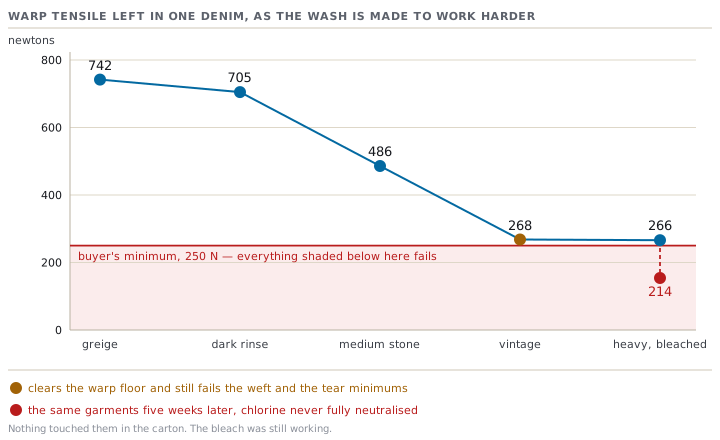
Ashbourne and Vane's purchase order carries three physical minimums. They are tested on the washed garment, not on the fabric roll:
- Tensile strength (the pull a strip of fabric takes before it breaks), ISO 13934-1, strip method: minimum 250 N warp and 200 N weft.
- Tear strength, ISO 13937-2, single tear: minimum 18 N warp and 15 N weft.
- Seam slippage, ISO 13936-2: maximum 6 mm at 120 N.
Here is the same 12.5 oz denim through each recipe.
| Warp tensile, N | Weft tensile, N | Warp tear, N | Weight loss | |
|---|---|---|---|---|
| Buyer's minimum | 250 | 200 | 18 | |
| Greige, before wash | 742 | 431 | 34 | |
| A, dark rinse | 705 | 412 | 32 | 1.2 percent |
| B, medium stone | 486 | 288 | 24 | 3.4 percent |
| C, vintage as approved | 268 | 191 | 16 | 6.5 percent |
| D, heavy stone with bleach, tested at the laundry | 266 | 208 | 19 | 8.1 percent |
| D, the same garments retested five weeks later | 214 | 163 | 11 |
Read row C first. The wash in the photograph stapled to the tech pack fails two of the three minimums on this fabric. Weft tensile reads 191 against 200. Tear reads 16 against 18. It was never going to pass, and nobody had tested it, because a photograph is not a specification and the approval had been done on look alone.
Then read the two D rows, because they are the same garments. D passed everything on the day it was made. It failed everything five weeks later, in a carton. Nothing scraped it in the carton. The neutralisation after the hypochlorite was cut short, chlorine stayed in the cotton, and it kept working at warehouse temperature for five weeks. This is the classic delayed denim failure. It is why the potassium iodide starch test on the garment, not on the bath, belongs on the laundry's own check sheet.
Getting back above the floor
| Route | What it does to the numbers | What it costs a pair |
|---|---|---|
| Cut stone from 50 to 20 minutes and make the contrast with the laser | 431 warp, 262 weft, 22 tear — passes | nothing extra; the laser package is already cheaper |
| Move up to a 13.5 oz base fabric | more strength at every stage, heavier hand, fit re-approval | USD 0.64 more fabric |
| Specify a higher-strength ring-spun warp at the same weight | roughly 12 percent more tensile before wash | USD 0.38 a pair |
| Ask the buyer to lower the minimum | usually refused; it is a returns position, not a preference | nothing, and it rarely works |
The first row is the one that matters. It is the reason a laser is a quality decision, not only a cost decision. A laser removes the dyed skin of the yarn. A stone removes the yarn. Two recipes can reach the same shade with the same contrast, and one of them leaves 431 N in the warp while the other leaves 268 N.
Shrinkage, skew and the pattern underneath
The wash also sets the size. A recipe change is a pattern change.
MJ-412 is wanted at an inseam of 82.0 cm finished. The pattern is cut long, by exactly the warp shrinkage of the recipe it will be washed in:
| Recipe | Warp shrinkage in the wash | Inseam cut at |
|---|---|---|
| A, dark rinse | 1.4 percent | 83.2 cm |
| B, medium stone | 3.1 percent | 84.6 cm |
| C, vintage | 3.8 percent | 85.2 cm |
Now apply the strength fix from the previous section. Cutting the stone step from 50 minutes to 20 takes the warp shrinkage from 3.8 percent down to 2.6 percent. The garments already cut at 85.2 cm would finish at 83.0 cm. That is a full centimetre over, against a tolerance of plus or minus 1.0 cm. The whole batch would sit exactly on the limit, and any normal variation puts half of it outside.
So the pattern must be recut at 84.2 cm for the new recipe. A wash change is a measurement change. The moment the recipe moves, the pattern, the marker and the cut plan move with it. This is the most expensive thing in this lesson to discover late, because it is discovered after cutting.
Two more facts about size belong on the same page. The industrial wash is where the fabric's leftover shrinkage is taken out. A heavily washed jean therefore moves less in the customer's machine than a rinse-only one, which carries all of that shrinkage home. And leg twist appears in the wash, not before it. The buyer's limit is measured after three home launderings to ISO 6330, on a garment that has already been through the laundry.
Prompt · Diagnose an off-standard batch and read it against the minimums
The afternoon a batch comes out of the light box outside the shade band, and the vessel has not moved.
Act as a senior denim quality manager. A batch has come out off-standard and I need a diagnosis and priced options today. Order facts: buyer [BUYER], PO [NUMBER], style [STYLE], total [QTY] pairs, FOB [PRICE], cost to make before wash [AMOUNT], wash charged [AMOUNT]. Affected quantity [QTY] pairs, which loads [NUMBERS]. The batch reads [LIGHTER OR DARKER] than the sealed standard under [ILLUMINANT], and [INSIDE OR OUTSIDE] the light and dark limits of the shade band. Recipe card: [PASTE IT]. What changed recently, if anything: [NEW CHEMICAL DRUM, NEW STONE SUPPLIER, LOAD WEIGHT, TEMPERATURE, SHIFT, FABRIC LOT]. Days to the vessel cut-off: [NUMBER]. The buyer's physical minimums are: tensile [N] warp and [N] weft to [METHOD], tear [N] warp and [N] weft to [METHOD], dimensional stability [PERCENT] length and [PERCENT] width after [NUMBER] home washes, skew maximum [CM]. Do the following. First, list the possible causes in the order I should check them, and for each one name the DOCUMENT that would prove or clear it. Second, tell me which direction this batch can still be moved and which it cannot, and say why. Third, give me at least four options — ship against a concession, correct the batch, remake, split the shipment — each with a cost in dollars, a duration in days, and what can still go wrong. Fourth, say which you would choose and what the choice depends on that is not in my numbers. Fifth, tell me what physical retesting this batch needs before it ships and whether any correction I make could put it below a minimum. Sixth, write the two-paragraph message to the buyer, naming the cause, attaching the evidence and putting the options in front of them. Do not recommend re-washing a light batch to bring it back to standard.
AI can make mistakes — check anything you act on.
Check yourselfA buyer sends you a swatch of washed denim and asks you to match the bulk to it. What do you send back before you start?Show the answer
A request for a washed garment standard, with the reason. A swatch and a jean washed in the same bath do not come out the same shade. The wear forms where the garment stands proud: seams, hems, waistband, pocket edges. A flat swatch has none of that. A swatch also cannot carry whisker position, hem grind, seam contrast, or the backstaining that shows on the pocket bags and the topstitch. Offer to make three garments to your best reading of the swatch. Send them as a proposed light limit, standard and dark limit, and ask the buyer to seal and return one set. That turns a two-week argument into one approval cycle, and it gives you a band instead of a single point.
Check yourselfYour wash passes tensile at the laundry on the day of production and fails it at the buyer's lab five weeks later. Where do you look first?Show the answer
At the neutralisation after the bleach. Chlorine left in the cotton keeps weakening it in the carton, and warehouse temperature speeds that up. So a garment that measured 266 N warp on the day can measure 214 N five weeks later, with nothing having touched it. Check the neutralisation step on the recipe card: chemical, dose, time, and whether it is verified on the garment with potassium iodide starch paper, not on the drained bath. The second place to look is the enzyme deactivation, for the same reason. An enzyme still alive in a wet pile keeps eating cotton while the load waits for the dryer.