Lessons · Lesson 1 of 3
The wash is a production process, and it is costed like one
Cost three real wash recipes per pair on the same jean, and find out which of them the agreed FOB price can carry.
Lesson 1 of 3 · 45 min
The situation
A pair of jeans reaches the shop already looking years old. Pale at the thighs, worn at the hems, soft instead of stiff. None of that happened on the sewing line. It was made afterwards, in a laundry, by a series of baths. Each bath is dosed, timed and priced like any other production step. This lesson walks through that series. Then it costs three versions of the same jean.
It is 19 May, 07:20, at a jeans factory in Ismailia. PO AV-3308 is for the British denim brand Ashbourne and Vane: 9,600 men's straight-leg jeans, style MJ-412, in a 12.5 oz ring-spun, rope-dyed denim, one colour. FOB USD 16.40. Order value USD 157,440. The goods must be on board on 26 August.
The fit was approved in April. The tech pack that came back with the approval has a photograph stapled to the last page. It shows the wash the buyer wants: a mid-blue jean with sharp whiskers at the hip, a sanded seat, ground hems and two small holes above the left knee.
The costing was signed in February. The cost sheet has one line for the wash: stone wash, USD 1.85.
Those two pages describe two different garments. The gap between them is bigger than the whole margin on the order. This lesson shows you how to find that out in May, not in August.
A wash is a second factory, not a finish
The mistake behind the situation above is simple. People treat the wash as something that happens to a finished jean. It is not. On a washed denim garment, the sewing floor makes a half-finished product, in a colour the customer will never see. The laundry makes the garment the customer buys. Shade, softness, whisker position, hem colour, the contrast on the seams, even the final measurements: all of it is created after the jean leaves the sewing line.
So cost a laundry the way you cost a production department. Machine hours, load size, labour minutes, chemicals, utilities, effluent (the used water the laundry must treat), and a reject rate. Never one price copied from last season's cost sheet.
Everything divides by one physical unit: the load. A pair of MJ-412 weighs 0.70 kg before washing. Nile Blue Laundry in Badr City runs 150 kg side-loading machines. A denim load is kept below that limit on purpose, so the garments can tumble: 200 pairs, 140 kg per load. This order is therefore 48 loads. Every minute you add to the recipe is added 48 times, not once.
The wet recipe, step by step
Desize. Always first, never optional. The warp (lengthwise) yarns of denim are coated with starch or PVA so they survive weaving. Until that coating is off, nothing after it works evenly. A stone wash on an undesized jean scrapes the coating, not the indigo dye. The step uses an amylase enzyme, at pH 6.0 to 6.5 and 60 degrees Celsius, for about 15 minutes. The jean loses weight here before any scraping has happened at all.
Rinse. Water and a softener. For a dark "raw-look" jean, this is the whole recipe. It is the cheapest thing a laundry can sell you.
Stone wash. Pumice stones tumbled with the garments. The scraping is mechanical and hits everything that sticks out: seams, hems, pocket edges, the top of the thick side seam. That is exactly why it looks like real wear. Stone is dosed against garment weight, usually between half and twice the load weight. The stones break up while they work. So a stone wash also brings grit in the pockets, a shake-out station, and stone sludge the laundry must dispose of.
Enzyme wash. Cellulase enzyme eats the surface of the cotton fibre and releases the indigo-carrying hairs with it. There are two families, and the choice is not cosmetic:
| Acid cellulase | Neutral cellulase | |
|---|---|---|
| pH window | 4.5 to 5.5 | 6.0 to 7.0 |
| Temperature | 50 to 55 degrees Celsius | 55 to 60 degrees Celsius |
| Speed | Fast, aggressive | Slower, gentler |
| Contrast produced | High | Moderate |
| Backstaining | Heavy, needs an anti-backstain agent | Much lower |
| Typical dose cost per load | Lower | Higher |
Whichever you use, the enzyme must be deactivated at the end, by raising the temperature or the pH. A live enzyme keeps eating cotton in the wet pile while the load waits for the dryer. The pairs at the bottom of the trolley then come out different from the pairs at the top.
Bleach. Sodium hypochlorite, used when the shade must lift a long way. It is fast and cheap. It is also the most dangerous step in the recipe, because its damage does not stop when the bath is drained.
Neutralisation. Sodium metabisulphite, or a peroxide route. This is not optional housekeeping. Chlorine left in the cotton keeps weakening it in the carton, in a warehouse, at 35 degrees Celsius, for weeks. A jean that passed testing at the laundry and failed six weeks later almost always failed here. Check it on the floor with potassium iodide starch paper. Test the garment, not the bath.
Tint and overdye. A weak solution of direct or sulphur dye that gives the whole garment a cast: grey, ecru, a warm brown. The tint is also the only step that goes the opposite way to everything else. It is how you make a garment darker. Nothing else in the list can.
Softening. Cationic or silicone softener. Worth knowing: a silicone softener gives a little tear strength back. It lets the yarns slide and bunch together at the tear point instead of breaking one by one. It is the only line in the recipe that does.
The three recipes, and what the laundry charges
| Recipe A, dark rinse | Recipe B, medium stone | Recipe C, vintage | |
|---|---|---|---|
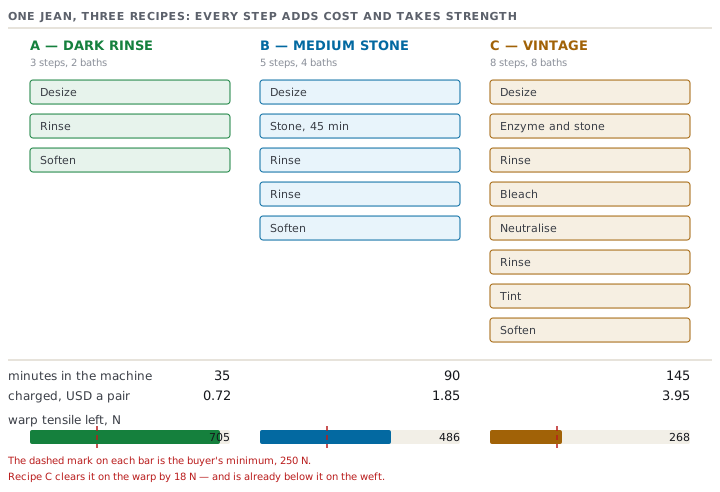
| Steps | Desize, rinse, soften | Desize, stone, two rinses, soften | Desize, enzyme and stone, rinse, bleach, neutralise, rinse, tint, soften |
| Minutes in the machine | 35 | 90 | 145 |
| Baths | 2 | 4 | 8 |
| Water, litres per pair | 12 | 28 | 52 |
| Dry processes | none | whiskers, light sanding | whiskers, sanding, grinding, destruction, PP spray |
| Quoted price per pair | USD 0.72 | USD 1.85 | USD 3.95 |
Read the minutes row before the price row. Recipe C holds a 150 kg machine for 145 minutes. Recipe A holds it for 35. Across 48 loads, that is the difference between roughly 28 machine-hours and 116. A laundry with eight machines has just told you how many other orders it can take that week.
Where the money actually goes
The number a merchandiser argues about is the quoted price. The number that tells you whether the price is real is the build behind it. Nile Blue opened recipe B:
| Line | Per pair |
|---|---|
| Chemicals, desize enzyme, detergent, softener | USD 0.16 |
| Pumice consumed | USD 0.09 |
| Water and effluent | USD 0.05 |
| Steam and electricity | USD 0.31 |
| Wet-side labour | USD 0.18 |
| Dry-process labour, whiskers and light sanding | USD 0.38 |
| Drying and pressing | USD 0.21 |
| Machine, building, depreciation | USD 0.24 |
| Laundry margin | USD 0.23 |
| Charged | USD 1.85 |
The largest single line is not the chemicals and it is not the stone. It is dry-process labour. On recipe C that one line is USD 1.18 of the USD 3.95. The next lesson is about that line.
The second largest is steam and electricity. That is why the recipe with eight baths costs more than twice the recipe with four.
The two lines that move under you
Water. Twelve litres a pair on recipe A. Fifty-two on recipe C. At the industrial rate Nile Blue pays, USD 1.60 per cubic metre including effluent treatment, that is USD 0.019 and USD 0.083 a pair. This is why nobody argues about it. Now move the same laundry to a district where treated discharge costs USD 6.00 per cubic metre. Recipe C's water line becomes USD 0.31 a pair. That is USD 2,976 across this order, against USD 797 at today's rate. It comes from a line item nobody looked at.
Energy. Every bath is heated. Steam is the largest utility in a laundry, and it follows the fuel price directly. A quotation given in February at one gas price is a quotation, not a contract. The ones that hold carry an escalation clause or a validity date.
Rejects are part of the wash price
A pair scrapped at the laundry has already absorbed everything before it: fabric, trims, cutting, sewing, and the wash itself. It is the most expensive unit of loss in the whole order. It belongs in the wash cost, not in a general overhead where nobody can see it.
MJ-412 costs USD 13.12 to make before the wash. That is fabric USD 6.38, trims USD 1.55, CMT USD 2.85, finishing and packing USD 0.35, factory overhead and margin USD 1.90, and freight to the laundry and back USD 0.09.
| Recipe A | Recipe B | Recipe C | |
|---|---|---|---|
| Cost before wash | USD 13.12 | USD 13.12 | USD 13.12 |
| Wash charged | USD 0.72 | USD 1.85 | USD 3.95 |
| Reject rate at the laundry | 0.4 percent | 1.5 percent | 3.6 percent |
| Reject loss per shippable pair | USD 0.06 | USD 0.23 | USD 0.64 |
| Total cost per shippable pair | USD 13.90 | USD 15.20 | USD 17.71 |
| Margin per pair | USD 2.50 | USD 1.20 | minus USD 1.31 |
| Margin on the order | USD 24,000 | USD 11,520 | minus USD 12,576 |
Recipe A leaves 15.2 percent of the FOB. Recipe B leaves 7.3 percent, a normal jeans margin, and the number the February cost sheet was built on. Recipe C, the photograph stapled to the tech pack, loses USD 12,576.
That is the whole finding. It is available in May, with a calculator. The conversation to have with Ashbourne and Vane is not "the wash is difficult". It is this: the approved photograph is a vintage recipe, it prices at USD 3.95 against a cost sheet carrying USD 1.85, and the gap is USD 2.10 a pair. Then offer the three ways out. A revised FOB of USD 18.50. A simpler dry package that drops the destruction and the PP spray and lands at USD 2.60. Or the recipe as originally costed. All three are acceptable answers. Only silence is not.
Prompt · Cost the wash from the recipe, not from the word
The moment a tech pack shows a wash photograph and your cost sheet carries a single line that just says wash.
Act as a denim laundry costing manager. I need a wash recipe costed properly against my cost sheet. Order facts: buyer [BUYER], PO [NUMBER], style [STYLE], quantity [QTY] pairs, FOB [PRICE] per pair, base fabric [WEIGHT] oz [CONSTRUCTION]. Garment weight before wash [KG]. My cost before wash is [AMOUNT] per pair, broken down as fabric [AMOUNT], trims [AMOUNT], CMT [AMOUNT], finishing and packing [AMOUNT], overhead and margin [AMOUNT]. The laundry's recipe card reads: [PASTE THE STEPS, WITH CHEMICAL, DOSE, TEMPERATURE, pH AND TIME FOR EACH]. Dry processes required by the tech pack: [LIST THEM — WHISKERING, SANDING, GRINDING, DESTRUCTION, PP SPRAY, LASER]. Machine capacity [KG] and the load size the laundry actually runs [KG]. Do the following. First, restate the recipe as a numbered sequence and give the total minutes in the machine and the number of baths. Second, tell me how many loads this order is and how many machine hours that is. Third, build the cost per pair line by line — chemicals, stone, water and effluent, steam and electricity, wet labour, dry-process labour, drying and pressing, machine and depreciation — and say which lines you had to assume. Fourth, add the reject rate as a cost per SHIPPABLE pair, not as a percentage, using the full made cost of a scrapped pair. Fifth, carry it all the way to a margin per pair and a margin on the order, and state plainly whether the FOB can carry this recipe. Sixth, if it cannot, give me three priced ways out: a revised FOB, a simplified recipe with what is dropped named, and any step that could be done differently for the same look. Do not give me a range where a number is possible, and name every assumption you make in a list at the end.
AI can make mistakes — check anything you act on.
Check yourselfA laundry quotes USD 1.85 for a stone wash and USD 3.95 for a vintage wash on the same jean. Your FOB is USD 16.40 and your cost before wash is USD 13.12. Before you argue about the price, what is the first number you should ask for?Show the answer
The reject rate for each recipe. It is invisible in the quotation and it moves the answer. At 1.5 percent on recipe B, the loss is USD 0.23 per shippable pair. At 3.6 percent on recipe C, it is USD 0.64. Add those to the quoted prices and the gap between the two recipes is USD 2.51 a pair, not the USD 2.10 the quotation shows. On 9,600 pairs, that unstated difference is USD 3,936. That is more than most price negotiations you will ever win.
Check yourselfYour buyer asks for the vintage wash to be made darker to match a new reference. Which step do you change?Show the answer
None of the scraping steps, because they only go one way. Stone, enzyme and bleach all remove indigo. Running them shorter gives a darker garment than the current recipe, but never darker than the fabric you started with. It also changes the whisker contrast and the hem colour that were already approved. Going darker means adding colour: a tint or an overdye, dosed weakly at the end of the recipe. Budget for it separately. A tint is an extra bath, an extra heat-up and an extra risk of going past the standard. It also needs its own approval, because a tint colours the pocket bags and the topstitching thread as well as the denim.