Lessons · Lesson 2 of 3
Dry processes: the laser, and what it replaced
Cost a hand-made dry package against a laser package on the same jean, and know which parts of the look a laser cannot make.
Lesson 2 of 3 · 43 min
The situation
The worn parts of a jean that are genuinely drawn on are not made in a machine. The pale creases at the hip, the rubbed seat, the whitened hems: all of it is done by hand. People hold abrasive paper against cloth stretched over a leg-shaped mould. This work is the largest single line in the price of the wash. This lesson puts the machine that has replaced most of that work up against the hands.
It is 2 June, on the dry floor at Nile Blue Laundry. Twenty-two men stand at inflated rubber dummies. Each one holds a pair of MJ-412 against the mould and works abrasive paper across the hip. Behind them is a spray booth with an extraction hood. Behind that is a machine the size of a photocopier. Nobody has switched it on this week.
The dry floor is where a jean stops looking new. It is also where the largest single line in the wash price sits: USD 1.18 of recipe C's USD 3.95. And it is where the industry has changed more in fifteen years than in the fifty before them.
What the dry processes are
None of these steps uses a machine full of water. They are done on a dry garment, before the wet recipe or between its steps. Each one puts wear in a specific place a machine cannot reach.
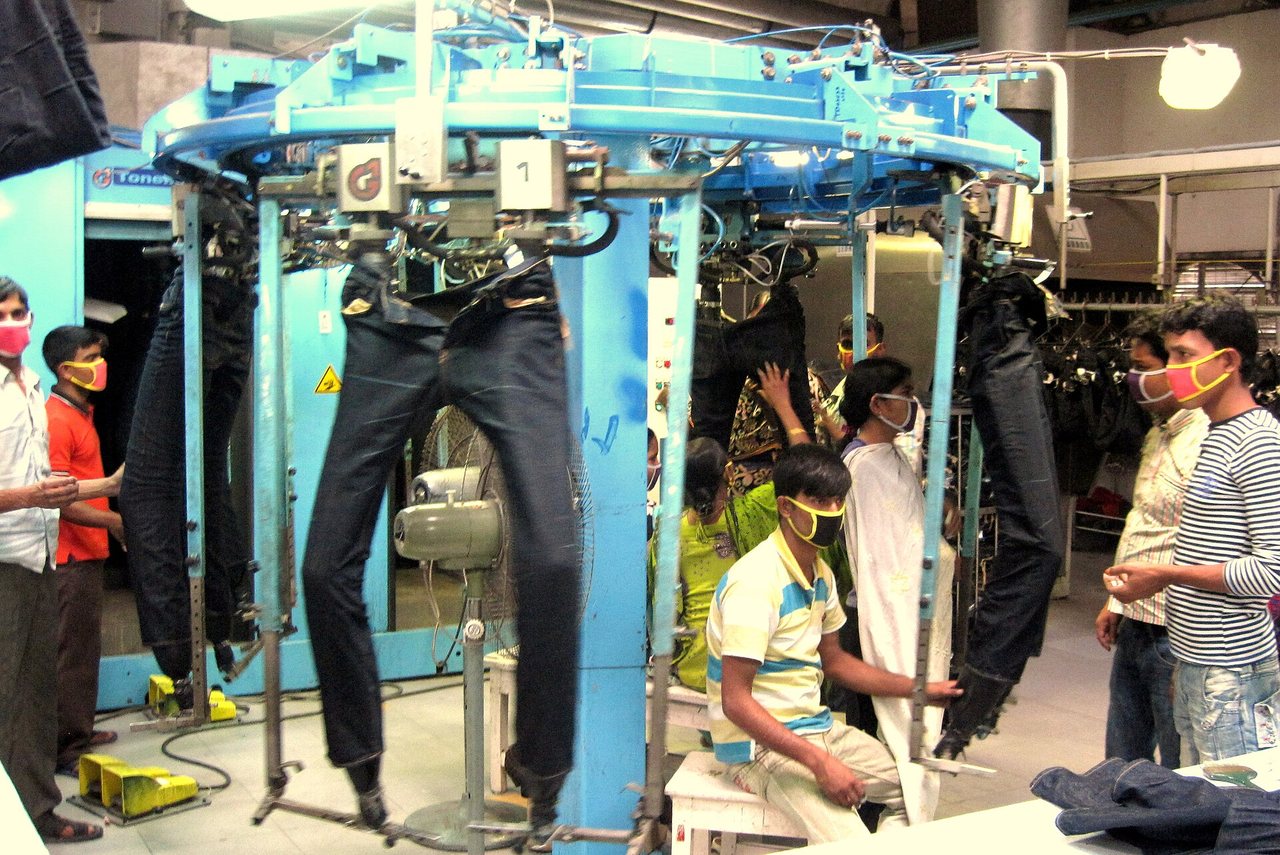
Whiskering. The fan of pale lines that spread from the fly across the hip, and the honeycomb creases behind the knee. Real ones are made by wearing a jean for two years. Ours are made on a rubber or resin mould shaped like a thigh. The garment is pulled over it, the raised ridges push the fabric out, and an operator runs abrasive paper along them, usually P320 to P400 grit. A full set takes three and a half minutes a pair, done well.
Hand sanding. Emery paper on an inflated dummy, across the front thigh and the seat. It lifts the flat areas rather than the creases. Two and a half minutes. This step used to be done by blasting abrasive at the garment under air pressure. That history matters enough to get its own section below.
Grinding. A small rotary tool with an abrasive head, run along hems, the waistband edge, pocket openings and the fly. One minute. It is the riskiest minute on the floor. The tool is fast, the hem is a thick folded seam, and an operator who leans through it has turned a jean into a reject.
Destruction. Designed holes. A hole is cut or scraped through the face of the fabric, and the warp yarns are left as a ladder across it. A backing patch or a net is stitched behind, so the hole does not grow. Position, length and backing all belong on the tech pack. A hole in the wrong place is a fault. A hole that keeps growing in the customer's washing machine is a claim.
PP spray. Potassium permanganate in solution, sprayed onto the whiskers and thighs. It lifts the indigo chemically where the abrasion has already thinned it. It is dramatic and fast. It is also a strong oxidiser. The operator needs a booth with extraction and full protection. The garment must be neutralised afterwards with sodium metabisulphite, or it turns brown in the carton. The manganese ends up in the waste water, where discharge permits increasingly measure it. Several denim brands have set dates to eliminate PP entirely. A factory that builds a look around PP today is building a look with an expiry date.
The laser
A carbon dioxide laser scans the garment and burns the indigo layer off the surface of the yarn. It draws rather than scrapes. The beam removes the dyed skin of a ring-dyed yarn and exposes the white core underneath. That is exactly what a stone wash does, but aimed instead of tumbled.
What it buys you is worth listing plainly, because each item is a real line in the cost sheet:
- Time. Thirty-eight seconds a pair for a whisker, sand and grind package, loading and unloading included. By hand, seven minutes.
- Consistency. The file is a file. The second pair is identical to the ten-thousandth, and to the pair you make when the buyer reorders in eighteen months.
- No water and no chemicals in the step itself, and no PP.
- No operator exposure to abrasive dust or permanganate.
What it does not buy you matters just as much. A merchandiser who promises a laser package without knowing these limits will be explaining something to a buyer later:
- A laser cannot make a hole. It can weaken a patch until it opens, but a designed hole with a ladder of warp yarns and a backing is still hand work.
- A laser cannot give softness. Softness comes from the wet recipe. A lasered jean that has not been washed feels like a new jean that has been drawn on.
- A laser cannot make a 3D crease. Permanent creases at the knee and hip are set with resin and an oven. That is a separate process with its own strength cost.
- A laser's result depends on the fabric. A deep, rope-dyed, ring-spun warp lasers with contrast. A shallow slasher-dyed or open-end warp lasers grey and dead. Change the fabric and the file must be re-approved, exactly like a wash recipe.
- On stretch denim, power is a specification. Too much energy damages the elastane at the surface and leaves a shine that reads as a burn. Power, speed and resolution belong on the recipe card, next to pH and temperature.
Costing the two packages
MJ-412's recipe C dry package by hand: whiskering, sanding, grinding, two knee holes, PP spray and neutralisation.
| Line | Per pair |
|---|---|
| Direct labour, 8.5 minutes at a loaded rate of USD 1.90 an hour | USD 0.27 |
| Abrasives, moulds, gloves, masks, filters | USD 0.06 |
| PP chemical, neutralisation bath, extra dry cycle | USD 0.31 |
| Rework and rejects from hand variation, 3.1 percent | USD 0.29 |
| Dry-floor overhead and supervision | USD 0.25 |
| Total | USD 1.18 |
Now the machine nobody switched on. It is a laser costing USD 165,000, written off over five years, across 300 working days a year.
| Line | Per day |
|---|---|
| Depreciation | USD 110.00 |
| Power, 8 kW for 20 hours at USD 0.09 a kWh | USD 14.40 |
| Two operators, one per shift | USD 24.00 |
| Optics, service contract, maintenance | USD 18.00 |
| Total | USD 166.40 |
The daily cost barely moves with volume. What moves is how many pairs you divide it by. This is the entire argument about lasers in one table:
| Pairs a day | Cost per pair |
|---|---|
| 1,800, two shifts at capacity | USD 0.09 |
| 600 | USD 0.28 |
| 200 | USD 0.83 |
| 141 | USD 1.18 |
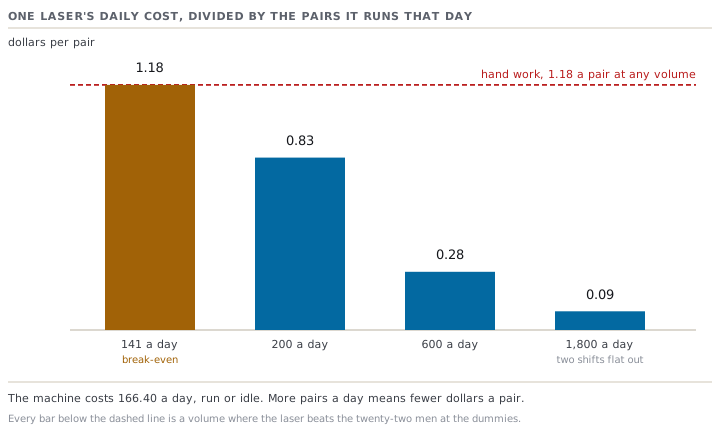
The last row is the break-even against hand work. Above roughly 141 pairs a day, the laser is cheaper than the twenty-two men at the dummies. Nile Blue washes several thousand pairs a day. The machine sat idle this week because nobody built a file for the styles running. That is a scheduling failure, not a technology question.
For PO AV-3308 itself, at the laundry's real utilisation:
| By hand | Laser package | |
|---|---|---|
| Whiskering, sanding, grinding | included below | USD 0.09 |
| File programming, USD 320 over the order | none | USD 0.03 |
| Two knee holes, still hand work, with backing | included below | USD 0.07 |
| PP spray and neutralisation | included below | none |
| Package total per pair | USD 1.18 | USD 0.19 |
| Across the order | USD 11,328 | USD 1,824 |
USD 0.99 a pair, USD 9,504 on the order. Recipe C's price falls from USD 3.95 to USD 2.96.
That does not rescue the order on its own. From the last lesson, recipe C at USD 3.95 lost USD 1.31 a pair. At USD 2.96, the reject rate also falls, from 3.6 percent to 1.9 percent, because the hand variation has gone. The reject loss becomes USD 0.31 and the total cost USD 16.39. The margin is one cent. Break-even is not a business.
Now replace the hypochlorite bleach with an ozone step: twelve minutes in a sealed drum instead of three baths and forty-five minutes. Another USD 0.34 comes out, in water, steam and effluent. The recipe lands at USD 2.62, the total cost at USD 16.04, and the margin at USD 0.36 a pair. That is 2.2 percent of the FOB. Technically shippable, and still not a job worth running: recipe B was making 7.3 percent.
So the conversation with Ashbourne and Vane becomes a better one, not a cancelled one. You are no longer asking for USD 18.50 to cover a package you have not improved. You are asking for USD 17.60, which on this cost base returns 8.9 percent, the level of margin the February cost sheet assumed. And you are asking with a recipe you can show them, from a floor that has taken the permanganate out of the process. That is a proposal a buyer can take to their own director.
Prompt · Build the case for a laser package, honestly
Before you promise a buyer a laser price, or before you accept a laundry's reason for keeping the work on hand dummies.
Act as a denim laundry operations manager who has installed laser equipment and has no reason to oversell it. I want an honest comparison of a hand-made dry package against a laser package on one style. Style facts: [STYLE], [QTY] pairs, base fabric [WEIGHT] oz, warp [RING-SPUN OR OPEN-END], dyeing [ROPE OR SLASHER], elastane content [PERCENT]. The tech pack calls for: [LIST EVERY DRY EFFECT — WHISKERS, HONEYCOMBS, SEAT SANDING, HEM AND POCKET GRINDING, DESTRUCTION AND ITS SIZE AND POSITION, PP SPRAY, 3D CREASES]. Hand-work times I have measured or been quoted: [MINUTES PER EFFECT]. My loaded labour rate is [AMOUNT] an hour. Laser facts, if known: machine price [AMOUNT], expected life [YEARS], working days a year [NUMBER], power draw [KW], electricity [AMOUNT] a kWh, operators per shift [NUMBER] at [AMOUNT] a shift, service and optics [AMOUNT] a year, cycle time per pair [SECONDS], file programming cost per style [AMOUNT], and the laundry's total daily denim volume [PAIRS]. Do the following. First, split the tech pack's effects into three lists: what a laser can do, what it cannot do at all, and what it can do only in combination with a wet process — and say why for each. Second, cost the hand package per pair including abrasives, PP chemistry and neutralisation, and the rejects caused by hand-to-hand variation. Third, cost the laser package per DAY and then divide by throughput at the laundry's real daily volume, not at my order's volume, and show the break-even daily volume where the two are equal. Fourth, amortise the file programming over MY order only and show what that adds per pair. Fifth, tell me what the laser does to the physical test results compared with achieving the same look by abrasion, and be specific about tensile and tear. Sixth, list what would make the laser the WRONG answer here. If any input is missing, ask me for it rather than assuming a number.
AI can make mistakes — check anything you act on.
Consistency is a cost, not a virtue
The reason the reject rate falls with a laser can be measured, and it surprises people. Nile Blue pulled forty pairs whiskered by four operators on one day. They measured where the topmost whisker line ended, from the fly seam.
| Mean, mm from fly seam | Range, mm | |
|---|---|---|
| Operator 1 | 96 | 21 |
| Operator 2 | 108 | 26 |
| Operator 3 | 91 | 34 |
| Operator 4 | 103 | 19 |
| All four | 100 | 43 |
A buyer's QC does not measure whisker position with a ruler. They put the garment next to the approved standard and say yes or no. Somewhere across a 43 mm spread, that answer changes. That is the 3.1 percent. It is not carelessness. It is four pairs of hands doing a judgement task eight hundred times a day.
Check yourselfA laundry tells you a laser package costs them USD 0.83 a pair and hand work costs USD 1.18, so they will keep doing it by hand on your 2,000-pair order. Is that reasoning sound?Show the answer
No, and the number they quoted proves it. USD 0.83 is the cost at 200 pairs a day, which means a machine standing idle most of the time. The laser's cost is a daily cost divided by throughput. So the right question is not what it costs on your order, but what it costs at the laundry's total daily denim volume. If they run three thousand pairs a day across all customers, the true figure is nearer USD 0.09, and your order should carry its share of that. There is an honest version of their argument, and it is worth hearing. A 2,000-pair order needs its own file, and USD 320 of programming spread over 2,000 pairs is USD 0.16 a pair. That really does change the arithmetic on a short run.
Check yourselfYour buyer's tech pack shows whiskers, a sanded seat, ground hems and two destroyed patches at the knee. Which of those can a laser do, and what does that mean for your quotation?Show the answer
The laser does the whiskers, the sanding and the grinding. Those are the marks made by removing surface indigo. It cannot make the destroyed patches. A real hole, with a ladder of warp yarns and a backing behind it, is still cut and scraped by hand, and it still needs a backing patch sewn in. So the quotation is a mixed package, not a laser package, and it must be priced as one. Quote the whole tech pack at the laser rate and discover the destruction afterwards, and the laundry ends up doing hand work at a machine price. They will recover it from you on the next order.