Lessons · Lesson 2 of 3
Turning a fit comment into one named change
Convert comments written in body language into a named part, a named measurement point and a single pattern change, and price the guess you would otherwise make.
Lesson 2 of 3 · 38 min
11 March, 14:05 — nine comments and eight days
When a buyer tries a sample on a model, what comes back is a list of remarks. Tight here, dropping there. Those remarks are evidence, not instructions. A pattern is changed by moving a named point and redrawing a named line, and a sensation can be answered several ways. This lesson is about that translation, and about the questions to ask when a remark cannot be translated at all.
The size set for SH-708 went to London on 3 March. The fit session was yesterday. The comment sheet arrives at 14:05 with nine lines on it, and the fabric for the bulk cut is booked into the cutting room on 25 March. Eight working days.
Eight of the nine comments are unambiguous. They name a measurement point, give a direction and give an amount: "Point 9, chest, reduce 1.0 cm", "Point 21, cuff opening, add 0.5 cm". Those are instructions. A pattern master can act on them without looking up from the desk.
The ninth is this:
Armhole is tight. Raise it 1.5 cm.
That sentence is the subject of this lesson, because it is the most common shape of comment in the trade and it cannot be executed as written. "Raise" describes a movement of a part. A pattern is changed by moving a point and redrawing a line, and there are four different points that a person could reasonably call "the armhole".
Body language and garment language
A fit session happens on a body. A pattern change happens on paper. Comments are written in the room where the fitting took place, in the language of the room: tight, dropping, standing away, riding up, pulling. Those words describe what the wearer feels and what the fitter sees. None of them is a dimension.
Every comment therefore has to be converted, and the conversion has three parts:
- Which part. Armhole, sleeve cap, shoulder, side seam.
- Which measurement point. The numbered point on the graded spec, so that both sides can check the result against the same number.
- Which direction and how much, expressed as that point's new value.
A comment that survives all three conversions is a change order. A comment that survives one or two is a guess wearing a number.
The point number is the whole trick
A graded spec sheet is a numbered list of measurements. Every row has a number, a name, a how-to-measure definition and a value for each size. The numbers exist for exactly one reason: so that two people in two countries can talk about the same measurement without describing it.
That is why a comment carrying a point number is an instruction and a comment carrying a part name is a conversation. "Point 9, chest, reduce 1.0 cm" cannot be misread. "Take some out of the chest" can be read as the chest point, the waist point, the sweep, or all three graded together, and each of those is a different garment.
There is a second trap sitting underneath the first, and it belongs here rather than in a measurement course. A point number identifies which measurement is meant. It does not, on its own, say how it is taken. Chest can be measured across the garment lying flat, in which case the value is a half measure, or all the way round, in which case it is a full one. Sleeve length can run from the HPS along the shoulder and down the arm, or from the shoulder point only, and the two differ by the shoulder width. Armhole can be measured straight — a ruler laid across from the shoulder point to the underarm — or along the curve, and on a men's shirt the curve reads roughly 4.0 cm longer than the straight.
So the conversion has a fourth step nobody writes down: check that both sides measure the point the same way. The how-to-measure page in the tech pack is what settles it. When there is no such page, the fastest fix is a photograph of the sample with the tape in position, sent with your reading of the value. It takes five minutes and it removes an entire class of argument at the final inspection.
Four readings of one comment
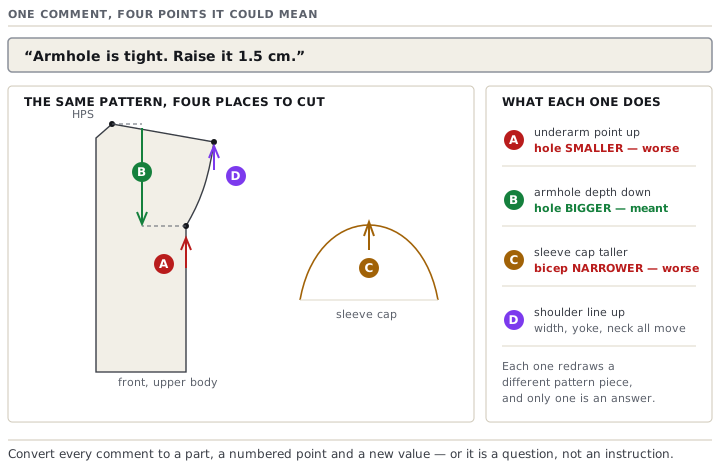
SH-708's graded spec has an armhole area with four points in it. "Raise the armhole 1.5 cm" can land on any of them.
Reading one: raise the underarm point. Move the junction of the side seam and the armhole up by 1.5 cm. This is the most literal reading of the English — the armhole, as a hole, moves up. It makes the armhole smaller: circumference drops from 49.0 cm to about 46.0 cm. The side seam gets 1.5 cm longer. The sleeve must be re-set into a smaller hole. The wearer's complaint was that the armhole is tight, and this reading makes it tighter.
Reading two: increase the armhole depth. Point 14, armhole depth measured straight down from HPS, goes from 24.5 cm to 26.0 cm. The underarm point moves down, the hole gets bigger, circumference rises from 49.0 cm to about 52.0 cm. The sleeve cap has to be redrawn to match the new armhole, and a redrawn cap on the same sleeve length widens the bicep by around 2.4 cm.
Reading three: raise the sleeve cap. Leave the body alone and add 1.5 cm to the height of the sleeve cap. The shoulder looks cleaner and the sleeve hangs closer to the body. It also narrows the bicep, because cap height and bicep width trade against each other on a fixed cap seam length — so it makes the arm feel more restricted, not less.
Reading four: raise the shoulder line. Move the shoulder seam up at the armhole end. This changes shoulder width, changes where the yoke sits, and changes the neck point. It is almost never what anybody means, and it is what a pattern master will do if the comment sheet also complains about the shoulder.
Four readings. Two of them make the complaint worse. All four are defensible from the sentence as written.
What each reading costs
| Reading | New pattern pieces | Consumption change | Cost per shirt | On the order | Days |
|---|---|---|---|---|---|
| Raise the underarm point | Front, back | None | None | None | 2 |
| Increase armhole depth to 26.0 cm | Front, back, sleeve | Sleeve wider, plus 0.038 m | USD 0.08 | USD 1,152 | 5 |
| Raise the sleeve cap | Sleeve | Sleeve taller, plus 0.024 m | USD 0.05 | USD 720 | 4 |
| Raise the shoulder line | Front, back, yoke, sleeve | Under review | Not costable yet | Not costable yet | 7 |
Notice what the table is really showing. The cheapest reading is the one that makes the garment worse, and the reading the buyer probably meant costs USD 1,152 and five days out of the eight you have. The price of the wrong answer is not the difference between USD 1,152 and nothing. It is a second fit round.
The message that gets it answered in one round
At 15:20 the merchandiser sends four sentences, not a paragraph:
Comment 9, armhole. Our spec has four points in that area, so we want to change the right one. Current values: point 12, armhole circumference 49.0 cm; point 14, armhole depth from HPS 24.5 cm; point 15, sleeve cap height; point 7, shoulder width. Our reading is that you want point 14 at 26.0 cm, which grows circumference to about 52.0 cm and widens the bicep by about 2.4 cm — please confirm, or name the point you meant.
Three things make that message work, and they are worth copying exactly.
- It names the points and their current values. The buyer's technologist does not have to open a file to answer.
- It offers a reading and its consequence, so the reply can be a single word.
- It says what else moves. A bicep growing 2.4 cm is a change to a measurement the buyer also has a number for. Telling them now is not a courtesy; it is what stops comment 9 from creating comment 10 on the next sample.
The reply comes back at 19:40 the same evening: "Yes — point 14 to 26.0 cm. Bicep is fine, keep the cuff as is."
One message, five hours, no sample.
What the guess would have cost
Suppose nobody asks. The pattern master takes the literal reading and raises the underarm point, because that is what the sentence says. He is not wrong; nobody asked him.
| Amount | Days lost | |
|---|---|---|
| Second fit sample, making and materials | USD 145 | |
| Courier, both directions | USD 62 | |
| Sample round, make to comment | 11 | |
| Bulk cut slips from 7 April to 18 April | 11 | |
| Shipping buffer falls from 18 days to 7 days |
USD 207 and eleven days, and the eleven days are the expensive half. SH-708 has an 18-day buffer between the last carton off the packing line and the vessel closing. Spend eleven of it and you have seven days for everything that has not happened yet — the final inspection, the re-inspection if the first one fails, the trucking to Alexandria, the port.
If any of that slips, the recovery is air freight. A packed shirt weighs 0.34 kg and the Cairo to UK rate is USD 4.10 a kg, which is USD 1.39 a shirt. A partial air shipment of 3,000 shirts to protect the launch date is USD 4,170 — twenty times the sample and the courier together, created by one question nobody asked.
The comments that never convert
Some comments genuinely cannot be turned into a point, and it is worth recognising them rather than forcing them.
- "The collar stands away from the neck." This is usually a collar band length and shape problem, sometimes an interlining problem, and occasionally a pressing problem. It needs a photograph of the sample on the form and a conversation, not a number.
- "The shirt looks boxy." This is a silhouette comment. It converts into several points at once, and if you convert it into one you will get it back.
- "Sleeve is twisting." Often not a measurement at all — it is grain, or a sleeve set in with the notches matched on the wrong side, or a fabric that has been finished with a skew.
The rule that holds for all three: say what you think it means, in parts and points, and ask. A comment you cannot convert is not a failure of your reading; it is a comment that was not finished.
Check yourselfA comment says: 'Back neck is gaping. Take out 1 cm.' You have points for neck width, back neck drop, collar band length and yoke depth. What do you send back?Show the answer
Send back the four current values and your reading. Gaping at the back neck is most often the back neck drop being too deep for the collar band, so your reading is probably that the back neck drop reduces and the collar band length stays. But taking 1 cm out of neck width instead changes where the shoulder seam starts and moves the collar points. Taking it out of the band changes the collar size the shirt is labelled and sold as, which is a commercial change, not a fit one. That last one is the reason you never guess this comment: on a men's shirt the collar band length is the size on the label, and a factory that quietly shortens it has changed the product.
Prompt · Turn a fit comment into one named pattern change
When a comment sheet says raise, drop, tighten or open, and the pattern room is waiting.
Act as a pattern technologist. I have fit comments written in body language and I need them converted into named pattern changes before anybody touches a block. Style facts: [STYLE], [GARMENT TYPE], [FABRIC AND STRETCH CONTENT], sample size [SIZE], sizes [RANGE]. Here is the graded spec, point by point, with the point numbers, names, how-to-measure definitions if I have them, and the sample-size values: [PASTE IT]. Here are the comments exactly as the buyer wrote them: [PASTE THEM]. Days until the fabric is cut: [NUMBER]. Do the following. First, take each comment and try to write it as: PART, POINT NUMBER, OLD VALUE, NEW VALUE. Say plainly which comments convert cleanly and which do not. Second, for every comment that does NOT convert, list every point on my spec that the wording could reasonably mean, and for each reading say what happens to the fit, which pattern pieces have to be redrawn, and whether the change makes the stated complaint better or worse. Third, flag any comment where a point number would still not settle it because the how-to-measure is missing or ambiguous, and tell me what to photograph. Fourth, name every knock-on measurement each change moves, because a point the buyer also has a number for is a comment on the next sample if I do not raise it now. Fifth, write the reply email: current values, my reading, its consequence, and a one-word way for the buyer to confirm or correct. Sixth, tell me which changes I can safely start now and which must wait for the answer, given the days I have. Never guess an intention where naming the alternatives is possible.
AI can make mistakes — check anything you act on.