Lessons · Lesson 3 of 3
The parts that are not in the drawing
Cost the components a flat sketch cannot show, and write a callout list that cannot be read two ways.
Lesson 3 of 3 · 34 min
17 March — the bill of materials against the sketch
Most of what a garment is made of cannot be seen from outside. A line drawing only draws the outside. The collar stiffening, the neck tape, the cloth folded inside every seam, the thread: all of it is paid for. Price a garment from the picture and you leave out a share of the cost that matters. The habit worth building is to work from a standing list, not from what the buyer drew.
The armhole is settled, the yoke is settled, and the bill of materials for SH-708 goes out for approval. It runs to twenty-two lines. The flat sketch in the tech pack shows nine.
That gap is not sloppiness on anybody's part. A flat is a drawing of the outside of a garment. It shows outlines, seam lines and topstitching, because those are the things you can see when the shirt is hanging on a rail. Almost everything that makes the shirt possible is either inside it, underneath it, or folded away — and every one of those things is bought, cut, sewn and paid for.
The parts that never appear on a flat
Interlining. The fusible that gives a collar its body and a cuff its edge. On SH-708 five separate parts are fused, and each has an area:
| Fused part | Area per shirt |
|---|---|
| Top collar | 0.031 m² |
| Collar band | 0.024 m² |
| Cuffs, two | 0.052 m² |
| Front placket | 0.028 m² |
| Sleeve placket tower, two | 0.013 m² |
| Total, at USD 1.28 a square metre | 0.148 m² |
Which plies are fused is a construction decision with a visible result. Fuse both plies of a collar band and the collar is stiff and holds a shape; fuse one and it is softer and creases at the neck. The flat draws the same collar either way.
Back-neck tape. A narrow strip that covers the seam where the yoke, the back and the collar band all meet, so the wearer's neck does not sit against three raw seam allowances. It is 0.24 m of 12 mm tape and about a third of a minute. It is on no sketch ever drawn.
The sleeve placket underlap. The tower shows on the outside and gets drawn. The underlap sits beneath it, is cut from the same cloth and is invisible in every photograph of a finished shirt. Two per shirt.
Turn of cloth. An undercollar is cut very slightly smaller than the top collar, so that when the collar rolls over, the seam sits underneath instead of showing along the edge. It is a pattern allowance of a few millimetres that never appears as a line on anything and is the difference between a collar that looks made and one that looks assembled.
Seam and hem allowances. A flat draws the finished edge of a shirttail. The pattern piece is bigger, by the hem allowance, all the way round. Across the whole garment the allowances account for 0.11 m of the 1.695 m of cloth.
Thread. Thread is consumed by seam length and stitch type, not by garment area, and a shirt is a long garment in seam terms. It has felled side seams, felled armholes, two rows of topstitching on the placket, the collar, the band, the cuffs and the yoke. SH-708 consumes about 168 m a shirt.
Ease. Not a part at all, but the same kind of invisible. Ease is the difference between the body measurement and the garment measurement, and it exists nowhere on the flat, nowhere in the bill of materials, and only implicitly in the spec sheet. It is why a shirt for a 100 cm chest is not made 100 cm around.
What the invisible parts cost
| Component | Per shirt | On 14,400 shirts |
|---|---|---|
| Fusible interlining, five parts | USD 0.19 | USD 2,736 |
| Back-neck tape, material and operation | USD 0.06 | USD 864 |
| Sleeve placket underlap, two | USD 0.09 | USD 1,296 |
| Thread, 168 m at USD 0.65 a thousand metres | USD 0.11 | USD 1,584 |
| Seam and hem allowances, 0.11 m of cloth | USD 0.24 | USD 3,456 |
| Total | USD 0.69 | USD 9,936 |
USD 9,936 is 40.1% of the margin on this order, and it is carried entirely by parts that a buyer's flat sketch does not draw and a junior merchandiser costing from that sketch would not think to add.
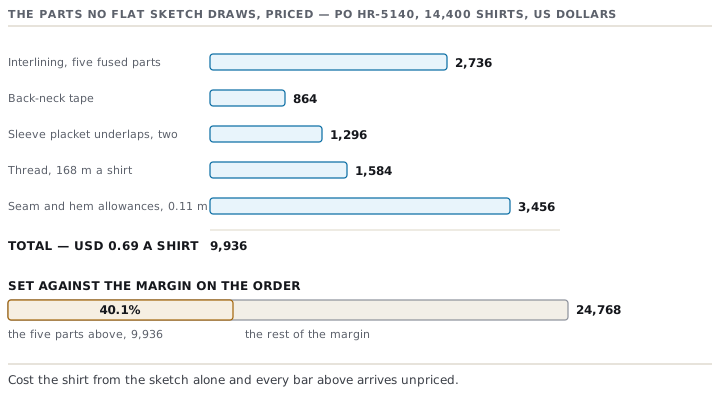
This is the reason the anatomy matters commercially rather than academically. You do not learn the parts so you can label a picture. You learn them so that when a sketch arrives you can list what has to be there and is not shown, before you put a number on the page.
The same problem in a trouser
The other style in the same booking, TR-330, is a flat-front cotton chino, and its hidden list is different again:
- Waistband curtain — the finishing strip that lines the inside of a tailored waistband. It is 0.98 m of curtain at USD 0.14 a metre and a little over half a minute of sewing: USD 0.21 a pair. The tech pack's entire waistband callout reads "waistband 4 cm, five belt loops".
- Pocket bags — the pouches behind the side-seam pockets, usually in a lighter, cheaper cloth than the shell. Two per trouser, and the fabric choice is a durability decision the sketch cannot express.
- Fly shield and fly facing — two different pieces, both behind the fly, both invisible when the trouser is closed, and frequently confused with each other in a callout list.
- Crotch gusset, on some blocks, and never drawn.
The lesson generalises: for every garment type, there is a standing list of parts that exist in the construction and never appear in the drawing. Build the list once, keep it, and run every incoming sketch against it.
Naming a part is cheaper than describing it
Last season the same buyer sent a tech pack for SH-661, an almost identical shirt, whose construction page was written in descriptions rather than names:
"Double layer collar with a stand. Buttoned opening at the sleeve. Curved hem. Reinforcement at the front opening."
Every sentence there is true, and every sentence can be built more than one way. That pack took three sample rounds to approve. The equivalent named callout list would have read:
"Collar: two-piece, top collar plus undercollar, top collar fused. Collar band: separate, both plies fused. Sleeve opening: two-piece tower placket, tower 14 cm, one gauntlet button. Hem: shirttail, double-turned. Front: applied placket, both plies of the strip fused."
The second version is shorter to read and impossible to misread. The difference between them, on SH-661:
| Amount | Days | |
|---|---|---|
| Two extra sample rounds, making | USD 290 | |
| Two extra couriers | USD 124 | |
| Total | USD 414 | 22 |
USD 414 is not the point. Twenty-two days out of a development calendar is the point, and so is the fact that the whole difference is vocabulary. Naming parts precisely is the cheapest engineering change available to anybody in this trade, because it costs nothing and it is done before any cloth is cut.
Five things a callout must say
A callout that cannot be read two ways answers all five of these. If yours answers three, you have three answers and two arguments.
- What the part is called, using the name and not a description.
- How many plies, where more than one is possible — a yoke, a collar, a cuff, a placket, a waistband.
- Cut on or applied — is it part of another piece, folded, or is it a separate piece of cloth?
- Which plies are fused, and with what.
- The finished dimension that the sewing floor works to — a width, a length, a topstitch distance.
Run that list against SH-708's original front placket callout, "Placket: 3.5 cm, topstitched both edges", and it answers one of the five. Run it against the fixed version, "Front: applied placket, separate strip, 3.5 cm finished, both plies fused, topstitch both edges", and it answers all five in the same number of words.
The artefact: an anatomy-checked callout list
The thing you hand on is not a list of complaints about the tech pack. It is a single page, per style, that a cost sheet and a pattern room can both work from. It has three columns and it is built in this order.
Column one, the part. Every part in the garment, named, including the ones the sketch does not draw. You are working from your standing list for the garment type, not from the buyer's drawing, which is the whole reason the page is worth having.
Column two, the construction, as stated. Copy the buyer's words exactly, and where the pack says nothing, write "not stated". Resist the urge to fill it in. A blank you can see is a question; a blank you have quietly filled with the obvious answer is the double yoke again.
Column three, your reading and its status. For each "not stated" line, write what you have assumed, and mark it either confirmed — the buyer answered — or assumed, with the date you asked. Anything still marked assumed on the day the cost sheet goes out is carried onto the face of the quotation as an assumption, in the buyer's sight, not buried in a folder.
Three things then become possible that were not possible before. The cost sheet can be built line by line against a list of parts rather than off a sketch. The pattern room gets a single document instead of a chain of emails. And when the marker comes back at 1.695 m instead of 1.62 m, there is one page to look at to find out which assumption was wrong.
What you can do now that you could not on 3 March
Three lessons ago, an order was losing USD 3,600 to a word. Working through it, you have picked up a way of reading a garment that a glossary would not have given you:
- A part name is an interface between the buyer's office, the pattern room and the floor, and the three of them do not share a dictionary.
- A fit comment is written in body language and has to be converted into a part, a point and a value before anybody touches a pattern.
- A flat sketch is a drawing of the outside, and on this order the parts it does not draw carry 40.1% of the margin.
- A consumption figure is a construction signal. When a marker disagrees with a cost sheet and nobody changed the pattern, somebody has read a word differently.
None of that is vocabulary. All of it is a decision you can now take on a Monday morning with a tech pack in front of you and a price due on Thursday.
Check yourselfA buyer's flat for a lined bomber jacket shows the outer shell, the rib collar, the rib cuffs, the rib hem and two welt pockets. Name four parts that must exist and are not on the drawing, and say which of the four you would query first.Show the answer
Candidates include the body lining and sleeve lining, the pocket bags behind the welts, the welt facings, the interlining under the welts and the front placket. They also include the zip tape and its top-stop and bottom-stop, the hanger loop, the back-neck tape or lining facing, and the seam and hem allowances. The one to query first is the lining, because it is the largest hidden material cost in the garment. The sketch does not say what it is, whether the sleeves are lined in a different cloth from the body, or whether the lining is bagged out or hand-finished at the hem. That single question moves a bigger number than the other three put together.
Prompt · Find the components that are in the garment and not in the drawing
Before a cost sheet is built from a flat sketch and a nine-line bill of materials.
Act as a costing engineer who has made this garment type many times. I am about to cost a style from a flat sketch and I want the components that exist in the construction and appear nowhere in the drawing. Style facts: garment type [TYPE], [MEN OR WOMEN], [WOVEN OR KNIT], shell fabric [DESCRIPTION, WEIGHT, WIDTH, PRICE], quantity [QTY], sizes [RANGE], target FOB [PRICE]. Here is what the flat sketch shows: [LIST THE LINES AND DETAILS VISIBLE]. Here is the bill of materials as supplied: [PASTE IT]. My loaded sewing minute is [AMOUNT] and my costed consumption is [METRES] a garment. Do the following. First, give me the standing list of parts that exist in this garment type and never appear on a flat: interlinings and which parts they fuse, tapes and bindings, underlaps and facings, pocket bags, linings and curtains, gussets, and the seam and hem allowances. Second, mark every item on that list as PRESENT in the supplied bill of materials, ABSENT, or PRESENT BUT UNSPECIFIED. Third, cost each absent or unspecified item per garment and on the order, showing the material quantity and the sewing minutes separately, and say which figures you had to assume. Fourth, give me the total of the hidden components as a per-garment figure, as an order figure, and as a percentage of my margin at the target FOB. Fifth, tell me which of them is the largest single exposure and what one question would settle it. Sixth, list anything on the sketch that suggests a construction the bill of materials does not support, because that is a disagreement I want to find before the cut. Give a number wherever a number is possible and name every assumption in a list at the end.
AI can make mistakes — check anything you act on.