Lessons · Lesson 1 of 3
Name the part, or you have costed a different garment
Read a shirt part by part the way a pattern room does, and watch one unnamed construction move a signed cost sheet.
Lesson 1 of 3 · 38 min
3 March, 08:40 — the marker comes back longer than the cost sheet
A drawing of a garment and a list of its parts look like a complete description. They are not. The pieces of a shirt have names, but the buyer's office, the pattern room and the floor use different words. One word can also cover two different ways of making it, and one of them uses more cloth. Leave the naming loose and a price is quoted for one garment while the factory builds another.
Delta Shirt Company, 10th of Ramadan City. PO HR-5140 from the British high-street buyer Halstead and Roe: 14,400 men's long-sleeve oxford shirts, style SH-708, 100% cotton oxford at 140 g/m² on a usable width of 147 cm, three colours, sizes S to XXL. FOB USD 9.85, order value USD 141,840. On board 12 June.
The cost sheet was signed on 22 January against a fabric consumption of 1.62 m a shirt. This morning the CAD room sends the size-set marker for the medium block and it reports 1.695 m.
Nobody changed the pattern. Nobody changed the fabric. Nobody made a mistake. The difference is one word on page 6 of the tech pack, and the word is yoke.
What happened, and why nobody is wrong
The buyer's construction page says: "Back yoke, self fabric, topstitch upper edge." The merchandiser costed it from the flat sketch, which draws a yoke as a single horizontal line across the back. A flat drawing of a yoke looks identical whether there is one layer of cloth behind that line or two.
The pattern master built a double yoke: two plies of the same shape, the back and the shoulders enclosed between them so no raw edge shows inside. He did that because on an oxford shirt of this class that is what a yoke is. Every shirt this factory has made for twenty years has a double yoke, and so did the proto Halstead and Roe approved from a different supplier last season.
Two people used one word for two things. The word was in the tech pack, in the cost sheet, and in the pattern — and it meant a different garment in each.
The garment, area by area
Before you can argue about a name you have to know the map. A shirt is not a shape; it is about twenty named pieces, and each one is a line on a bill of materials, a pattern piece, an operation, or all three.
| Area | Parts | Why a merchandiser cares |
|---|---|---|
| Front | Front panels, front placket or button stand, pocket, pocket facing | The placket may or may not be a separate piece |
| Back | Back panel, yoke, back pleat or darts | The yoke may be one ply or two |
| Shoulder | Shoulder seam, armhole, sleeve head | Where the fit comments land |
| Collar | Top collar, undercollar, collar band, collar points | Four pieces where a sketch shows one shape |
| Sleeve | Sleeve panel, sleeve placket tower, placket underlap, cuff | The placket is two pieces, not one |
| Hem | Shirttail or straight hem, side vent, vent gusset | Hem allowance is fabric nobody draws |
| Inside | Interlining, back-neck tape, labels | None of it appears on the flat |
Two of those rows are where the money hides, and both are covered properly in lesson 3. For now, notice the shape of the problem: every row contains at least one part that a flat drawing cannot distinguish from its alternative.
Reading the flat and the callout together
A flat sketch is drawn to a convention, and once you know the convention it stops being a picture and becomes a document. Three line types carry almost all of it.
- A solid line is a seam or an edge: where two pieces join, or where the garment stops.
- A broken line is topstitching, drawn parallel to the seam it sits beside.
- A detail view — a small enlarged drawing at the side of the page, usually circled — is the designer telling you that this area cannot be understood at the scale of the main view. Read every detail view before you read the callouts, because a detail view exists precisely where something unusual is happening.
What the convention cannot carry is layers. A seam line is a seam line whether there is one ply behind it or two, which is exactly why this lesson opens with a yoke. It also cannot carry anything on the inside: a flat has a front view and a back view, sometimes an inside-neck view, and everything else is unrepresented.
So the reading order is: detail views first; then the flat itself as a map of seams and topstitching; then the callout list against that map, marking every callout that names a part the map cannot distinguish from its alternative. That last step is the job, and on a shirt it takes about ten minutes.
Three vocabularies, one garment
The same part has different names in the buyer's office, in the pattern room and on the sewing floor. None of the vocabularies is wrong. They come from different traditions — British tailoring, American mass production, the pattern-cutting textbooks a factory's oldest cutter learned from — and they collide inside one tech pack.
| The buyer's office says | The pattern room says | The floor says |
|---|---|---|
| Armhole | Armscye, AH | The scye |
| Sleeve head | Sleeve cap, crown | The cap |
| Collar stand | Collar band, neckband | The band |
| Top collar | Upper collar, collar leaf | The leaf |
| Front placket | Button stand, extension | The placket |
| Sleeve opening | Sleeve placket, tower and underlap | The tower |
| Inside neck binding | Back-neck tape | The tape |
| Curved hem | Shirttail | The tail |
| Waistband lining | Waistband curtain | The curtain |
| High point shoulder | HPS, shoulder neck point, SNP | Neck point |
Read the last row twice. A spec sheet that measures "sleeve length from HPS" and a comment sheet that says "measured from the neck point" may or may not be measuring from the same place. The difference on a men's shirt sleeve is around 2 cm.
The word that means three different parts
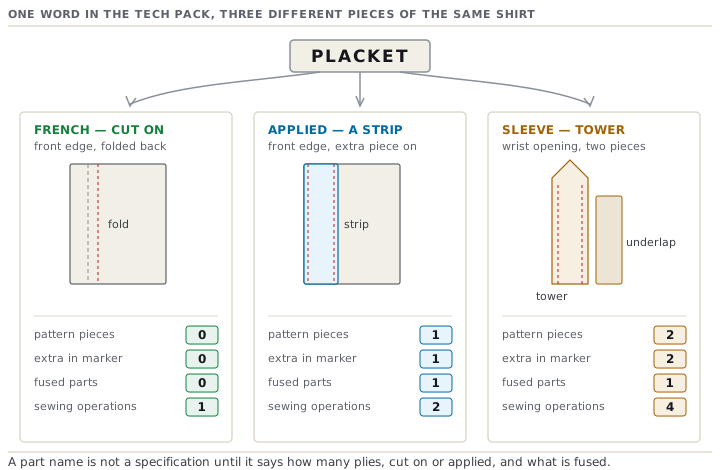
Placket is the most confusing word in the whole shirt, because it names three physically different things and the tech pack uses the bare word for all of them.
- A French placket is not a piece at all. The front edge of the front panel is folded back twice and topstitched. No separate pattern piece, no extra cutting, one operation.
- An applied placket is a separate strip of cloth sewn onto the front edge and topstitched both sides. One extra pattern piece per shirt, one extra cutting line in the marker, an extra fusible part, two rows of topstitching.
- A sleeve placket is the opening at the wrist. It is two pieces — the tower that shows on the outside and the underlap hidden beneath it — plus a fused tower and a gauntlet button.
Three parts, one word. "Placket: 3.5 cm, topstitched both edges" describes all three and specifies none of them.
Split is not double
Here is the trap inside the trap. On a shirt back, two different constructions are both spoken of as a yoke with something extra:
- A double yoke is two plies of the same shape, one facing out and one facing in. It is a construction, and it costs an extra piece of cloth.
- A split yoke is a yoke cut in two halves and joined at centre back, usually on the bias, so the shirt eases over the shoulders. It is a pattern decision, and on its own it costs nothing but a seam.
Both get called "double yoke" in conversation, because both involve more than one piece. A tech pack that says "double yoke" without saying whether it means two layers or two halves has specified nothing at all. A factory reading it can produce a shirt that is right, a shirt that is cheap, or a shirt that is neither.
What the yoke cost
SH-708's cost sheet, signed on 22 January:
| Line | Per shirt |
|---|---|
| Fabric, 1.62 m at USD 2.15 | USD 3.48 |
| Interlining | USD 0.19 |
| Buttons, labels, thread, packing trims | USD 0.71 |
| Making, 18.4 minutes at USD 0.132 | USD 2.43 |
| Finishing, pressing, packing | USD 0.46 |
| Factory overhead | USD 0.86 |
| Total cost | USD 8.13 |
| FOB | USD 9.85 |
| Margin | USD 1.72 |
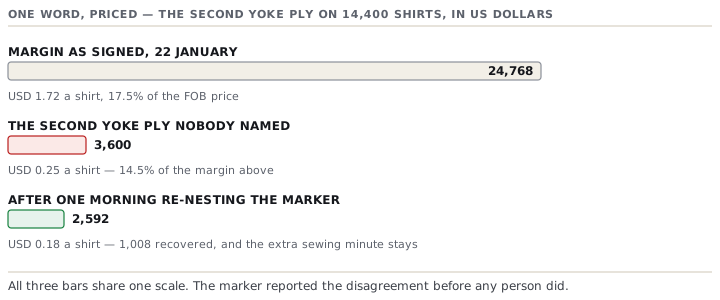
The margin is 17.5% of FOB, and USD 24,768 on the order. Now put the second yoke ply back in.
| Per shirt | On 14,400 shirts | |
|---|---|---|
| Extra fabric, 0.075 m at USD 2.15 | USD 0.16 | USD 2,304 |
| Extra sewing, 0.7 minutes at USD 0.132 | USD 0.09 | USD 1,296 |
| Total | USD 0.25 | USD 3,600 |
USD 3,600 is 14.5% of the margin on the order, and it was created by a word that everybody in the chain read correctly in their own dialect.
The three ways out, priced
Change to a single yoke. Free to ask, and the buyer will almost certainly refuse. On a single-ply yoke the shoulder and armhole seam allowances are exposed inside the shirt, the neck seam has to be bound, and the approved proto does not look like that. Ask anyway, in writing, because the refusal is worth having on file.
Absorb it. USD 3,600 off a USD 24,768 margin. Survivable, and the wrong instinct if it becomes a habit, because the next style will do it again.
Re-nest the marker. The second yoke ply is a wide, shallow piece, and a wide shallow piece nests into the waste between two sleeve heads. The CAD room re-marks and recovers 0.031 m of the 0.075 m. The residual is 0.044 m of fabric plus the sewing minute that does not go away:
| Per shirt | On 14,400 shirts | |
|---|---|---|
| Residual fabric, 0.044 m at USD 2.15 | USD 0.09 | USD 1,296 |
| Extra sewing, unchanged | USD 0.09 | USD 1,296 |
| Total | USD 0.18 | USD 2,592 |
A morning in the CAD room recovered USD 1,008. That is the whole argument for taking consumption seriously as a signal: the marker told you about a construction disagreement before any human did.
What a merchandiser does with this on Monday morning
You are not being asked to become a pattern cutter. You are being asked to do three things a pattern cutter cannot do for you:
- Read the callout list as a list of parts, and mark every one whose construction is not stated.
- Compare the parts to the consumption. If a marker comes back longer than the cost sheet and nobody changed the pattern, the disagreement is a construction, not an error.
- Ask before the cut, not after. The cost of asking is an email. The cost of not asking is whatever the difference turns out to be, multiplied by the order quantity.
Check yourselfA tech pack says: 'Front: placket 3.5 cm, topstitch 6 mm both edges. Sleeve: placket, one gauntlet button.' What have you actually been told, and what have you not?Show the answer
You have been told there is a front placket 3.5 cm wide with topstitching 6 mm from both edges, and that the sleeve opening has a placket with one gauntlet button. You have not been told whether the front placket is cut on and folded, which costs one operation and no extra piece. The alternative is a separate strip, which costs an extra pattern piece, an extra fusible part and an extra cutting line. You have not been told whether the sleeve placket is a two-piece tower and underlap or a continuous bound placket, which is a different pattern and a different machine. Both of those decide a cost line, and neither is in the pack. Send two questions, not nine, and send them today.
Prompt · Audit a callout list for the parts nobody named
The morning a tech pack lands and you are about to cost it from the flat sketch.
Act as a senior garment technologist in a factory that has to make what this tech pack describes. I am going to paste a construction callout list and I want every ambiguity in it found before I put a price on the style. Style facts: buyer [BUYER], style [NUMBER], garment type [TYPE], fabric [DESCRIPTION AND WEIGHT], quantity [QTY], target FOB [PRICE]. Here is the callout list exactly as written: [PASTE IT]. Here is what the flat sketch shows: [DESCRIBE THE VIEWS AND ANY DETAIL DRAWINGS]. Do the following. First, list every PART named in the callout list, and beside each one write whether the pack states the number of plies, whether the part is cut on or applied as a separate piece, which plies are fused, and the finished dimension the floor works to — mark each of the four as STATED or NOT STATED, and never fill in a not-stated with the obvious answer. Second, list every part that must exist in this garment type and is named nowhere in the pack or the sketch. Third, for each not-stated item and each missing part, give me the two or three constructions a factory could reasonably choose, and say what each one costs relative to the others in extra pattern pieces, extra pieces in the marker, extra fused parts and extra sewing operations. Fourth, rank the whole list by how much money separates the cheapest reading from the dearest, so I know which questions to send first. Fifth, write the question list as short numbered lines I can paste into an email, with my proposed reading offered for each so the buyer can reply with one word. Do not answer any question on the buyer's behalf, and mark clearly anything you are inferring from the garment type rather than reading in my paste.
AI can make mistakes — check anything you act on.