Lessons · Lesson 1 of 3
Two numbers and no drawing
Read and write a seam the way a factory reads it: a stitch type, a seam class, a density and a thread — not an adjective.
Lesson 1 of 3 · 44 min
The situation
Two seams can look identical from outside and be completely different underneath. A different number of layers, raw edges hidden or showing, thread that locks or thread that can be pulled undone. Because a picture cannot tell them apart, the trade stopped drawing seams and started numbering them. This lesson is what those numbers mean. Leave a seam vague and the factory builds the cheapest thing the words permit.
6 April, the pre-production meeting at Meridian Apparel in Sadat City. On the table are two trousers that are supposed to be the same trouser.
The order is PO KW-2214 for Kolstad Workwear, a Norwegian workwear brand: 18,000 pairs of MT-540, a men's cotton-twill work chino, 100% cotton twill at 280 grams per square metre, one colour, FOB USD 11.80. Order value USD 212,400. On board 12 July.
One trouser is Meridian's fit sample, approved on measurements three weeks ago. The other is Kolstad's reference garment, made last season by a different supplier. From a metre away they are identical. Turned inside out they are not the same garment at all.
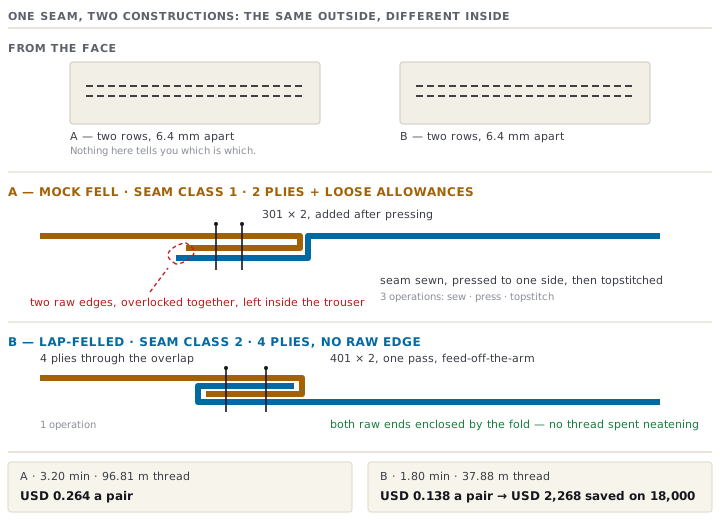
Meridian's outseam is a plain seam: the two panels sewn face to face, the raw edges overlocked together, the allowance pressed to the back, and two rows of topstitching run down the outside. Kolstad's outseam has no raw edge anywhere. One panel is folded around the other and the whole thing is sewn shut in a single pass, so the inside is as clean as the outside.
Both of them satisfy the words on page 9 of the tech pack, which read, in full:
Side seam and inseam: double-needle topstitch, 2 rows, 6 mm apart.
Nobody was careless. The line says what it says, and it describes both garments. This lesson is about the notation that would have made it describe only one.
A picture of a seam is not a specification
The reason a drawing cannot settle this is simple: the two seams look the same from the face. Two parallel rows of stitching on the outside of a trouser leg is the whole visual signature of both, and a flat sketch of a trouser is drawn from the face. Whatever the illustrator drew, they drew both constructions at once.
What separates them is invisible in a drawing: the number of plies inside the seam, whether the raw edges are enclosed, whether the stitch is locked or looped. And what the seam does when it is pulled. These are not matters of taste. They are the difference between a seam that survives an industrial laundry and one that grows a frayed edge inside the trouser after eight washes.
So the trade stopped drawing seams and started numbering them. Two independent numbers describe any seam completely:
- ISO 4915 numbers the stitch — how the thread or threads are formed into the cloth.
- ISO 4916 numbers the seam — how the plies of cloth are arranged before the stitch goes through them.
They are independent on purpose. The same stitch can be used on many different seam arrangements, and the same arrangement can be sewn with several different stitches. You need both numbers, and you need a density, and then you have specified something.
ISO 4915: six classes, and what each one is doing
| Class | Name | How it is formed | Ravels? | Extension |
|---|---|---|---|---|
| 100 | Chain stitch | One needle thread looped through itself | Yes, from one end | Moderate |
| 200 | Originating as hand stitches | A thread passed through as a single line | Locally | Low |
| 300 | Lockstitch | Needle thread interlaced with a bobbin thread | No | Low |
| 400 | Multi-thread chain stitch | Needle thread interlooped with a looper thread | Yes, from one end | High |
| 500 | Overedge chain stitch | Loops formed around the edge of the cloth | Yes | High |
| 600 | Covering chain stitch | Needle threads plus a covering thread over the surface | Yes | High |
The hundreds digit is the class and the class is the mechanism. Everything a merchandiser needs to predict about a stitch follows from one distinction inside that table.
Class 300 interlaces. Everything else interloops. A lockstitch pulls a bobbin thread up into the cloth and knots it with the needle thread inside the fabric — two threads crossing, one from each side. Every other class forms loops of thread through loops of thread, like a knit.
That single mechanical fact produces every practical consequence:
- A lockstitch does not ravel. Cut one stitch and you lose one stitch. That is why it is the stitch for anything that will be cut into later, anything decorative, and anything a repair shop will meet.
- A chain stitch ravels from one end — pull the correct end of the correct thread and the whole seam runs out. This is a defect on a trouser and a feature on a sack.
- A lockstitch has very little extension, because the knot is set inside the cloth and there is barely any spare thread in the structure. A chain stitch has a lot, because a loop can straighten before the thread has to stretch. Put a numbers-free version of that in your head now. On the same cloth, at the same density, a class 400 chain stitch stretches roughly twice as far as a class 300 lockstitch before the first stitch breaks. Lesson 3 measures it.
- A lockstitch needs a bobbin, and a bobbin runs out. A chain stitch and an overedge take thread from cones, which do not, so those machines run faster and stop less.
| 301 lockstitch | 401 two-thread chain stitch | |
|---|---|---|
| Threads | Needle plus bobbin | Needle plus looper |
| Thread supply | Bobbin, refilled | Cone, continuous |
| Appearance, face | Identical rows | Identical rows |
| Appearance, back | Same as the face | A double chain, visibly different |
| Ravels | No | Yes, from the last stitch sewn |
| Extension | Low | High |
| Thread used per unit of seam | Low | Roughly double |
| Where it belongs on MT-540 | Waistband, fly, pockets, hem, labels | Felled outseam and inseam, back rise |
Read the last row of that table against page 9 of the tech pack. "Double-needle topstitch" does not choose between the two columns, and the two columns are different garments.
ISO 4916: eight classes, and the one digit that settles this argument
Where ISO 4915 numbers the thread, ISO 4916 numbers the cloth: how the plies sit before anything is sewn.
| Class | Name | The arrangement | Where you meet it |
|---|---|---|---|
| 1 | Superimposed | Plies face to face, sewn near the edge | The plain seam, most of a shirt |
| 2 | Lapped | Plies overlapped, offset | Lap-felled jeans and chino seams, yokes |
| 3 | Bound | A separate strip wrapped over an edge | Bound necklines, bag seams, Hong Kong finishes |
| 4 | Flat | Edges butted together and covered | Underwear, base layers, thermal seams |
| 5 | Ornamental stitching | Stitching on a single ply, no join | Decorative rows, pintucks, edge topstitch |
| 6 | Edge finishing | An edge turned or neatened | Hems, cuffs, neatened raw edges |
| 7 | Adding a separate item to an edge | A second component applied to a raw edge | Elastic to a brief, tape to a raw edge |
| 8 | Plies of limited width | A narrow strip worked on its own | Belt loops, ties, drawcords, straps |
Now go back to the two trousers on the table, and notice that you do not need the letter codes or the variant numbers to settle it. You need the class digit.
Meridian's outseam is a class 1 seam: two plies face to face, sewn together, then neatened and top-stitched afterwards. The trade calls it a mock fell, and the name is accurate — it is imitating a fell.
Kolstad's outseam is a class 2 seam: the plies are lapped, one folded around the other, and the fold is what encloses the raw edges. The trade calls it a lap-felled seam, LSc-2 in the letter notation most tech packs still use, where the 2 is the number of rows of stitching.
One digit. Class 1 or class 2. Written on page 9, there would have been no meeting.
The gauge that does not exist
There is a second, quieter defect on page 9. It says the rows are 6 mm apart.
A twin-needle machine's row spacing is a physical property of its needle bar, and needle bars come in a fixed set of gauges, sold in inches:
| Gauge | Row spacing | Where it is used |
|---|---|---|
| 1/8 inch | 3.2 mm | Fine topstitch, shirt yokes |
| 3/16 inch | 4.8 mm | Light trousers, casual shirting |
| 1/4 inch | 6.4 mm | The standard chino and jeans seam |
| 5/16 inch | 7.9 mm | Heavier jeans topstitch |
| 3/8 inch | 9.5 mm | Waistbands, wide decorative rows |
| 1/2 inch | 12.7 mm | Very heavy topstitch, workwear detail |
Nobody makes a 6 mm needle bar. A factory reading that line does the only sensible thing and fits the nearest gauge it owns, which is 1/4 inch at 6.4 mm. That is almost certainly what the buyer wanted. But "almost certainly" is a decision the factory has made on the buyer's behalf. A second factory quoting the same pack might fit 4.8 mm. Then two suppliers ship the same style with visibly different topstitching.
The rule that follows is small and it saves arguments: specify a gauge in the units the machine is sold in, and give the millimetre equivalent in brackets. Write 1/4 inch (6.4 mm) and there is nothing to interpret.
Writing the line properly
Here is page 9's line as it was, and as it should have been.
Before:
Side seam and inseam: double-needle topstitch, 2 rows, 6 mm apart.After:
Side seam and inseam
  Seam    ISO 4916 class 2, lap-felled, LSc-2
  Stitch  ISO 4915 type 401, two-needle
  Gauge   1/4 inch (6.4 mm)
  Density 3.5 stitches per cm (8.9 SPI)
  Thread  ticket 60 core-spun polyester, both needles and looper
  Needle  Nm 100, round point
  Allowance  12 mm
Seven lines instead of one. Every one of them is a thing somebody in the factory has to decide, and every one of them will be decided by somebody. The only question is whether it is decided by you or by whoever is standing at the machine.
Three notes on that block:
Density is given both ways on purpose. European specifications use stitches per centimetre; American ones and most machine manuals use stitches per inch, and the conversion is not intuitive. Multiply stitches per cm by 2.54 to get SPI. A spec that gives only one and is read by a floor that uses the other is a spec that gets guessed at.
The needle is part of the seam. A round point pushes between the yarns; a ball point pushes them aside; a cutting point slices. On a woven cotton twill a round point is right and a cutting point would sever warp yarns and start a tear along the seam line. On a knit a round point does damage. The needle number matters too, and it is not decoration either. A needle too coarse for the cloth leaves a visible hole at every stitch. One too fine deflects off a heavy seam and skips stitches.
Seam allowance is a costing line, not a sewing detail. Twelve millimetres against ten on this trouser is more cloth in every seam, which is fabric consumption, which is the biggest single line on the cost sheet.
Prompt · Turn a vague construction line into a buildable seam specification
When a tech pack describes a seam with an adjective — double-needle, felled, clean finish, overlocked — and you have to send it to a factory that will interpret it.
Act as a garment technologist writing a construction page. I will give you the construction lines exactly as a tech pack has them, plus the garment and the fabric. For each line, turn the adjective into a specification. Garment: [TYPE], [WOVEN OR KNIT], fabric [COMPOSITION] at [WEIGHT] grams per square metre, buyer [BUYER], quantity [QTY], FOB [PRICE]. Wash or finish after sewing: [NONE, INDUSTRIAL LAUNDRY, GARMENT WASH, OTHER]. The construction lines as written: [PASTE THEM]. For every line do the following. First, list every construction that the line as written legitimately describes, and say what is different about each one inside the garment — plies, enclosed or raw edges, what a laundry does to it. Second, choose one and give it as: seam class from ISO 4916 with the letter code if there is one, stitch type from ISO 4915, needle gauge in inches with the millimetre equivalent, stitch density in stitches per cm AND stitches per inch, thread ticket and construction, needle point type and size, and seam allowance. Third, name the machine each stitch type requires, in the words a factory uses for it. Fourth, flag any seam where the garment will be EXTENDED along the seam in wear rather than pulled across it, and say whether the stitch you chose can take it. Fifth, list every line you could not specify without an answer from the buyer, and write the exact question for each. Do not give me a range where a number is possible, and mark clearly anything you assumed.
AI can make mistakes — check anything you act on.
Check yourselfA tech pack says the back yoke of a shirt is joined with a 'double-needle seam'. Name the two numbers you must add, and say what each one prevents.Show the answer
You need a stitch type from ISO 4915 and a seam class from ISO 4916. The stitch type decides whether the yoke is sewn 301 lockstitch or 401 chain stitch. That decides whether the seam ravels if it is ever cut, how far it stretches when the wearer reaches forward, and how much thread the operation consumes — the chain stitch uses roughly double. The seam class decides whether the plies are superimposed and top-stitched afterwards, class 1, or lapped and felled in one pass, class 2. That decides whether there is a raw edge inside the shirt, and how many plies are carrying the load. Add a density and a thread ticket and the line is now buildable by any factory in the world without a phone call.
Check yourselfWhy is the lockstitch, which is the weaker and less extensible of the two, still the stitch used for almost everything on a chino?Show the answer
Because for most of a chino, extension is not the property that matters and raveling is. A waistband, a fly, a pocket mouth and a hem are all seams that will be cut into, unpicked, repaired or altered. A chain stitch that runs out from one end when a stitch is broken is a liability in all four places. The lockstitch is also the same on both faces, so a repair is invisible. It takes almost any thread on almost any machine, which makes it the cheapest operation on the floor to set up and to fix. You reach for a class 400 chain stitch exactly where extension or thread continuity is the property you need. That means a felled seam sewn in one pass on a scarce machine, or a seam that has to survive being stretched. Choosing 301 everywhere is not laziness; choosing it on a back rise is, and lesson 3 is about that.