Lessons · Lesson 2 of 3
Every number is a machine, a minute and a rate
Cost the same seam two ways down to a figure per pair and per order, and read a machine list as the capacity plan it actually is.
Lesson 2 of 3 · 43 min
The situation
A stitch number is not a filing reference. It is an order for a particular machine, and a factory owns a fixed number of each kind. So choosing how a seam is sewn quietly chooses how many garments a day the line can make. This lesson follows that choice through the minutes and the thread each construction consumes. The sturdier one often turns out to be the cheaper one to sew.
9 April, three days after the pre-production meeting. Kolstad have confirmed what they want: the lapped, felled seam, class 2, sewn 401 on both the outseam and the inseam. Meridian's industrial engineer, Hala, has been asked one question by the general manager — what does it cost us?
She comes back with an answer nobody expected. The construction the buyer wants is the cheaper one to sew. It costs USD 0.126 a pair less, which is USD 2,268 across the order, and Meridian quoted the more expensive one anyway.
That is not a mistake in the quotation. It is what happens when a costing is done from a price list and a planning constraint is never written down. This lesson is the arithmetic she did, in the order she did it.
A stitch number is a machine order
The first thing to understand is that ISO 4915 is not a filing system. Each number is a different machine, and a factory owns a fixed number of each.
| Stitch | Machine | Threads | What it does that the others cannot |
|---|---|---|---|
| 301 | Single-needle lockstitch | Needle and bobbin | Sews anything, ravels nowhere, repairs invisibly |
| 301 | Twin-needle lockstitch, fixed gauge | Two needles, two bobbins | Two parallel rows in one pass, on the face |
| 304 | Bar tack | Needle and bobbin | A dense zigzag block at a stress point |
| 401 | Single-needle chain stitch | Needle and looper | Extension, and no bobbin to run out |
| 401 | Feed-off-the-arm, twin needle | Two needles, two loopers | Folds and closes a tubular seam in one pass |
| 514 | Overedge, four thread | Two needles, two loopers | Joins and neatens a raw edge together |
| 516 | Safety stitch, five thread | Two needles, three loopers | A chain seam and an overedge, simultaneously |
Two of those rows are the whole lesson.
The feed-off-the-arm machine in row five is a specialist. Its bed is a narrow cylinder rather than a flat table, so a sewn trouser leg can be fed over it as a tube, and its folder turns one ply around the other as it goes. It produces a true felled seam — plies lapped, edges enclosed, two rows of 401 — in one operation. It is the machine that makes a class 2 seam economic, and it is the machine most factories own two of, because it does nothing else.
The safety stitch in row seven does two jobs at once: a 401 chain stitch holding the seam and a 503 overedge neatening the edge, formed together in a single pass. That is why ISO 4915 gives it its own number rather than describing it as two stitches.
Costing the two constructions
The seam being costed is the outseam and inseam of one pair. That is 104 cm down each outside leg and 79 cm up each inside leg, so 366 cm in total, or 3.66 metres of felled seam per pair.
Two things are being bought: operator minutes and thread.
Meridian's costed minute is USD 0.062 — the operator's wage plus the factory overhead carried on each standard minute. Thread is ticket 60 core-spun polyester on a 5,000 metre cone at USD 3.40, which is USD 0.00068 a metre.
Thread quantity comes from the consumption ratio for the stitch type, which course 2.5 sets out. A lockstitch row uses about 2.5 times the seam length in thread, a two-needle felled 401 about 9.0 times, and a four-thread overedge about 18.0 times. Add 15% for wastage — thread pulled at seam starts and ends, cone changes, breaks and trimmed tails.
| A — mock fell, class 1 | B — true fell, class 2 | |
|---|---|---|
| Operation 1 | Close both seams, 514 overedge, 1.20 min | Fell the outseam, 401, 0.95 min |
| Operation 2 | Press the allowance to one side, 0.45 min | Fell the inseam, 401, 0.85 min |
| Operation 3 | Topstitch two rows, 301 twin needle, 1.55 min | — |
| Total minutes | 3.20 | 1.80 |
| Labour at USD 0.062 a minute | USD 0.198 | USD 0.112 |
| Thread ratio | 18.0 plus 2.5 plus 2.5, so 23.0 | 9.0 |
| Thread sewn | 84.18 m | 32.94 m |
| Thread bought, plus 15% | 96.81 m | 37.88 m |
| Thread at USD 0.00068 a metre | USD 0.066 | USD 0.026 |
| Cost per pair | USD 0.264 | USD 0.138 |
The true fell is USD 0.126 a pair cheaper, and on 18,000 pairs that is USD 2,268.
Both halves of the gap point the same way, and both are counter-intuitive until you see the mechanism.
Labour. The mock fell is three operations and three handlings of the same trouser: sew, press, topstitch. The true fell is one pass on a machine built for it. Three operations are almost never cheaper than one, whatever the machine hour costs, because the garment is picked up, positioned and put down three times.
Thread. The mock fell uses more thread, not less. An overedge is an extravagant stitch. It wraps loops around an edge and consumes eighteen times the seam length. The mock fell pays for that overedge and two rows of lockstitch on top of it. The felled seam gets its neatening from the fold, which costs no thread at all.
So why did the quotation say mock fell?
Because of a column nobody reads. The operation bulletin has a machine column, and Meridian owns two feed-off-the-arm machines.
Here is what two machines mean, in the only units that matter.
The felling work is 1.80 minutes a pair. A shift is 540 minutes and the line runs at 85% efficiency, so each machine gives 459 productive minutes a day. Two machines give 918 minutes a day, which is 510 pairs a day.
The order is 18,000 pairs. At 510 a day that is 35.3 days, so 36 working days on the floor.
The plan gives the whole order 26 working days of sewing — the line is planned at 700 pairs a day, and 18,000 divided by 700 is 26 days once you round up. Every other operation on MT-540 can hold that rate. The felling cannot. Two machines cap the entire line at 510 pairs a day and the order lands ten days late.
That is the real reason the quotation said mock fell. Nobody wrote it down as a reason. A bottleneck is discovered by a planner, a price is written by a costing clerk, and the two documents never meet. The costing clerk priced the construction the factory could actually run.
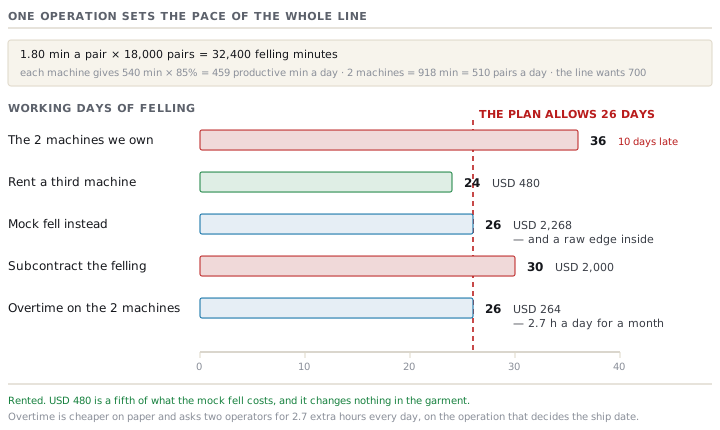
Four ways out, priced
| Option | What changes | Cost on the order | Days needed |
|---|---|---|---|
| Rent a third felling machine | Nothing in the garment | USD 480 | 24 |
| Sew a mock fell instead | The seam class, and the inside of the trouser | USD 2,268 | 26 |
| Subcontract the felling | Two extra journeys and a handling risk | USD 2,000 | 30 |
| Overtime on the two machines | Two operators work a longer day for a month | USD 264 | 26 |
Every one of those numbers is worth walking through, because the cheapest is not the answer.
Rent a third machine. A used feed-off-the-arm twin-needle chain stitch machine rents for USD 240 a month locally, and the order needs it for two months: USD 480, which is USD 0.027 a pair. Three machines give 1,377 minutes a day, or 765 pairs a day, so the order takes 24 days and fits inside the plan with room. Buying one outright is USD 3,800, which the rent would equal after sixteen months — so if MT-540 or anything like it repeats, buy rather than rent.
Mock fell. The construction Meridian originally quoted. It costs USD 2,268 more in labour and thread, before anybody discusses the raw edge inside the trouser or what an industrial laundry does to it. Note what this really is: paying USD 2,268 to avoid spending USD 480.
Subcontract. An outside unit will fell at USD 0.09 a pair, which is USD 1,620, plus USD 380 of transport, so USD 2,000, or USD 0.111 a pair. It also adds four days of moving trousers in and out of the factory, and every one of those days is a day the garments are somewhere you cannot inspect them.
Overtime. This is the cheapest number on the table and it is worth understanding why it is not the answer. The order needs 18,000 times 1.80, which is 32,400 felling minutes. Twenty-six days on two machines gives 26 times 918, which is 23,868. The shortfall is 8,532 minutes. Paid at a 50% overtime premium, the extra cost is 8,532 times USD 0.031, which is USD 264. But spread that over two machines and twenty-six days and it is 164 minutes a machine a day. That is 2.7 hours of overtime, every working day, for a month, by the same two operators, on the operation that decides whether the order ships. That is not a costing decision. It is a fatigue decision, and a tired operator on the felling machine is where your rework comes from.
Meridian rented the third machine.
The same principle, one size smaller
The pocket bags on MT-540 are two seams totalling 62 cm a pair. There are two ways to close them.
Two operations: a 301 seam at 0.42 min, then a 504 overedge to neaten it at 0.53 min. Total 0.95 min.
One operation: a 516 safety stitch, which forms the chain seam and the overedge together in a single pass, at 0.55 min.
The saving is 0.40 min, which is USD 0.0248 a pair and USD 446 across the order. The safety stitch uses more thread. 0.62 metres of seam at a ratio of 20.0 is 12.40 metres against 10.23 for the two-operation route, a difference of 2.17 metres a pair. But at USD 0.00068 a metre that is only about USD 31 on the whole order. Net saving: about USD 415.
Meridian has six safety-stitch machines, so unlike the felling operation this one has no capacity question attached. That is the point of doing both exercises: the arithmetic is identical, and the answer changes entirely depending on a number that is not on the cost sheet at all.
Prompt · Cost two constructions against each other, and check the machines exist
Before you agree a seam construction with a buyer or quote one to them, when you have a choice between two ways of building the same seam.
Act as an industrial engineer costing a sewing operation. Compare two ways of building the same seam and tell me which to choose. Order: buyer [BUYER], style [STYLE], quantity [QTY], FOB [PRICE], ship [DATE]. Seam: [WHICH SEAM], total sewn length per garment [CM]. Construction A: [LIST EACH OPERATION WITH ITS STITCH TYPE AND STANDARD MINUTES]. Construction B: [SAME]. Factory facts: costed minute [AMOUNT], thread [TICKET AND CONSTRUCTION] at [PRICE] per [LENGTH] cone, thread wastage allowance [PERCENT], shift length [MINUTES], line efficiency [PERCENT], planned line output [UNITS PER DAY], working days available for sewing [DAYS]. Machines owned, by stitch type: [LIST THEM WITH QUANTITIES]. Do this. First, cost each construction per garment: labour from the standard minutes, thread from the consumption ratio for each stitch type plus wastage, and a total per garment and across the order. Second, say plainly which is cheaper and explain WHY in mechanism terms — number of handlings, and whether an edge is neatened by thread or by a fold. Third, for every stitch type in the cheaper construction, work out how many units a day the machines we own can produce at that operation, and compare it with the planned line output. Name any operation that caps the line. Fourth, if an operation caps the line, give me at least four priced ways to close the gap — another machine bought and rented, a different construction, a subcontractor, overtime — each with its cost on the order and the days it needs. Fifth, recommend one and say what makes the cheapest option on the list the wrong answer, if it is. Show every division you do.
AI can make mistakes — check anything you act on.
Check yourselfA buyer asks for a felled seam. Your factory has two feed-off-the-arm machines and the operation is 1.80 minutes a pair. Before you answer, what do you need to know?Show the answer
Three things, in this order. First, how many pairs a day the rest of the line will run, because that is the rate the felling has to keep up with. Second, the productive minutes a machine actually gives in a day. That is the shift length times the efficiency, not the shift length. Here it is 459 minutes, so two machines give 918 and therefore 510 pairs a day. Third, what else is booked on those two machines during your window, because a machine that is free in the plan and busy in reality is the same as a machine you do not have. If the line runs faster than 510 pairs a day, the felling is the bottleneck and you have a capacity problem, not a costing one. The four options are the same four every time: another machine, a different construction, a subcontractor, or a longer day.
Check yourselfExplain why the construction with the enclosed edges, more plies and better durability is also the one that uses less thread and fewer minutes.Show the answer
Because it neatens its edges with a fold instead of with thread, and it does the whole job in one machine pass instead of three. The mock fell has to overedge the raw edges to stop them fraying, and an overedge consumes about eighteen times the seam length in thread. Then it still needs two rows of topstitching on top, which is a second handling and a third operation after pressing. The felled seam's folder turns one ply around the other as the trouser feeds over the cylinder bed, so the edges are enclosed by the geometry of the seam rather than by stitches. The two rows of 401 that hold it are the only thread in it. On this order that is USD 0.126 a pair, or USD 2,268, in the buyer's favour and the factory's. The reason the factory quoted the other one is not cost at all — it is that it only owns two of the machine that makes it possible.