Lessons · Lesson 3 of 3
Grain, shrinkage, and the pattern nobody re-issued
Price a request to tilt a piece off grain, build a shrinkage allowance the right way round, and read a failed size set backwards to the pattern that caused it.
Lesson 3 of 3 · 46 min
8 August: the number the whole production pattern is built on
Cloth is not the same in every direction. It has threads running the length of the roll (the warp) and threads running across it (the weft). The two relax by different amounts when the garment is washed. So every pattern piece carries a grain line: a line saying which way round the piece must be laid on the cloth. That line looks like a cutting-room detail. It is really a decision about the finished product.
KM-118 is washed after making. That means the pattern has to be drafted larger than the garment the buyer will measure, by exactly the amount the cloth is going to lose.
On 8 August Rosetta washed twenty garments made from bulk fabric, three cycles at 40 degrees Celsius, and measured them before and after.
| Direction | Shrinkage |
|---|---|
| Length, along the warp | 3.6% |
| Width, across the weft | 1.4% |
Two numbers, not one, because cloth does not shrink evenly. A woven fabric is tensioned along its warp on every machine it passes through, so it carries far more stored strain in that direction and gives far more of it back in the wash. Nearly everything that goes wrong with a shrinkage allowance goes wrong because somebody treated it as one number.
Grain is a product decision that arrives disguised as a marker decision
Every pattern piece carries a grain line, and that line does one job: it tells the cutting room which way the warp runs through the piece. It is drawn by the pattern room, and it is drawn for reasons that have nothing to do with fabric utilisation.
On 22 August, working on the marker for KM-118 — the cutting plan that lays every pattern piece onto the cloth — the CAD room sent a note: tilting the two front panels by 4 degrees closes a gap in the lay and saves 2.6 cm of marker per garment. Across 12,000 pieces that is 312 m of twill, USD 983.
Rosetta cut ten garments with the fronts tilted and washed them three times.
| Measure | Result |
|---|---|
| Side-seam displacement at the hem after three washes | 4.6 cm |
| The buyer's limit, 3.0% of a body length of 68.0 cm | 2.0 cm |
| Verdict | Fail, by more than double |
The mechanism is worth understanding, not memorising. Warp and weft relax at different rates — here, 3.6% against 1.4%. If the warp runs parallel to a long vertical seam, both sides of that seam shorten by the same amount and the seam stays where it was put. If the warp runs 4 degrees off, the piece relaxes along a diagonal, and the seam rotates round the body as it relaxes. The wearer sees a side seam that has walked towards the front by the third wash, on a garment that was perfect when it left the factory.
Two things stop that hardening into a slogan, because grain is a decision and not a default.
Some pieces carry a stated tilt tolerance. A pocket flap, a small facing or an under-collar can often be laid up to one or two degrees off without anything visible. A pattern that says so in writing — the angle and the tolerance, on the piece — lets the marker maker use that room legitimately. A long front panel with a vertical seam carries a tolerance of zero. The pattern states which is which.
Some patterns carry a deliberate tilt. A 3/1 twill has a diagonal structure and it torques in a predictable direction when it is washed. Trousers cut from heavy twill are sometimes drafted with a compensating tilt so that the finished leg hangs straight after the wash rather than before it. That is a considered pattern decision with a test behind it, and it is the opposite of letting a marker tilt a piece to save cloth.
And a twill is directional in the other sense too. The diagonal catches the light one way and not the other, so a piece laid head to foot against its neighbour reads as a different shade in daylight even though it came off the same roll. That is why the pattern carries a one-way arrow, and it is a pattern instruction rather than a cutting-room preference.
Shrinkage: divide, do not multiply
The pattern must be big enough that after it loses its shrinkage it lands on the finished measurement. That is a division, not a multiplication, and the difference is small enough to be missed for years.
Body length, finished, is 68.0 cm.
- The right way: 68.0 divided by 0.964 gives a pattern length of 70.54 cm.
- The wrong way: 68.0 increased by 3.6% gives 70.45 cm.
The error is 0.09 cm, which is invisible on this garment and inside any tolerance you will ever be given. Say so plainly rather than pretending otherwise. The reason to fix the habit is that the same person will do the same arithmetic on a cotton fleece that shrinks 8%. There it shows: a 100.0 cm piece needs to be 108.7 cm and the multiplication gives 108.0 cm. That is an error of 0.7 cm on one measurement, repeated on every length in the garment.
Three patterns, and only one of them is the production pattern
| Revision | Date | What it is |
|---|---|---|
| Rev A | 12 May | The sample pattern. Finished measurements, no wash allowance, sewing allowances as the sample room prefers them |
| Rev B | 26 June | Rev A with the fit corrections from the 19 June session |
| Rev C | 12 August | The production pattern |
Rev C is a different kind of document from the two before it. A production pattern adds, at minimum:
- The wash allowance, applied by direction, length and width separately
- Sewing allowances rebuilt to the folders and attachments that are actually on the line that will sew this order
- Notches on both pieces of every seam, and drill marks for every placement
- Grain lines and one-way arrows on every piece
- Fusible pieces separated out, with their own allowances, because interlining behaves differently under heat
- Piece names, piece counts and the cut list the cutting room works from
Any of those missing and it is not a production pattern; it is a sample pattern that somebody has started calling one.
21 August: three widths out, every length in
The grading was done on 30 July, from Rev B, because Rev B was the approved pattern and Rev C did not exist yet.
Rev C was issued on 12 August with a note on the front sheet: add wash allowance 3.6%. The CAD operator applied 3.6% to the graded nest, in both directions, exactly as the note said. The size set was cut on 18 August, washed, and measured on 21 August.
| Measurement | Spec | Tolerance | Pattern as issued | After wash | Deviation | Verdict |
|---|---|---|---|---|---|---|
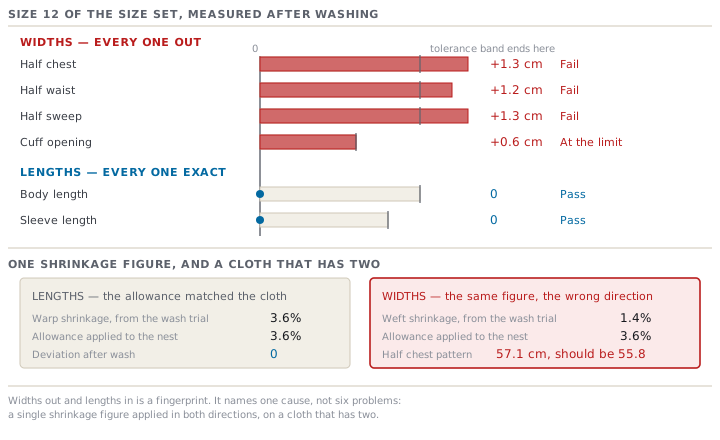
| Half chest | 55.0 cm | 1.0 cm | 57.1 cm | 56.3 cm | plus 1.3 cm | Fail |
| Half waist | 53.0 cm | 1.0 cm | 55.0 cm | 54.2 cm | plus 1.2 cm | Fail |
| Half sweep | 58.0 cm | 1.0 cm | 60.2 cm | 59.3 cm | plus 1.3 cm | Fail |
| Cuff opening | 24.0 cm | 0.6 cm | 24.9 cm | 24.6 cm | plus 0.6 cm | At the limit |
| Body length | 68.0 cm | 1.0 cm | 70.5 cm | 68.0 cm | zero | Pass |
| Sleeve length | 58.0 cm | 0.8 cm | 60.2 cm | 58.0 cm | zero | Pass |
Read the verdict column before you read anything else. Every width is out and every length is exactly right. That pattern is a fingerprint, and it points at one cause rather than at six problems.
If the grading were wrong, the errors would grow or shrink across the size range and would not respect the difference between widths and lengths. If the sewing were wrong, the errors would be scattered and would show up on some pieces and not others. If the fabric had shrunk differently from the trial, the lengths would be out too. Only one thing produces "all widths out by roughly the same proportion, all lengths perfect": a single shrinkage figure applied in both directions when the cloth has two.
The widths were built at 3.6% when the cloth only gives back 1.4%. The correct half chest pattern was 55.8 cm, and it was cut at 57.1 cm.
What it cost, and the register that would have prevented it
The material loss was trivial: twelve garments at USD 10.54 is USD 127. The cost was calendar.
| Event | Planned | Actual |
|---|---|---|
| Size set approved | 25 August | Rejected 21 August, re-graded and re-cut |
| Pre-production sample approved | 25 August | 2 September |
| Bulk cut | 8 September | 15 September |
| Buffer remaining before the 4 November vessel | 14 days | 5 days |
Nine of the fourteen days of buffer went, and the sleeve problem from the first lesson was still ahead, on 25 September, and it took a day and a half more. An order that started with a comfortable calendar shipped with three and a half days in hand, and the whole of that loss came from the pattern room.
The mechanism that prevents it is a page, not a process. Every pattern revision carries five things: the revision letter, the date, what changed, which sample it was cut for, and who released it. And one rule sits on top of the register:
A grade is void the moment the base pattern changes.
The grading on 30 July was done on a pattern that was not the production pattern, and nobody said so, because nobody had written down which sample Rev B was cut for. The register makes that visible in one line rather than in a conversation nobody has.
Prompt · Is this a production pattern, or a sample pattern somebody renamed?
Before a pattern is released to the cutting room, and again the moment a size set fails.
Act as a technical manager auditing a production pattern before it is released to cutting, and then diagnosing a size set. Style facts: [STYLE], [QTY] pieces, fabric [COMPOSITION AND CONSTRUCTION], washed after making [YES OR NO], usable width [CM], price [AMOUNT] a metre. The pattern front sheet says: revision [LETTER], date [DATE], shrinkage allowance [PASTE EXACTLY WHAT IT SAYS]. Wash trial: [NUMBER] garments, [NUMBER] cycles at [TEMPERATURE], measured shrinkage length [PERCENT] and width [PERCENT], run on [DEVELOPMENT OR BULK] fabric on [DATE]. Revision history: [LIST EVERY REVISION, ITS DATE, WHAT CHANGED AND WHICH SAMPLE IT WAS CUT FOR]. Grading: done on [DATE] from revision [LETTER]. Size set measurements against spec, with tolerances: [PASTE THE SHEET]. Do the following. First, tell me whether this is a production pattern, by checking it against the six things a production pattern must add to a sample pattern, and name every one that is missing. Second, recompute the shrinkage allowance the right way round — finished divided by one minus the shrinkage, by direction, not multiplied and not averaged — and show the difference against what was applied. Third, sort the size set failures into widths and lengths and into whether they grow across the size range, and name the single most likely cause and the document that proves it. Fourth, tell me whether the grading is still valid given the revision history, and state the rule you are applying. Fifth, list every piece whose grain line or one-way arrow could legitimately be tilted and every piece where the tolerance is zero, and say what test decides it. Sixth, give me the corrective actions in order, each with a cost and a number of days, and say which of them can run in parallel. Do not tell me a pattern is fine because it validated in CAD.
AI can make mistakes — check anything you act on.
Check yourselfYour size set fails on chest, waist and sweep, and passes every length. Name the two most likely causes and the document that separates them.Show the answer
A directional allowance applied in one direction only, or applied uniformly when the cloth is directional; or a grade whose width increments were applied to a base that already carried an allowance. The document that separates them is the graded nest itself, read across the size range. If the width errors are roughly the same proportion in every size, the base pattern is wrong and the grade is fine — look at the shrinkage allowance. If the errors grow from the smallest size to the largest, the grade increments are wrong and the base is fine. Do not start with the sewing floor: sewing errors are not that tidy, and they do not respect the difference between a width and a length.
Check yourselfYour marker maker offers a fabric saving worth USD 983 on this order by tilting the front panels four degrees. What do you need before you can answer, and what is the answer likely to be?Show the answer
You need three things: whether the pattern states a tilt tolerance for that piece, whether the garment is washed, and what the buyer's limit for seam displacement or spirality is. A front panel with a long vertical seam on a garment that will be washed carries a tolerance of zero, so the answer is no. The reason to say it in numbers is that USD 983 is 0.7% of a USD 141,600 order, while the exposure is the whole delivery and a returns problem that appears after the invoice is paid. If the piece had been a pocket flap with a stated tolerance of one degree, the same request would have been legitimate, and the pattern would already have said so.