Lessons · Lesson 1 of 3
The ease stack, and a fit comment executed exactly as written
Take a fit comment apart into the pattern quantities that actually produce it, and price what happens when it is carried out literally.
Lesson 1 of 3 · 48 min
6 May: an order with no pattern line on it
Every measurement on a spec sheet is a sum of at least three things: the body it must fit, the room the wearer needs to move, and the looseness the design wants. The sheet almost never shows that addition. Once you know the split, you can tell a fit argument about shape from a fit argument about size. The rest of the lesson follows one sleeve, because a sleeve is a curve sewn into another curve.
Kestrel and Moor, a British high-street brand, send the tech pack for KM-118 to Rosetta Apparel in 10th of Ramadan City. A women's utility shirt in 3/1 cotton twill (a cloth woven with a diagonal line), 150 g per square metre, washed after making, sizes 8 to 18 on a ratio of 1:2:3:3:2:1, 12,000 pieces, FOB Alexandria USD 11.80, on board 4 November. Order value USD 141,600.
The cost sheet behind that price is thin, and there is nothing wrong with it.
| Line | Per piece |
|---|---|
| Fabric, 1.62 m at USD 3.15 | USD 5.10 |
| Trims | USD 0.94 |
| CMT (cut, make, trim — the sewing charge) | USD 2.60 |
| Finishing, wash and packing | USD 0.28 |
| Overhead and margin | USD 1.62 |
| Cost to make | USD 10.54 |
| Margin against FOB | USD 1.26 |
USD 1.26 a piece is 10.7% of FOB and USD 15,120 on the order. Now notice what is not on that sheet: the pattern. The pattern room is not a cost line anywhere in this business. And yet by the time KM-118 ships, three decisions taken in that room will have moved USD 2,512 of cost, eaten nine days of calendar, and forced one concession request to the buyer. Every one of them was a written instruction carried out exactly as it was written.
This course is about what a pattern decides on your behalf. You will not draft a pattern. You will learn which numbers in it carry the weight, which ones your buyer silently relies on, and what each one costs when it moves.
The ease stack: three numbers that arrive as one
Every finished measurement on a spec sheet is a sum, and the sheet almost never shows the addition. Take the chest on the base size, size 12.
| Component | Size 12 | What it is |
|---|---|---|
| Body measurement | 90.0 cm | The wearer's chest, taken to a standard |
| Wearing ease | 6.0 cm | Room to breathe, sit, raise an arm |
| Design ease | 14.0 cm | The look: how relaxed this shirt is meant to be |
| Finished chest | 110.0 cm | What a tape reads on the garment |
| Half measure, 2.5 cm below armhole | 55.0 cm | What the spec sheet actually states, tolerance plus or minus 1.0 cm |
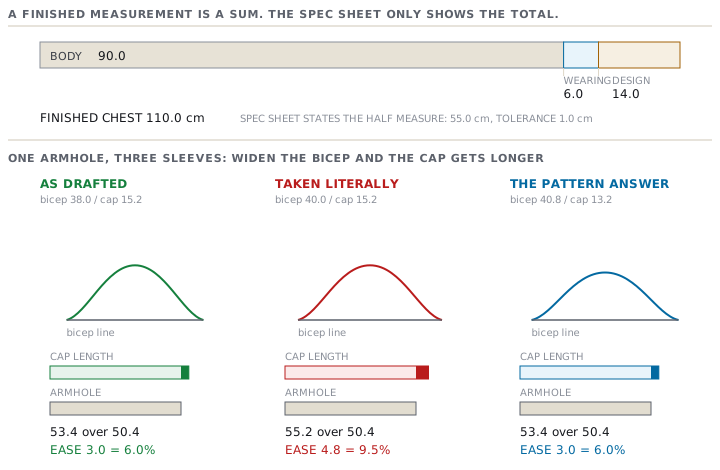
Three facts follow from that table, and each one is a decision you will have to defend.
The spec sheet gives you the total, never the split. A sheet that says 55.0 cm has not told you whether that is a fitted shirt on a broad body or a relaxed shirt on a narrow one. Those are different garments and they fit differently on the same person. When a buyer says the fit is wrong, they are almost always talking about the split, and you are almost always looking at the total.
Wearing ease is a physical minimum. Design ease is an opinion. A woven shirt with less than about 4 cm of wearing ease at the chest binds (pulls tight) when the wearer leans forward, whatever the design intends. Design ease above that is a choice, and it is the buyer's choice, not the pattern room's. When you find yourself arguing about whether a garment is "too big", first agree which of the two numbers you are talking about.
Ease is not standardised anywhere. There is an international standard for where to put the tape on a body. There is none at all for how much room to leave. That is why two brands' size 12 shirts can both be correct and fit differently, and why a size chart alone can never tell you how a garment will feel.
The block is not a neutral starting point
Rosetta did not draft KM-118 from nothing. They drafted it from their own women's shirt block — the base pattern they start every shirt from — corrected against their own sewing line over four seasons. The armhole is 0.4 cm deeper than the textbook, because the sleeve-setting folder on that line needs the room. The shoulder sits 0.3 cm further forward, because their fusible interlining (the stiffening layer ironed on inside collars and plackets) pulls the shoulder back by about that much after pressing.
Those corrections are worth money. They are the difference between a first sample that fits and a first sample that starts a round of comments. A block that has absorbed a factory's own machines, its own fusible and its own pressing is an asset, and it belongs to the factory that built it.
This causes one of the most common misunderstandings in the trade. When a buyer sends "the block", ask which of two things it is:
- A measurement chart. Then it is a target, and you draft to it from your own block. This is the normal case and it is the one you want.
- A pattern file. Then it carries somebody else's sewing allowances, somebody else's armhole and somebody else's fusible behaviour. It will sew on their line. It will not necessarily sew on yours.
If it is a pattern file, walk it against your own block before you quote — lay the two patterns seam line against seam line and compare — and report the differences in writing. A 0.4 cm shallower armhole is not a fit issue. It is minutes on the sleeve-setting operation, and minutes are the CMT line.
19 June: two sentences from a fit session
The first fit sample was made on 28 May from Rev A of the pattern and fitted in London on 19 June. Two comments came back. The second one is the subject of the next lesson. This is the first:
Sleeve reads tight through the bicep on the model. Please release 2 cm.
Rosetta's pattern room did exactly that. Rev B, issued 26 June, released the bicep by 2 cm, from 38.0 cm finished to 40.0 cm. Nothing else was touched. The second fit sample on 8 July was approved.
Everything about that is defensible. The instruction was clear, it was executed precisely, and the buyer signed the result.
What "release 2 cm at the bicep" does to a sleeve
A set-in sleeve is a curve sewn into another curve, and the two are related by a number nobody in the comment mentioned: cap ease, the amount by which the sleeve cap is longer than the armhole it goes into. That surplus is what makes a sleeve head round instead of flat. Too little and the sleeve reads pinched at the shoulder; too much and no operator can distribute it without folds.
| Rev A, as drafted | Rev B, the literal answer | What Rev B should have been | |
|---|---|---|---|
| Finished bicep | 38.0 cm | 40.0 cm | 40.8 cm |
| Cap height | 15.2 cm | 15.2 cm | 13.2 cm |
| Cap length, walked | 53.4 cm | 55.2 cm | 53.4 cm |
| Armhole, walked | 50.4 cm | 50.4 cm | 50.4 cm |
| Cap ease | 3.0 cm | 4.8 cm | 3.0 cm |
| Cap ease as a share of the armhole | 6.0% | 9.5% | 6.0% |
Widening the bicep pushes the two ends of the cap curve further apart. If the cap height does not come down to compensate, the curve simply gets longer. Every extra millimetre of that length has to be eased into an armhole that did not change. A 2 cm release at the bicep added 1.8 cm of cap length, and cap ease went from 3.0 cm to 4.8 cm.
For a 3/1 cotton twill at 150 g per square metre, that is the difference between a sleeve head that can be set and one that cannot. Woven shirting absorbs roughly 5% to 7% of the armhole as ease. Above about 8% you are relying on the operator, and on a line running to a standard minute value you will not get it.
The comment was right about the sensation and wrong about the cause
Here is the part that makes this a pattern lesson rather than a sewing one.
The bicep was never tight. The body upper-arm measurement for size 12 on this brand's chart is 28.0 cm. A finished bicep of 38.0 cm is 10.0 cm of ease on that arm. Nothing about that binds.
What binds is the cap height. Rev A carried a cap of 15.2 cm on an armhole of 50.4 cm — 30.2% of the armhole, which is a tailored-jacket proportion. A high cap makes a narrow sleeve. It hangs beautifully when the arm is at rest, and it restricts the arm as soon as the arm comes forward, because there is very little cloth across the top of the arm to give. The model felt that restriction while moving and reported it where she felt it: at the bicep.
The right answer was to lower the cap to 13.2 cm — 26.2% of the armhole, a shirt proportion — and then widen the bicep by whatever it takes to bring the cap length back to where it was. That turns out to be 2.8 cm, not 2 cm. The bicep does grow, but as a consequence of the change rather than as the change itself, and cap ease does not move at all.
So the buyer asked for 2 cm at the bicep. The correct pattern answer gives them 2.8 cm at the bicep, takes 2.0 cm off the cap, holds cap ease at 3.0 cm, and costs 0.01 m more fabric per garment — 120 m across the order, USD 378.
25 September: the line finds it
Rev B went into the size set, into the pre-production sample and into the bulk. Every one of those garments was sewn by a sample machinist working at their own pace, and every one of them was fine.
Bulk sewing started on 22 September. On 25 September the sleeve-setting operation had produced 2,400 pieces, 780 of them with visible pucker at the sleeve head, and the operation was running at 1.72 minutes against a standard of 1.35. The line stopped.
You cannot re-cut 12,000 sleeves; the fabric was bought to the order. You can only remove cloth from what is already cut, so the salvage was a trimmed cap: take 0.8 cm off the crown of every cut sleeve on the band knife.
| Value | |
|---|---|
| Cap height after trimming | 14.4 cm |
| Cap length after trimming | 54.1 cm |
| Cap ease after trimming | 3.7 cm, 7.3% of the armhole |
| Sleeve length from shoulder, was 58.0 cm | 57.2 cm, inside a tolerance of plus or minus 0.8 cm |
| Re-blocking and trimming 240 cut bundles | USD 140 |
| Unpicking and re-setting 780 pieces at 11.2 minutes | USD 454 |
| Needle-marked pieces downgraded, 9% of 780, so 70 pieces | USD 738 |
| Overtime to recover a day and a half of line output | USD 1,180 |
| Total | USD 2,512 |
The correction that was available on 26 June was forty minutes of a patternmaker's time and one extra fit sample: USD 55, and USD 378 of fabric across the order.
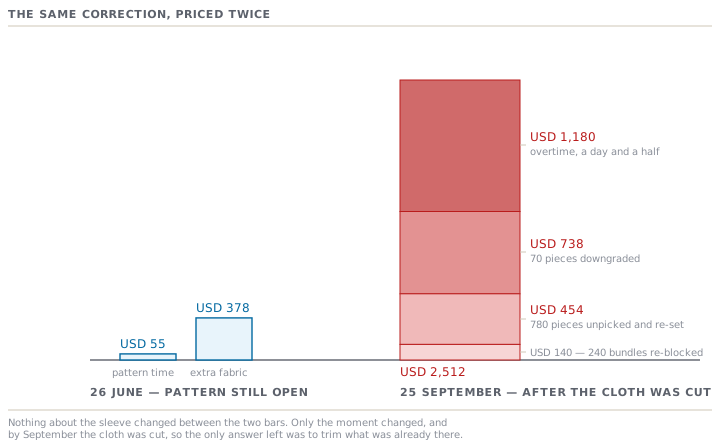
And the USD 2,512 is not the whole bill. The shipped garment now has a sleeve length of 57.2 cm against a spec of 58.0, and a bicep of 40.0 cm that the buyer approved on a photograph rather than on a measurement. Both had to go to Kestrel and Moor as a concession request. That is the part you cannot put a number on.
Prompt · Turn a fit comment into a pattern instruction
The moment a fit comment arrives naming a sensation and a place, and before anybody in the pattern room draws a line.
Act as a senior patternmaker in a garment factory who has to convert a buyer's fit comment into a pattern instruction and report what else it moves. Style facts: buyer [BUYER], style [STYLE], garment type [TYPE], fabric [COMPOSITION, CONSTRUCTION, WEIGHT], stretch content [PERCENT], washed after making [YES OR NO]. Base size [SIZE]. The body chart the spec was built from, for the base size: [PASTE IT]. The finished spec measurements with tolerances: [PASTE THEM]. The pattern as it stands, walked: armhole [CM], sleeve cap length [CM], cap height [CM], finished bicep [CM], neckline [CM], collar stand [CM], shoulder [CM], back length [CM]. The fit comment, word for word: [PASTE IT]. Do the following. First, write out the ease stack for every measurement the comment could plausibly be about — body measurement, wearing ease, design ease, finished — and say which of them has an unusual value. Second, list every pattern quantity that could produce the sensation described, in order of likelihood, and say why the one the comment names may not be the cause. Third, for each candidate, give me the change in centimetres and then a table of everything else that moves as a consequence, with before and after numbers. Fourth, tell me which seams have to be walked again after each candidate change. Fifth, state what each candidate does to fabric consumption per garment and across an order of [QTY] pieces at [WIDTH] cm usable width and [PRICE] a metre. Sixth, write the two-sentence reply to the buyer that describes what you propose to change and what it will look like, so they are approving a decision rather than a number. Do not give me a range where a number is possible, and list every assumption you had to make.
AI can make mistakes — check anything you act on.
Check yourselfYour buyer writes: shoulder digs in at the top of the arm, please widen the shoulder by 1 cm. What do you ask before the pattern room touches anything?Show the answer
Whether the shoulder point is actually in the wrong place, or whether the armhole shape is producing the sensation. Widening across the shoulder moves the shoulder point outwards, which lengthens the armhole, which lengthens the required cap, which changes cap ease — the same chain as the bicep case. If the real cause is a high, narrow armhole, widening the shoulder will make the garment look wrong at rest and will not fix the digging. Ask for a photograph of the model with the arm raised, and ask for the cap height and armhole measurement of the sample as it was sewn, before anybody draws a line.
Check yourselfA buyer sends a pattern file rather than a size chart and asks you to quote CMT from it. What do you check first, and why is it a costing question rather than a fit question?Show the answer
Walk it against your own block and list every difference in the armhole, the shoulder slope and the sewing allowances. Those three carry the machine time. An armhole 0.4 cm shallower than your line is used to, or a sewing allowance 0.2 cm off what your folders are built for, changes the standard minute value on the sleeve-setting and felling operations, and CMT is minutes. Quote from a pattern you have not walked and you have quoted somebody else's line, not yours. Report the differences in writing when you quote, so that a later request to change them is a change to a stated position rather than an argument.