Lessons · Lesson 3 of 3
The size set proves the range, not the sample size
Run a size set as a costed event that tests the grade rule and the ends of the range, and settle the before-or-after-wash question before the pattern is cut.
Lesson 3 of 3 · 45 min
31 October, 14:10 — the size nobody looked at
Approving a sample proves that one size of a garment fits. It says nothing about the sizes either side of it. The step added from one size to the next is often not the steady one everybody assumes. Checking that the buyer's chart matches the steps the pattern room applied takes minutes at a desk. It is skipped almost everywhere, because a table at the back of a specification reads like an appendix.
Final inspection at the factory. The lot has passed workmanship, passed the packing check, and the inspector is on the measurement sample: 15 pieces across the sizes.
She measures a 3XL. Half chest 62.1 against a specified 64.0. She measures a second 3XL. 62.0. A third. 62.2.
Every S, M, L and XL she measures is inside tolerance. Every 2XL sits exactly on the limit. Every 3XL is out by about 2 cm, in the same direction, on every garment.
Nobody made a mistake. The pattern room graded the style with a standard, uniform grade rule — the fixed amount added at each point of measure when you move up one size. The fit sample was approved. The second size set — S, M and L, exactly the three sizes Marbach asked for — was approved on 24 September without a single comment. And 920 garments are wrong.
What actually happened
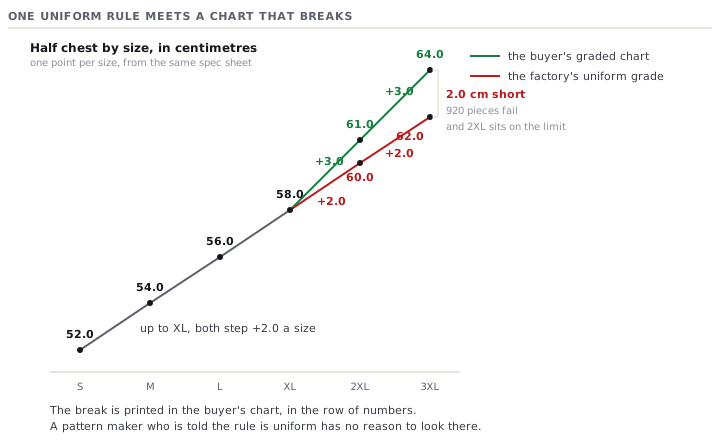
Here is Marbach's graded chest chart beside the grade rule the factory applied.
| Size | Marbach's chart | Step from the size below | Factory grade | Step applied | Difference |
|---|---|---|---|---|---|
| S | 52.0 | 52.0 | none | ||
| M | 54.0 | 2.0 | 54.0 | 2.0 | none |
| L | 56.0 | 2.0 | 56.0 | 2.0 | none |
| XL | 58.0 | 2.0 | 58.0 | 2.0 | none |
| 2XL | 61.0 | 3.0 | 60.0 | 2.0 | minus 1.0 |
| 3XL | 64.0 | 3.0 | 62.0 | 2.0 | minus 2.0 |
Marbach's chart breaks the grade above XL. Their large sizes step 3.0 cm of half chest instead of 2.0, because the body they are fitting above XL is not the same shape scaled up. That break is printed on the graded spec sheet, in the row of numbers, where a pattern maker who has been told the grade rule is 2.0 cm will never look for it.
A grade rule and a graded chart are two different documents saying the same thing, and when they disagree the chart wins, because the chart is what the buyer's inspector measures against.
The tolerance is ± 1.0 cm. So the 2XL, one full centimetre under, passes every individual garment and sits with no margin at all. The whole size is balanced on the edge of the band, which is exactly the drift the mean rule in lesson 2 was built to catch. The 3XL is 2.0 cm under and fails outright.
| Size | Pieces | Status |
|---|---|---|
| S | 1,840 | Inside |
| M | 4,600 | Inside |
| L | 5,520 | Inside |
| XL | 3,680 | Inside |
| 2XL | 1,840 | On the limit, no margin |
| 3XL | 920 | Outside — fails |
Approving a sample size is not approving the range
This is the sentence to take out of the whole course. A fit sample proves a fit. A size set proves a grade. They are different questions, and a size set made of S, M and L cannot answer the second one for a range that runs to 3XL, because the sizes that were argued about are not in it.
Two defences would have caught this, and both are nearly free.
The desk check. Take the buyer's graded spec sheet, put a column beside it, and write the step between each pair of sizes. Then compare that column with your own grade rule, line by line, on every point of measure — not just the chest. It takes about ten minutes for eighteen points across six sizes, it needs no garments and no samples, and it finds every grade break the buyer has printed and not mentioned. On PQ-318 the break is visible in the chart from the day the tech pack arrived, on 4 August.
The right sizes in the set. A size set exists to test the ends of the range, so it should contain them. The default that a buyer asks for — the base size and its neighbours — tests the middle, which is the part nobody was worried about.
| Set | Garments | Proves the fit at the base size | Proves the grade at the small end | Proves the grade at the large end |
|---|---|---|---|---|
| S, M, L | 6 | Yes | Partly | No |
| S, M, 3XL | 6 | Yes | Partly | Yes |
Same number of garments, same cost, same days. One of them would have found this in September.
The size set is an event, and it has a price
Merchandisers treat a size set as a formality that happens to a sample room. It is a small production run with a cost and a duration, and the duration is what hurts.
| Line | Cost |
|---|---|
| Pattern correction and re-grade, six hours in the pattern room | USD 54.00 |
| Sample cutting, hand cut | USD 22.75 |
| Sample sewing, twelve garments | USD 60.48 |
| Fabric, from the bulk lot | USD 46.87 |
| Trims | USD 5.76 |
| Pressing, conditioning, measuring and the report | USD 26.00 |
| Courier to Zurich | USD 118.00 |
| Total | USD 333.86 |
Twelve garments, USD 333.86 — USD 27.82 each. Adding a pair of 3XL garments to the set would have cost USD 55.64. Hold that number against what is on the table on 31 October.
The duration matters more than the money. Even when nothing goes wrong, a size set round trip is about 12 working days. One day to correct and re-grade, one to cut and sew, and two to press and let the garments relax and condition. Then one to measure and write the report, three in the courier, three for the buyer to review, and one for the comments to come back. The first PQ-318 size set took 21 days, because nine of them were spent arguing about definitions that a how-to-measure page would have settled for nothing.
Plan the calendar around 12 days, protect them, and do not spend them on an argument that a document prevents.
Before wash or after wash
There is one more question that has to be answered before a pattern is cut, and it is the one most often left to assumption.
A measurement taken before wash and the same measurement taken after wash are different numbers, and a specification that does not say which is not a specification.
PQ-318 is not garment washed. It is sold to be washed at home, and Marbach's testing page requires dimensional change no worse than minus 5% in length and minus 3% in width after three domestic washes. The fabric, tested from the bulk lot, comes back at minus 4.2% in length and minus 1.1% in width. Comfortably inside the limits — and completely silent on the question of what the spec sheet's 74.0 cm body length refers to.
Work the two answers out:
- If 74.0 is the as-produced garment, the pattern is cut to deliver 74.0 off the press and the consumer's polo measures 70.9 after three washes.
- If 74.0 is the garment after washing, the pattern has to be cut to deliver 77.2 off the press.
That is 3.2 cm of pattern, decided by a word nobody wrote. It is also fabric: cutting the body panels 3.2 cm longer adds about 3.0% to consumption, USD 0.12 a piece and USD 2,208 across the order, which is a line the cost sheet either has or does not have.
On PQ-318 the merchandiser asked the question on 15 September, in the same message as the six definitions, and Marbach answered in one line: the spec is the as-produced garment, and wash performance is covered by the dimensional-change limits. That is the common answer for a knit that is not garment washed — and it is common enough that people stop asking, which is precisely how a garment-washed style eventually gets cut to the wrong pattern.
Ask it every time, in writing, and put the answer on the how-to-measure page beside the state, where it belongs.
The four ways out, priced
| Option | Cost | Days | What can still go wrong |
|---|---|---|---|
| Re-cut and remake the 3XL from stock fabric | Impossible as it stands | — | Only 456.32 kg of the bulk lot is left and the 3XL bodies need 653.20 kg |
| Remake on a new dye lot and air-freight it after the vessel | USD 7,864.16 | 18 | A new dye lot is a new shade; the shade band has to be approved again |
| Ship the 3XL as made, against a price concession | USD 866.64 | 0 | The buyer's stores get a 3XL that measures like a 2XL, and it comes back next season |
| Short-ship the 3XL and cancel it | USD 800.40 of margin, and a broken size ratio | 0 | A retailer with no 3XL on the rail may refuse the whole delivery |
Marbach's buying team took the concession: a 12% reduction on 920 pieces, USD 866.64, and the grade break written into the tech pack in red for next season. It was the right decision on the day, and it is a bad outcome. Every one of these four options is worse than the ten-minute desk check and the USD 55.64 pair of 3XL garments that would have prevented it.
Prompt · Plan a size set that proves the grade, not the fit
Before you book sample-room time for a size set, and before you accept the three sizes the buyer named.
Act as a merchandiser who has been caught once by a grade break at the top of a size range and never intends to be caught again. Help me plan a size set. Facts: buyer [BUYER], style [STYLE], quantity [QTY], full size range [RANGE], base size [SIZE], quantity per size [BREAKDOWN], sizes the buyer has asked to see [SIZES], ship date [DATE], date the cut must start [DATE]. Here is the buyer's GRADED spec sheet, every point of measure across every size: [PASTE IT]. Here is the grade rule my pattern room applied: [PASTE IT, OR SAY IT IS A UNIFORM STEP]. Do the following. First, do the desk check before anything else: for every point of measure, compute the step between each pair of adjacent sizes in the buyer's chart, compare it with my grade rule, and list every place they disagree, with the size, the point and the difference. Treat the chart as the specification when they disagree. Second, recommend which sizes belong in the size set given what the desk check found and where my quantities sit, and say what each chosen size proves that the others do not. Third, cost the size set as an event: pattern time, cutting, sewing, fabric, trims, pressing and conditioning, measuring, courier, and a realistic elapsed calendar in working days from decision to buyer comments. Fourth, tell me the latest date the size set can leave to protect the cut date, and how many days of float remain after it. Fifth, tell me what the size set will NOT prove, in a short honest list. Sixth, draft the size-set report table I should send back: a row per point of measure, a column per size, specified against measured, plus two rows giving the measured step and the specified step so the grade is on the page as a number. If any input is missing, ask for it rather than assuming.
AI can make mistakes — check anything you act on.
Check yourselfYour buyer asks for a size set in the base size and the two sizes either side. The range runs from XS to 4XL. What do you send?Show the answer
Send what they asked for, and add the two ends — and say why in the covering note rather than substituting quietly. The set they asked for tests the fit and the grade in the middle of the range, which is where the pattern is already known to be right, because the fit sample was approved in the base size. The risk lives at the extremes. That is where a grade rule that was applied uniformly meets a chart that breaks, where the shape of the block — the base pattern every size is built from — stops working, and where the smallest and largest quantities in the order sit with nobody watching them. Two extra garments cost about the price of a courier. If the buyer will only review three sizes, review the extremes yourself against their graded chart, measure them, and put the readings in the report anyway.
Check yourselfA knit polo spec sheet gives a body length and a tolerance, and the tech pack's testing page allows minus 5% dimensional change in length. Is the specification complete?Show the answer
No. The two pages are answering different questions and neither answers the one the pattern maker needs. The testing page says how much the fabric may move when a consumer washes it. The spec sheet says what the garment must measure — but not in what state. On this style the difference between the as-produced number and the after-wash number is 3.2 cm of pattern and about USD 0.12 a piece of fabric. A dimensional-change limit is not a substitute for saying whether the specification is measured before or after washing; a garment can satisfy the limit and still be the wrong length in the shop. Ask, get it in writing, and write it onto the how-to-measure page next to the point of measure, because that is the page the person with the tape is holding.