Lessons · Lesson 2 of 3
The tolerance decides pass or fail, not the garment
Measure your own process, then choose a tolerance you can hold and prove why the tighter one rejects a garment nobody would call wrong.
Lesson 2 of 3 · 47 min
16 September, 09:00 — the number that was not negotiated
The narrow limit a buyer asks for sounds like a promise about care. Agreeing to it feels like the only professional answer. It is not. Whether garments pass or fail is decided by two things: how much output naturally varies, and how wide a band the contract allows. Move the band and the verdict changes while the garments stay exactly as they were.
The definitions are agreed. Marbach's quality manager sends the revised spec sheet back with one change nobody expected: the chest tolerance has moved from ± 1.0 cm to ± 0.5 cm.
Her reason is not arbitrary and it is worth understanding before you argue with it. On PQ-318 the chest grades 2.0 cm of half chest per size. A tolerance of ± 1.0 cm means a size M at the top of its range measures 55.0 and a size L at the bottom of its range measures 55.0. The two sizes touch. Two garments with different labels, both inside specification, can be the same garment. She is not being difficult; she is protecting a size chart.
The merchandiser's instinct is to say yes, because ± 0.5 sounds like a promise about care and nobody wants to argue that their factory is careless. That instinct costs money. A tolerance is not a statement about how careful you are. It is a statement about how much your process varies, and you can measure that.
Measure the process before you promise it
The factory has 60 size M bodies from the pilot cut, sewn on the line that will run the order, pressed, and left flat overnight in the measuring room. One person measures all 60 at the chest, at the agreed point, with the agreed tape.
| Deviation from spec, cm | Garments | Running total |
|---|---|---|
| minus 1.2 | 1 | 1 |
| minus 0.9 | 2 | 3 |
| minus 0.6 | 5 | 8 |
| minus 0.3 | 10 | 18 |
| on the number | 14 | 32 |
| plus 0.3 | 13 | 45 |
| plus 0.6 | 8 | 53 |
| plus 0.9 | 5 | 58 |
| plus 1.2 | 2 | 60 |
This is a good process. The average garment sits 0.11 cm above the specified chest — the pattern is very slightly generous and the line is stable. Nothing here needs fixing.
Now apply tolerances to it, and nothing changes except the verdict:
| Tolerance | Garments outside it | Share of the pilot | What that means on 18,400 pieces |
|---|---|---|---|
| ± 1.5 cm | 0 | none | The factory could hold this blindfolded, and adjacent sizes overlap |
| ± 1.0 cm | 3 | 5.0% | About 920 pieces across the order sit outside |
| ± 0.75 cm | 10 | 16.7% | About 3,073 pieces |
| ± 0.5 cm | 23 | 38.3% | About 7,047 pieces |
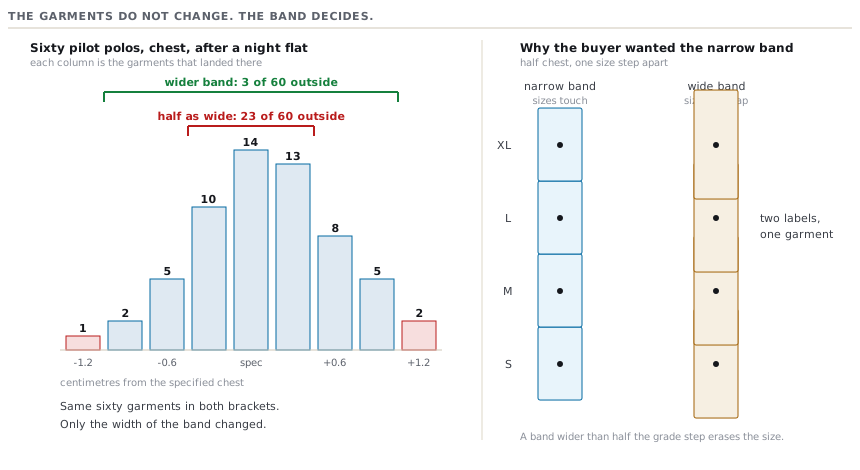
Read the middle two rows again. The garments did not change. Not one stitch, not one pattern piece, not one operator. Moving a number in a column from 1.0 to 0.5 turned 3 rejects into 23, and turned a process that is genuinely well behaved into a process that fails more than a third of what it makes.
That is the single most useful thing in this course. A measurement rejection is a verdict produced by two things — the spread of the process and the width of the band. The band is the one that gets agreed in an email by people who have never measured sixty garments.
What a failed measurement check actually costs
An out-of-tolerance garment is rarely thrown away. It becomes a measurement defect at final inspection, and defects are counted against an inspection plan.
Marbach's protocol is plain: the inspector measures 15 pieces spread across sizes, and more than 2 outside tolerance fails the lot. Take the pilot as the truth about the process and that is a straightforward piece of arithmetic:
| Tolerance | Share of pieces outside | Lot passes the check | Lot fails the check |
|---|---|---|---|
| ± 1.0 cm | 5.0% | 96.4% | 3.6% |
| ± 0.5 cm | 38.3% | 3.6% | 96.4% |
At ± 1.0 the order gets through the measurement check on nineteen days out of twenty. At ± 0.5 it fails on nineteen days out of twenty. That is the same factory, the same garments and the same inspector.
And a failed check is not a discussion, it is a bill:
- Re-inspection fee, charged by the buyer's inspection agency: USD 350.
- A hundred percent measurement of the lot before re-presenting it. 18,400 pieces at 1.8 minutes a piece is 552 hours, USD 772.80 of labour, and it needs bodies pulled off a line that has another order on it.
- Four days, which on this order is twice the float — the spare days in the plan — that is left after the size-set argument in lesson 1.
- And then the sort: whatever the measuring finds still has to be replaced, discounted or shipped short.
So the honest way to answer the quality manager is not "we cannot do ± 0.5". It is: at ± 0.5 this order fails its measurement check 96.4% of the time, here are the sixty readings that say so, and here is what I propose instead.
What to propose instead
There are only four real moves, and three of them are usually available.
Widen the band. Free, and the buyer will not give it to you on this style, because ± 1.0 already makes adjacent sizes touch. Know that before you ask.
Narrow the spread. This is the only move that improves the garment rather than the paperwork. On a knit body the two biggest contributors are the fabric's relaxation state at cutting and the height of the lay — the stack of fabric layers the cutter cuts through in one go. Letting the fabric relax flat for 24 hours before spreading, and dropping the lay from 72 layers to 40, tightened a second pilot noticeably. But it did not get anywhere near ± 0.5. And it costs USD 0.055 a piece in extra cutting, USD 1,012 across the order, plus two days of table space. Worth doing here; not a route to ± 0.5. Be careful of the promise it tempts you into.
Move the aim. Free, immediate, and almost always forgotten. More on it below.
Control the average instead of the individual. This is the answer that got signed. The factory proposed, and Marbach accepted:
Chest tolerance ± 1.0 cm on the individual garment, and the mean — the average — of any ten consecutive garments measured must sit within ± 0.3 cm of the specified number.
Read what that does. The buyer's real fear is not one garment 0.9 cm wide; it is a whole lot drifting 0.9 cm wide, which is what makes a size L feel like a size XL in a shop in Basel. The individual tolerance protects the wearer of one polo. The mean rule protects the size chart, which is what she was actually defending when she asked for ± 0.5. It costs the factory nothing when the process is centred, and it catches a drifting one within ten garments instead of within a container.
An asymmetric tolerance is an instruction, not a preference
An asymmetric tolerance is one that allows more on one side of the number than on the other. Marbach's outerwear programme writes some tolerances one-sided: body length plus 2.0 cm, minus nothing. A garment may be longer than specified and may never be shorter.
People read that as "be careful on the short side". It is not a mood, it is an instruction about where to put the pattern, and it has an arithmetic answer.
Take the same sixty pilot readings and judge them against a one-sided band of plus 1.5 cm, minus nothing:
| Where the pattern aims | Garments outside the band | Share |
|---|---|---|
| At the specified number | 18 | 30.0% |
| At the specified number plus 0.75 cm | 10 | 16.7% |
Aiming at the number throws away the whole of one side of the band. Half your process sits below the specified value — that is what a spread is — and below is now a reject. Move the pattern to the middle of the band and the reject rate almost halves, with no change to the fabric, the operators or the machine.
The rule generalises, and it is worth memorising: once the pattern aims at the centre of the tolerance band, only the WIDTH of the band decides the reject rate, not where it sits. A band of plus 1.5 and minus nothing rejects exactly as much as ± 0.75, because both are 1.5 cm wide. That is why the 16.7% in this table is the same number as the ± 0.75 row earlier.
What it costs: aiming 0.75 cm higher on a half chest widens both body panels, which adds about 0.9% to fabric — USD 0.035 a piece, USD 644 across the order. Against a reject rate that halves, that is not a close decision. Against a symmetric tolerance where you are already aiming at the centre, it is money for nothing. Read the tolerance column before you draft the pattern, not after.
Prompt · Argue a tolerance from your own measurements
When a buyer asks for a tighter tolerance and your only answer so far is that it feels difficult.
Act as a quality manager who decides tolerances from measured data rather than from habit. I need to answer a buyer's tolerance request with evidence. Facts: buyer [BUYER], style [STYLE], point of measure in dispute [POM], specified value [VALUE], tolerance they are asking for [TOLERANCE], tolerance currently in the tech pack [TOLERANCE], grade step between adjacent sizes at this point [VALUE], order quantity [QTY], FOB [PRICE]. Here are my own measurements of that point on garments from a pilot or a previous run, one reading per line: [PASTE THE READINGS]. The buyer's final measurement check is: [HOW MANY PIECES MEASURED AND HOW MANY OUT OF TOLERANCE FAILS THE LOT]. Do the following. First, give me the mean and the spread of my readings, and say plainly whether the process is centred on the specified value or sitting to one side of it. Second, tell me what share of my readings falls outside each candidate tolerance, and turn each share into a piece count on my order quantity. Third, calculate the probability that a lot from this process fails the buyer's measurement check at each candidate tolerance, and show the working. Fourth, cost a failure: re-inspection fee, the labour hours to measure the whole lot at a realistic minutes-per-piece, and the delay in days. Fifth, check the tolerance against the grade step and tell me whether adjacent sizes touch or overlap at each candidate, because that is usually the buyer's real concern. Sixth, propose the alternative that protects what the buyer actually wants — for example a tolerance on the individual garment plus a rule on the mean of a run of consecutive pieces — and write the two-paragraph reply I send. If the data I gave you is too small to support a conclusion, say so and tell me how many more readings I need.
AI can make mistakes — check anything you act on.
Check yourselfA buyer asks for plus or minus 0.5 cm on the chest. Your sixty-garment pilot puts 38.3% outside that band and 5.0% outside plus or minus 1.0 cm. What do you send back?Show the answer
The readings, and a proposal. Attach the sixty measurements and the two reject rates, and state plainly that at ± 0.5 the lot fails its own measurement check 96.4% of the time. Then give the buyer what they actually want rather than what they asked for. They asked for ± 0.5 because they are protecting the distance between sizes, so protect it a different way: keep ± 1.0 on the individual garment and add a rule on the mean of ten consecutive pieces. Offer the process improvement you can genuinely make — relaxing the fabric before cutting, a lower lay — and price it honestly. What you must not do is agree to ± 0.5 to end the email and hope. The tolerance is in the contract, and the inspector on the day will read the contract.
Check yourselfSleeve length is specified at 22.0 cm with a tolerance of plus 1.0 cm and minus 0.5 cm. Where should the pattern aim, and why is that not the same as being careful?Show the answer
At 22.25 cm — the middle of the band, which runs from 21.5 to 23.0. Aiming at 22.0 puts a third of the band above the process and two thirds below it, so ordinary variation that costs nothing at 22.25 becomes a defect at 22.0. Being careful reduces the spread of your process, slowly and at a cost; aiming at the centre of the band costs a line in the pattern instruction and takes effect on the first cut. They are different levers and the second one is free. The only thing to check before you move it is fabric: a centred aim on a width measurement widens the panel and changes consumption, so price it. On a length it usually costs nothing at all, because the marker — the cutting plan that arranges the pattern pieces on the fabric — has the room.