Lessons · Lesson 1 of 3
Two people, one garment, two numbers
Take one rejected size set apart point by point and show that a measurement is four things, not one.
Lesson 1 of 3 · 48 min
8 September, 11:40 — six failures on a garment that is not wrong
Two competent people can measure the same garment with the same tape and write down different numbers. Neither of them has done anything wrong. A number on its own is only a quarter of a measurement. It also needs where the tape starts and stops, what path it takes, and what the garment is doing. Where those are not written down, each side supplies its own answers, and both are reasonable.
A knitwear unit in Sadat City. PO MB-5108 for the Swiss menswear retailer Marbach: 18,400 men's short-sleeve piqué polos, style PQ-318, 100 percent cotton, 210 g/m², one colour. FOB USD 7.85, order value USD 144,440. On board 12 November.
The fit sample was approved on 26 August. The size set went by courier on 3 September and landed in Zurich on the 5th. This morning the quality report came back: six of the eighteen points of measure fail.
The merchandiser walks to the sample room, takes the retained size M off the rail — the twin of the garment now sitting in Zurich — and measures it himself with the buyer's own spec sheet in front of him. Every one of the eighteen reads inside tolerance.
Two people, one garment, two answers. Neither of them is careless and neither of them is lying. This lesson is why that happens, and how you make it impossible before the next size set goes out.
A measurement is four things
Write a number on a spec sheet and you have written down one quarter of a measurement. The other three are the ones that get argued about at eleven in the morning with a vessel booked.
- The point. Exactly where the tape starts and exactly where it ends. "Chest" is not a point of measure. "Chest, half, measured 2.5 cm below the armhole seam junction, edge to edge, garment flat" is.
- The method. The path the tape takes and what it counts. Straight across, or following the curve of a seam. Seam to seam, or edge to edge. Half the garment, or all the way round.
- The state. What the garment is doing while you measure it. Relaxed or extended. Hot off the press or after a night flat on a table. Before wash or after wash. Conditioned or straight out of an air-conditioned van.
- The tolerance. How far from the number is still the garment the buyer bought. Without it, a reading is a fact with no verdict attached, and the person holding the tape has to invent one.
A spec sheet gives you the number. A how-to-measure page gives you the point, the method and the state. The tolerance column gives you the fourth. Marbach's tech pack for PQ-318 has a spec sheet, a tolerance column and a four-page how-to-measure — written for their woven shirt programme. It defines fourteen points of measure. This spec sheet has eighteen.
The four it does not define are the four this order argued about, and two more were defined in a way that does not survive contact with a knit.
The six disagreements
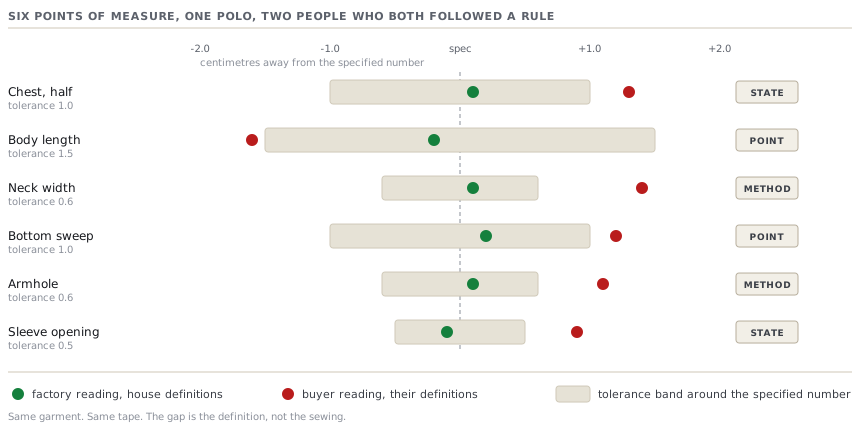
| Point of measure | Spec | Tolerance | Factory read | Marbach read | What was never written down |
|---|---|---|---|---|---|
| Chest, half | 54.0 | ± 1.0 | 54.1 | 55.3 | The STATE: lying as it falls, or smoothed flat under the tape |
| Body length | 74.0 | ± 1.5 | 73.8 | 72.4 | The POINT: from the high point of the shoulder, or from the centre-back neck seam |
| Neck width | 17.0 | ± 0.6 | 17.1 | 18.4 | The METHOD: seam to seam, or edge to edge |
| Bottom sweep, half | 52.0 | ± 1.0 | 52.2 | 53.2 | The POINT: at the bottom edge, or at the top of the side vent |
| Armhole, straight | 22.5 | ± 0.6 | 22.6 | 23.6 | The METHOD: straight across, or following the seam |
| Sleeve opening, half | 17.5 | ± 0.5 | 17.4 | 18.4 | The STATE: relaxed, or extended to the width a forearm needs |
The other twelve points agreed to within 0.2 cm, which tells you the tapes are fine, the table is fine and both people can measure. Every factory reading sits inside tolerance. Every Marbach reading sits outside it. The disagreement is not in the hands. It is in the document.
Look at what each row actually is:
Chest. Piqué is a stable knit but it is still a knit. Let a polo lie as it falls and the chest reads one number; run the tape out until the fabric is smooth and flat under it and the same garment reads 1.2 cm wider. Nobody stretched anything. One person let the garment be, and the other did what you do to a woven shirt.
Body length. The high point of the shoulder and the centre-back neck seam are 1.4 cm apart on this collar. A factory that measures from the shoulder and a buyer who measures from the back neck will disagree by roughly that amount on every garment ever made to this pattern, in every size, forever.
Neck width. Seam to seam is inside the collar attachment. Edge to edge is across the outside of the ribbed collar. The difference is two seam allowances and the collar's own thickness: 1.3 cm.
Bottom sweep. PQ-318 has a 6.0 cm side vent, so the body has two widths near the hem — one at the bottom edge, where the vent is open, and one at the top of the vent, where the side seam closes. They are 1.0 cm apart. The spec sheet says "bottom sweep" and the garment has two of them.
Armhole. A set-in sleeve seam is a curve. Straight across the armhole from the shoulder point to the underarm point is a chord. Running the tape along the seam is an arc. An arc is longer than its chord, here by 1.0 cm.
Sleeve opening. A rib cuff relaxed is not a rib cuff extended. On this cuff the difference is 1.0 cm, which is twice the tolerance.
Half or full, and the season it ends
One row on that table could have been very much worse than 1.4 cm.
Marbach writes chest as a half measurement: 54.0 across the flat garment. A polo whose chest is genuinely 54.0 all the way round is a garment for a child. The industry writes chest, waist and sweep as half measurements so often that people stop saying so. Then a spec sheet crosses to a factory that writes them full, or a buyer takes a competitor's chart in full and drops it into their own template in half.
It has happened, it will happen again, and it is not caught by a tolerance because the error is a factor of two, not a fraction of a centimetre. The defence takes four seconds: look at the number and ask whether a person fits inside it. A half chest of 54.0 is a 108.0 cm garment, which is a comfortable regular-fit polo for a man with a 100 cm chest. A full chest of 54.0 is not a garment at all.
Do the same on body length, on sleeve length, on the neck. Any spec sheet you did not write is guilty until it is read.
What the how-to-measure page has to say
The fix is a document, and the document is cheap. For every point of measure on the spec sheet, in the order the sheet lists them, six things:
- The code and the name. A number, so a rejection report can say "POM 7" instead of "the chest one".
- Where the tape starts. Named against a seam or an edge that exists on this garment, not against a body landmark.
- Where the tape ends.
- The path. Straight, or along the seam. Say it even when it seems obvious, because it is only obvious on a garment with no curves.
- Half or full. On every width, every time, including the ones that could not possibly be misread.
- The state. Relaxed or extended, and on what surface. Before or after wash. How long the garment has been lying flat.
Then a flat drawing with the points numbered on it, and the tolerance column beside the numbers. That is the whole document. On PQ-318 the pattern room drafted it in one afternoon and sent it to Zurich as a page of the counter-sample report. Marbach's quality manager signed it back the same week with two changes. She wanted the armhole measured straight rather than along the seam, and the sweep taken at the bottom edge rather than at the top of the vent.
Both of those changes moved the number. Neither of them moved the garment. That is the whole lesson in one sentence.
The measuring room, and the hour that changes the answer
Even a perfect document loses if the two ends measure in different rooms.
The retained size M read 54.1 at the chest at half past eleven in the sample room, lying relaxed on the table where it had spent the night. A garment of the same cut taken from the press twenty minutes after it was pressed reads 54.7. That is 0.6 cm from nothing but time, on a point whose tolerance is 1.0 cm either way — more than half the allowance spent before anyone has made a mistake.
So the measuring conditions belong in the same document as the definitions:
- A flat, hard table wide enough for the whole garment, not a cutting table with a lay on it and not somebody's lap.
- A steel or fibreglass tape that is checked against a rule at the start of every shift. A cloth tape that has been pulled for a year is not the length it says it is, and it is short in exactly the direction that makes your garments look big.
- Time flat. Knitted garments are measured after they have been allowed to lie flat and relaxed. Marbach asks for a minimum of four hours off the press and the factory works to overnight, because overnight is a rule an operator can follow and four hours is a rule an operator estimates.
- The same conditions at both ends. Cotton takes up moisture from the air and changes size doing it. If the factory measures in an unconditioned room in Sadat City in September and the buyer measures in a conditioned laboratory in Zurich in November, some part of every disagreement is the weather.
Prompt · Turn a spec sheet into a measurement passport
The day a tech pack lands with a table of numbers and a how-to-measure page that was written for a different kind of garment.
Act as a senior garment technologist who settles measurement disputes for a living. I have a spec sheet and I need every point of measure on it turned into something two people in two countries cannot read differently. Style facts: buyer [BUYER], style [STYLE], garment type [TYPE], fabric [CONSTRUCTION AND WEIGHT], knit or woven [WHICH], garment washed or not [WHICH], size range [RANGE], base size [SIZE]. Here is the spec sheet, point by point, with the specified value and the tolerance for the base size: [PASTE EVERY ROW]. Here is the buyer's how-to-measure page, or a description of it if there is not one: [PASTE OR DESCRIBE]. Do the following. First, for EVERY point of measure, write a one-line definition that names five things: where the tape starts, where it ends, the path it takes (straight or along the seam), whether the value is half or full, and the state the garment must be in (relaxed or extended, before or after wash, and how long it has been lying flat). Second, list the points where the buyer's page does not answer one of those five, and rank them by how much the answer could move the number on THIS fabric — give me a centimetre estimate for each, not an adjective. Third, flag any value that looks like a half-and-full confusion by checking whether a human body fits inside it, and say which ones you checked. Fourth, name the points where a knit or a curve makes the definition matter more than it would on a flat woven. Fifth, write the message I send to the buyer asking only the questions that survive all of the above, with a deadline and an offer to send photographs of the tape in place. Do not invent a definition and present it as the buyer's; where you are proposing, say so.
AI can make mistakes — check anything you act on.
What those days were worth
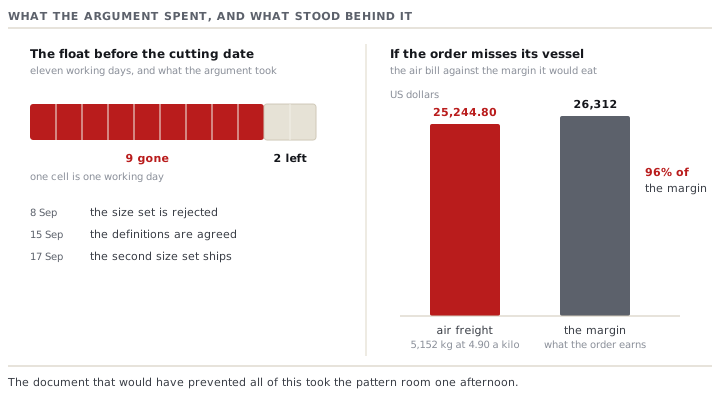
The rejection landed on 8 September. The definitions were agreed on 15 September, the corrected pattern and the second size set were couriered on 17 September. Nine days.
The critical path is the chain of steps that decides the ship date. Between size-set approval and the cutting date of 22 September it had eleven days of float. Nine of the eleven are gone. The rest of the order now runs with two days of slack instead of eleven — fabric in house on 15 September, sewing from 25 September to 24 October, final inspection on 31 October, on board 12 November.
Put a price on the thing that was at risk. If PQ-318 misses the 12 November vessel and has to fly, the order weighs 5,152 kg packed, and at USD 4.90 a kilo air freight is USD 25,244.80 against an order margin of USD 26,312. One document that costs an afternoon protects almost the entire profit on the order.
Check yourselfYour buyer's quality report says the chest is 1.3 cm over on every garment in the size set, in every size. Before you touch the pattern, what does that pattern of failure tell you?Show the answer
That it is almost certainly a definition, not a garment. A real chest problem in a size set varies: one garment is over, another is on, a third is under, because sewing and relaxation move each piece a little differently. A failure that is exactly the same amount and exactly the same direction in every size is a systematic difference. The only things that are systematic are the pattern, the grade rule and the way the measurement is being taken. Check the last one first, because it is free. Ask the buyer for the exact tape placement they used — ideally a photograph — and re-measure your retained garment in that place. If your reading now matches theirs, the garment is fine and the document is wrong. If it does not, you have a pattern problem and you have lost ten minutes finding out.
Check yourselfA tech pack gives sleeve opening as 17.5 cm with a tolerance of plus or minus 0.5 cm, on a polo with a ribbed cuff. What is wrong with that line before anybody measures anything?Show the answer
The state is missing, and on a rib it is worth more than the tolerance. The same cuff reads 17.4 cm relaxed and 18.4 cm extended. So the specification permits a band 1.0 cm wide around a number that the tape can move by 1.0 cm on its own, depending on how the person holding it treats the garment. Whichever state the buyer intends, the line has to say it. And if the intended state is relaxed, the factory also needs to know the minimum extended width. A cuff that measures beautifully relaxed and will not go over a hand is a garment nobody buys. Two numbers, both defined, is a specification. One number with no state is an invitation to a rejection report.