Lessons · Lesson 1 of 3
What efficiency measures, and what one point of it is worth
Read a marker efficiency correctly, work out what one point of it is worth in money on a real order, and price the design decisions that set it.
Lesson 1 of 3 · 35 min
The situation
Cloth is the largest single cost in most garments. There is one place you can cut that cost without changing the garment at all: the marker. A marker is the plan that lays every pattern piece on the cloth before cutting. How tightly the pieces pack is quoted as a percentage. That percentage often means different things on the two sides of a conversation. This lesson teaches you to read it properly. The second half shows why some fabrics simply refuse to let the pieces pack tightly.
It is 9 June, 08:40, in the marker room at Amreya Garments, Sadat City. PO MP-4417 is for the British high-street brand Marlow and Pike: 21,600 women's cotton-twill overshirts, style MP-2210, in three colourways — ecru 9,600 pieces, olive 7,200, and a yarn-dyed navy and ecru stripe, 4,800. FOB USD 14.20. Order value USD 306,720. On board 12 September.
The cost sheet was signed on 6 March. Its fabric line carries one consumption figure, 1.869 m a garment, and it carries it for all three colourways. Consumption is the metres of cloth one garment uses.
This morning the marker maker delivers the stripe marker. It runs at 77.5%. The solid colours run at 86.4%.
Nobody has done anything wrong. Same patterns, same marker maker, same cloth width. The stripe number is lower because the stripe has to be matched at the fronts and the pockets. Matching was a decision the buyer's designer took in October, eight months before anyone in this room saw it.
By the end of this lesson you will be able to say what that decision cost, to the metre and to the dollar. You will also see which cheaper choices were still open, and on which date each one closed.
Efficiency, stated properly
A marker is a scale plan of every pattern piece of one or more garments. The pieces sit inside a rectangle. The rectangle is as wide as the cloth can actually be cut. Marker efficiency is the share of that rectangle the pattern pieces cover.
marker efficiency = total pattern area ÷ (marker length × cuttable width)For MP-2210 the marker holds 6 garments in the ratio one S, two M, two L, one XL. Their pattern pieces add up to 13.47 m². Amreya's cloth cuts at 1.46 m wide. The solid marker came out 10.68 m long.
rectangle = 10.68 × 1.46 = 15.5928 m²
efficiency = 13.47 ÷ 15.5928 = 0.864
86.4%. The other 13.6% of the cloth is cut away as gaps between the pieces. That is normal, and it cannot be recovered. Pattern pieces are curved. A rectangle is not.
There are three things this number is not. Each mix-up has cost somebody an argument.
It is not consumption. Efficiency is a ratio. Consumption is metres. Here the metres are 10.68 ÷ 6 = 1.780 m a garment, and that is the figure a cost sheet carries. A buyer who asks you to improve efficiency really wants fewer metres. So answer in metres.
It does not compare across garments, fabrics or factories. A trouser marker beats a shirt marker, because trouser pieces are long and straight. A raglan sleeve beats a set-in sleeve. If a buyer says another supplier achieves 88% on "the same kind of thing", ask for three numbers: their pattern area, their cuttable width and their marker length. Without all three, the percentage is a number with no denominator — no bottom half of the fraction.
It depends entirely on which width went into the denominator. Behera Mills sells this cloth as 150 cm. Put 1.50 in the formula instead of 1.46, and the same marker reads:
13.47 ÷ (10.68 × 1.50) = 0.84184.1% — 2.3 points lower, and nobody touched the marker. A marker room that reports against the nominal width, the width on the invoice, looks worse than one that reports against the cuttable width. A factory judged on efficiency has an obvious reason to pick the flattering figure. Ask which width was used, every time.
The three markers on one style
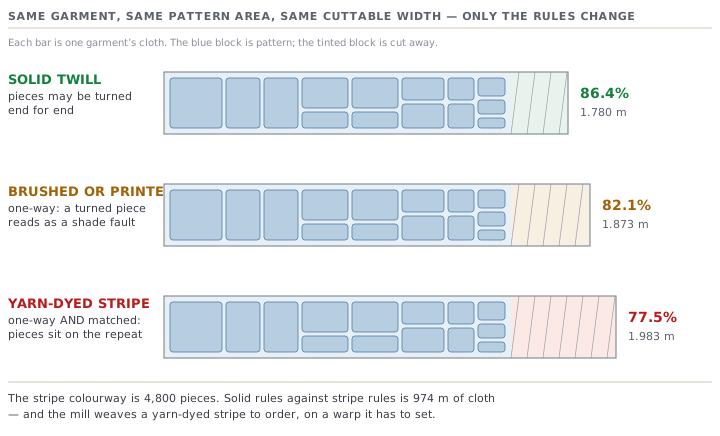
| Marker | Pieces may be turned | Efficiency | Marker length | Metres a garment |
|---|---|---|---|---|
| Solid twill, two-way | yes | 86.4% | 10.68 m | 1.780 |
| Brushed or printed, one-way | no | 82.1% | 11.24 m | 1.873 |
| Yarn-dyed stripe, one-way and matched | no | 77.5% | 11.90 m | 1.983 |
Two-way means a piece may be turned end for end inside the marker. That lets the marker maker nest a hem against a hem, instead of a hem against a shoulder. It is worth several points on every garment there is. And you get it, or lose it, from the fabric — not from the pattern.
A twill has a visible diagonal line. Merchandisers often assume that makes it one-way. It does not. Turn a piece through 180 degrees and the diagonal still runs the same way, because it is the same line seen from the other end. What kills a two-way marker is a surface with a direction rather than a line: a nap, which is a brushed or raised face; a pile such as corduroy or velvet; or a directional print. On those fabrics a turned piece reflects light differently from its neighbour. In the finished garment that reads as a shade fault.
An uneven stripe kills it for a third reason, and this is the one that catches people. MP-2210's stripe repeat is navy 22 mm, ecru 30 mm, navy 6 mm, ecru 6 mm. That repeat is asymmetric — it does not read the same in both directions. Turn a piece end for end and the order of the bands across it reverses. A reversed front then sits beside an unreversed one, and the placket looks visibly wrong. Had the designer balanced that repeat — the same bands, arranged symmetrically about a centre — the pieces could have been turned. The stripe marker would have run at 81.2% instead of 77.5%.
Matching costs cloth on top of that. A piece that must line up with the stripe cannot slide freely along the width. It can only sit where the repeat lands correctly. So the marker maker loses the fine adjustments that close the last gaps.
What a point is worth here
Rearrange the formula to give consumption, and you can price a point on any order in about a minute.
metres a garment = pattern area per garment ÷ (efficiency × cuttable width)
2.245 ÷ (0.864 × 1.46) = 1.780 m
2.245 ÷ (0.874 × 1.46) = 1.759 m
One point is 0.021 m a garment on this style. Across the 16,800 solid pieces that is 352.8 m of marker. Add Amreya's 5.0% cutting allowance and it is 370.4 m of purchased cloth. At USD 3.85 a metre:
USD 1,426 a point.
Now put that number beside the thing it should always be put beside. Amreya costed MP-4417 at a margin of USD 1.28 a garment, which is USD 27,648 on the whole order. One point of marker efficiency is 5.2% of everything this order will earn. And the spread between this order's best marker and its worst is 8.9 points.
What the stripe actually cost
The cost sheet booked 1.869 m for every one of the 21,600 pieces. For the 4,800 stripe pieces that means:
booked: 4,800 × 1.869 = 8,971 m
needed: 4,800 × 1.983 × 1.05 = 9,994 m
short:                          1,023 m
The stripe's own price is USD 4.30 a metre. So that is USD 4,399 of yarn-dyed cloth that was never bought. The whole margin on the stripe colourway is 4,800 × 1.28 = 6,144 USD. The gap eats 71.6% of it, and 15.9% of the margin on the whole order.
It is also 1,023 m of a fabric that is woven to order, on a warp the mill has to set. The mill needs a 38-day lead time. The vessel is 22 days away. Cloth you can buy is a cost. Cloth you cannot buy in time is a late delivery.
Three levers, and the date each one expired
| What is allowed | Efficiency | Metres a garment | Metres needed | Short by | Cost |
|---|---|---|---|---|---|
| One-way, match fronts, pockets and side seams | 77.5% | 1.983 | 9,994 m | 1,023 m | USD 4,399 |
| One-way, match fronts and pockets only | 80.9% | 1.900 | 9,576 m | 605 m | USD 2,601 |
| Balanced repeat, two-way, match everything | 81.2% | 1.893 | 9,541 m | 570 m | USD 2,451 |
| Balanced repeat, two-way, match fronts and pockets | 84.0% | 1.830 | 9,223 m | 252 m | USD 1,084 |
Read the table as a calendar, not as a menu.
The balanced repeat was free in October, when the stripe was drawn. It changes nothing a customer can see. It was worth 3.7 points.
Releasing the side seams was free in April, at the fit approval. Somebody could have asked the buyer one question: which seams does a customer actually look at on this garment? Marlow and Pike answered it on 14 June, when it was finally asked. They said fronts and pockets, side seams not critical. That answer, given in April, was worth 3.4 points.
On 9 June, both levers have expired. What is left is the marker maker's skill. And the marker maker has already used it.
Check yourselfYour marker is 14.60 m for 8 garments on 1.52 m cuttable, and the pattern set is 18.90 m². The buyer changes the fabric to a peached finish. What do you tell them it costs, on 12,000 pieces at USD 4.10 a metre, before you have any new marker at all?Show the answer
Efficiency now is 18.90 ÷ (14.60 × 1.52) = 0.851, so 85.1%. Consumption is 14.60 ÷ 8 = 1.825 m. A peached face is a nap, so the marker becomes one-way. On a garment of this shape that is worth about 4 points. At 81.1% the consumption is 2.3625 ÷ (0.811 × 1.52) = 1.917 m. That is 0.092 m more per garment, or 1,104 m on 12,000 pieces — about USD 4,526 before any allowance. Say that number out loud in the same meeting where the finish is proposed. Say clearly that it is an estimate from the width and the pattern area, and that you will confirm it with a real marker. What you must not do is accept the finish silently and redo the marker afterwards.
Prompt · Challenge a consumption figure with arithmetic
A consumption number has landed on your cost sheet and you cannot say whether it is good, bad or made up.
Act as a cutting-room manager who makes markers for a living and has no interest in flattering anybody. I want a consumption figure audited. Style facts: buyer [BUYER], PO [NUMBER], style [STYLE], garment [DESCRIBE IT], quantity [QTY] pieces, FOB [PRICE], and the colourways with their quantities [LIST THEM]. Fabric: [CONSTRUCTION], [WEIGHT], nominal width [CM], contractual width tolerance [PERCENT OR CM], price [AMOUNT] per [METRE OR KILO]. Surface: [SOLID / BRUSHED / PILE / DIRECTIONAL PRINT / STRIPE OR CHECK, WITH THE REPEAT IN MM AND WHETHER IT IS SYMMETRICAL], and what must be matched [LIST THE SEAMS AND PANELS]. What I have been given: consumption [METRES] a garment, cutting allowance [PERCENT], marker efficiency [PERCENT] if quoted, marker length [METRES], garments in the marker [NUMBER], total pattern area [SQUARE METRES] if known. Do the following. First, tell me the cuttable width you would work to and how you got it from the nominal width and the tolerance, and say what a marker made at the wrong one would do. Second, recompute the efficiency from the pattern area, the marker length and the cuttable width, and say which width my figure appears to have used. Third, tell me what a realistic efficiency band is for THIS garment on THIS surface, and separate the part that is the fabric's fault from the part that is the marker maker's. Fourth, price one point of efficiency in metres per garment, in metres on the order, and in dollars, and put it beside my margin. Fifth, cost each colourway separately if their surfaces differ, and tell me whether one consumption figure can honestly cover them all. Sixth, list every lever that could still raise the efficiency, and beside each one write the DATE it stopped being free — design, fit approval, fabric booking, today. Give me numbers, not ranges, and name every assumption in a list at the end.
AI can make mistakes — check anything you act on.