Lessons · Lesson 2 of 3
The cut plan is where efficiency is actually decided
Turn a buyer's size ratio into a cut plan against a real ply height and a real table, and judge a lay-splitting decision in money against the line time it bought.
Lesson 2 of 3 · 35 min
The situation
A layout on a screen cuts nothing. What the cutting room works to is a plan. The plan says which markers to use, and how many layers of cloth to stack under each one. Turning a buyer's size mix into that plan is the quiet skill of a cutting room. This lesson follows one decision. It was right when it was taken. Then its reason went away, the decision kept running, and it cost a quarter of the profit.
It is 24 June, 16:10, in the planning office at Amreya. The olive fabric for MP-4417 has been sitting at Alexandria port for four days on a customs query. It will not clear before 30 June. Olive was supposed to be cut first. Line 3 finishes its previous style on Friday. From Monday, 1 July, it has nothing to sew.
The ecru fabric is on the floor. That afternoon the cutting manager makes a decision. Every planner reading this would have made it too, and on its own terms it is correct. He starts ecru immediately, and he cuts it in small lays. That way the first bundles reach the sewing line the same day, and they keep arriving steadily instead of landing in one lump every four hours.
The line never stops. The vessel is never at risk. And the decision costs the order USD 3,203 — of which only about a quarter was worth paying.
This lesson shows you how to separate the quarter from the rest. Before the cutting order is written, not after.
What a cut plan actually is
Lesson 1 priced a marker. A marker on its own cuts nothing. What the cutting room executes is a cut plan: a list of markers, and for each marker the number of plies — layers of cloth — to spread underneath it.
garments of a size = plies of a marker × that size's count in the marker, summed over all markersTwo limits turn that from arithmetic into a decision.
Ply height. Amreya's straight knife can cut through 120 plies of this 240 g/m² twill. The cutting room works to 100. The limit is not the blade. A deeper lay compresses. The lower plies distort. The knife bends on a tight curve. And a fabric fault in one roll ruins one ply — a fault found on ply 90 of a 120-ply lay means 30 pieces to re-cut, after the lay has already been taken apart.
Table length. Amreya's spreading table gives 12.0 m of usable length. A marker longer than that cannot be spread, whatever the software says.
The size ratio, and what it does to the marker
Marlow and Pike's ecru breakdown is a ratio of 1 : 4 : 4 : 2 : 1 across S to XXL. On 9,600 pieces:
| Size | Pieces | In marker A | In marker B |
|---|---|---|---|
| S | 800 | 1 | |
| M | 3,200 | 2 | 2 |
| L | 3,200 | 2 | 2 |
| XL | 1,600 | 1 | 1 |
| XXL | 800 | 1 | |
| Garments in the marker | 6 | 6 | |
| Plies | 800 | 800 |
Marker A is S, M, M, L, L, XL. Marker B is M, M, L, L, XL, XXL. Run each one for 800 plies and every size comes out exact: 800 S, 3,200 M, 3,200 L, 1,600 XL, 800 XXL. At 100 plies a lay, that is 8 lays of A and 8 of B — 16 lays in total.
Finding that pair is the marker room's real skill, and it is not obvious. Look at what it uses: the two big middle sizes, M and L, appear in both markers. That is what lets one pair of markers absorb a lumpy size curve. A ratio that does not break down this cleanly leaves you two ways out, and both cost money. Add a third marker — more lays, more ends, more set-up. Or overcut a size — cut cloth into garments nobody ordered. On this fabric one overcut piece is 1.869 × 3.85 = 7.20 USD of cloth before any labour. A plan that overcuts 300 pieces to avoid a third marker has spent USD 2,160 to save one day of marker making.
What the ends cost, and why nobody sees them
Every ply is spread a little longer than the marker, so the spreader has cloth to clamp and to cut against — 2 cm at each end, so 0.04 m a ply. That loss is fixed per ply. So it is divided by the number of garments in the marker.
end loss per garment = 0.04 ÷ garments in the marker
6 garments: 0.04 ÷ 6 = 0.007 m   (0.4% of consumption)
3 garments: 0.04 ÷ 3 = 0.013 m   (0.7% of consumption)
Four centimetres is invisible. But across the ecru colourway, the 16-lay plan spends 16 × 100 × 0.04 = 64 m on ends. No cost sheet has a line for it.
The split, priced
On 24 June the cutting manager replaced the two 6-garment markers with four 3-garment markers — S, M, L and M, L, XL and M, L, XL and M, L, XXL. They produce exactly the same sizes in exactly the same numbers. Each runs 800 plies. So the plan becomes 32 lays instead of 16.
A 3-garment marker of these pieces runs at 82.7% and is 5.58 m long. Half the garments, but less than half the length. The gain from a longer marker is real, and it does not grow in a straight line. A marker maker's freedom comes from having unlike shapes to nest against each other. The sixth garment adds fewer new shapes than the third did.
| Two markers, 6-up | Four markers, 3-up | |
|---|---|---|
| Marker length | 10.68 m | 5.58 m |
| Efficiency | 86.4% | 82.7% |
| Lays at 100 plies | 16 | 32 |
| Cloth on the table | 17,152 m | 17,984 m |
| Metres a garment | 1.787 | 1.873 |
| End loss | 64 m | 128 m |
832 m more cloth, at USD 3.85 = USD 3,203
of which marker efficiency = 768 m = USD 2,957
of which lay ends         =  64 m = USD   246
per garment: 0.087 m = USD 0.33
USD 0.33 a garment, against a margin of USD 1.28 a garment. A quarter of the margin on the ecru colourway, decided in one afternoon, by somebody who was solving a different problem correctly.
Was he right? Give the answer a number
He was right — for part of it. The honest way to judge the decision is to ask what the smaller lays actually bought, and when they stopped buying it.
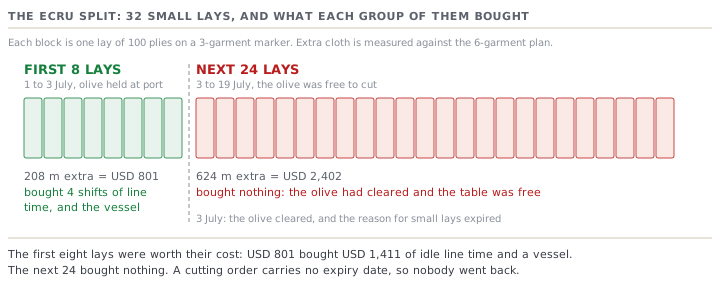
Line 3 runs 42 operators. Amreya's loaded cost is USD 1.05 an operator-hour. So an idle line costs 42 × 1.05 = 44.10 USD an hour, and USD 352.80 a shift. The split kept the line fed from 1 July until the olive cleared customs on 3 July. That is four shifts, worth USD 1,411 in idle labour — and, far more importantly, four days of a critical path that ends at a 12 September vessel.
The first eight lays are what bought that.
first 8 lays  (2,400 garments): 4,496 m against 4,288 m = 208 m = USD   801
next 24 lays  (7,200 garments): 13,488 m against 12,864 m = 624 m = USD 2,402
USD 801 bought four shifts of line time and a vessel. USD 2,402 bought nothing at all. By 3 July the olive had cleared, the table was free, and there was no longer any reason to cut three garments at a time.
The table nobody costed
Put 8 garments in the marker instead of 6, and this pattern set runs at 87.6% on a marker of 14.04 m. That is 1.755 m a garment — 0.025 m better than the 6-garment marker. On the 16,800 solid pieces, that is 441 m of purchased cloth: USD 1,698 on this order alone.
Amreya cannot do it. The marker is 14.04 m, and the table gives 12.0 m.
Follow that number through, because it turns a piece of factory equipment into a case a merchandiser can put in front of an owner. Amreya cuts roughly 1.8 million woven pieces a year. Say 40% of that volume is styles whose pieces would nest better in a longer marker. That is 720,000 pieces at USD 0.101 each, or USD 72,720 a year — against a 16 m spreading table at about USD 28,000. It pays for itself in under five months.
Two honest caveats, because a number this good usually has one. Not every style gains from a longer marker: a garment with a few large panels reaches its limit quickly, and an 8-garment marker may be worth almost nothing. And a longer lay ties up more fabric and more floor space before the first bundle reaches the line — which is exactly the flexibility the cutting manager needed on 24 June. The saving is real. It is not free.
Check yourselfYour buyer's ratio is S 1 : M 3 : L 3 : XL 2 : XXL 1 on 9,600 pieces, and you cannot find a pair of 6-garment markers that produces it exactly. Your options are a third marker, or overcutting. How do you choose?Show the answer
Price both. A third marker costs a marker maker's time, one more marker file to check, and one more set of lays — so more set-ups and more ends, at 0.04 m a ply. Overcutting costs the full made cost of every extra garment: cloth at 1.869 × 3.85 = 7.20 USD, plus trims and labour. It is a total loss unless the buyer takes the extra pieces. On most orders the third marker wins, and by more than people expect — the overcut garments usually land in the size that was hardest to place, which is the size nobody wants. Overcutting does win in one place: a small top-up cut at the end of an order, where one short lay of a single marker is cheaper than re-planning. Whichever you choose, decide before the cutting order is released — not when the cutting master finds he is 240 XXL short.
Prompt · Turn a size ratio into a cut plan, with the constraints in it
Before you accept a cut plan, or when a cutting room proposes shorter markers to feed a line and nobody has priced it.
Act as a cut-order planner in a woven garment factory. Build me a cut plan and show your working. Order facts: [QTY] pieces of style [STYLE], colourways and quantities [LIST THEM], size ratio [GIVE IT PER COLOURWAY], ship date [DATE]. Marker facts: total pattern area [SQUARE METRES] for [NUMBER] garments, cuttable width [METRES], and the efficiency my marker room achieves at [NUMBER] garments in the marker — give me the efficiency at 3, 4, 6 and 8 up if I do not have it, and say it is an estimate. Cutting room: maximum ply height [NUMBER] and the working height they prefer [NUMBER], usable table length [METRES], spreading rate [METRES AN HOUR], end allowance per ply [METRES], fabric price [AMOUNT] a metre, and the sewing lines this order feeds with their operator counts and loaded hourly cost. Do the following. First, propose the smallest set of size combinations that produces every size EXACTLY, and show the plies of each; if no exact set exists, give me the two nearest plans and price the overcut against the extra marker. Second, convert it into lays at my working ply height and tell me the cloth on the table, the end loss and the metres a garment. Third, do the same for a plan with SHORTER markers, and give me the difference in metres, in dollars and per garment. Fourth, tell me how many hours sooner the first bundles reach the line under each plan and what an idle line costs me an hour, so I can see what the shorter markers actually buy. Fifth, if a longer marker would be better but will not fit my table, tell me the efficiency it would reach, what it is worth a piece and a year, and treat it as a capital case. Sixth, write me the two lines that should appear on the cutting order: why this marker, and until when. Ask for any input you need rather than assuming it.
AI can make mistakes — check anything you act on.